
Key takeaways
- B2B SEO focuses on lower-volume, higher-value keywords tied to complex, multi-stakeholder sales cycles, plus content that builds trust and demonstrates expertise.
- It is a long game: meaningful gains usually take about six to 12 months of consistent optimization, and content quality and relevance are the biggest lever.
- An effective strategy starts with buyer personas and your sales funnel, then persona keyword research and topic clusters that reach buyers at every stage.
- Optimize product and service pages, cover technical foundations, publish a scalable content strategy, and earn high-quality backlinks.
- Done well, B2B SEO turns organic search into a predictable pipeline of qualified leads rather than raw traffic.
B2B SEO (business-to-business search engine optimization) is the practice of improving a B2B company’s visibility in search results so it reaches other businesses, decision-makers, buyers, and procurement teams across a longer, multi-stakeholder buying journey.
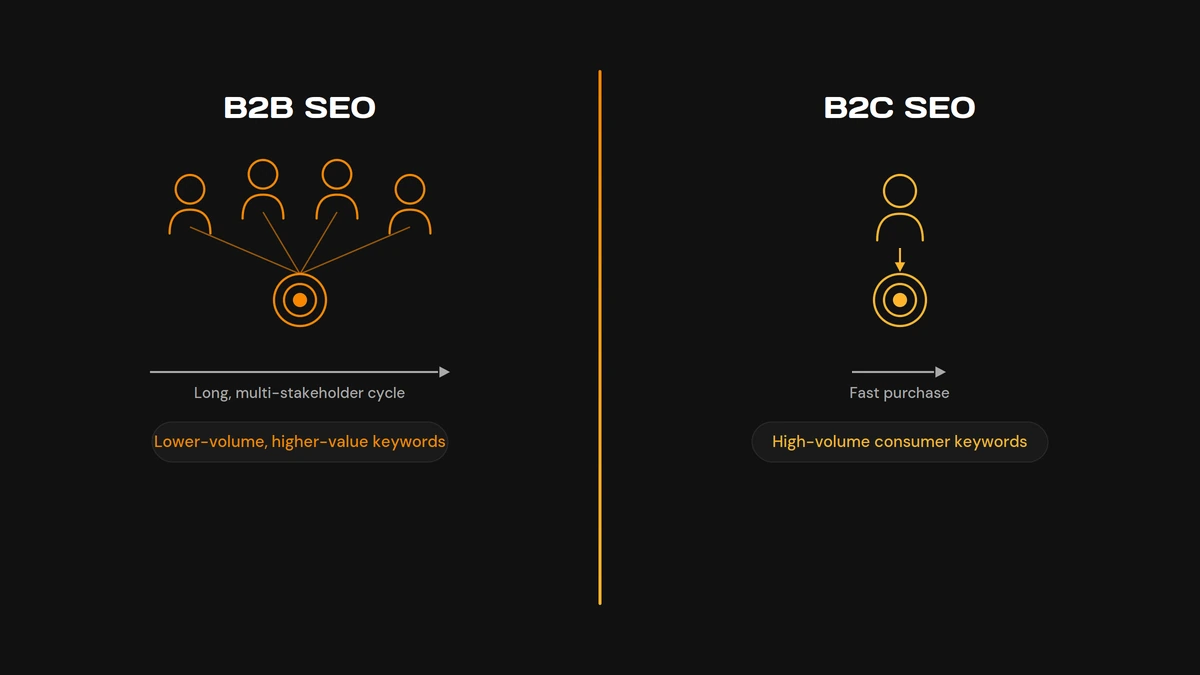
Unlike B2C SEO, which targets high-volume consumer keywords and quick purchases, B2B SEO focuses on lower-volume, higher-value terms tied to complex sales cycles. It also prioritizes content that builds trust and demonstrates expertise to the people who research before they buy.
A B2B SEO strategy typically combines keyword and topic research around buyer pain points, on-page and technical optimization, authoritative content for each funnel stage, and high-quality backlinks. Done well, it turns organic search into a predictable pipeline of qualified leads rather than raw traffic. This guide covers what B2B SEO is, how it differs from B2C, and the step-by-step strategy and best practices to rank and convert.
A great SEO strategy is necessary for B2Bs (businesses that offer goods and services to other businesses). Like many B2B businesses, you may wonder how to appear at the top of search engine results to increase visibility and drive more traffic to your pages.
Luckily, you’ve come to the right post. Having offered SEO services for many years, we know how to help you create a winning B2B SEO strategy that ranks higher on search engine results pages (SERPs).
Whether you want to build awareness, position your brand as an industry authority, or drive more qualified leads, you need a systematic SEO strategy that brings results. The fundamentals below are what make one work in 2026.
Why B2B SEO Matters
B2B SEO is a long game. You won’t see instant results, and meaningful gains usually take about six to 12 months of consistent optimization. The biggest lever is the quality and relevance of the content you deliver.
The payoff is worth the patience. Consider these statistics:
- Most B2B buyers research independently online before they ever speak to a salesperson (Gartner).
- SEO and organic traffic are the top marketing priority for 61 percent of B2B marketers.
- Online research makes up about 27 percent of the full B2B buying cycle.
- The top three organic results capture roughly 69% of all clicks, and barely anyone reaches the second page.
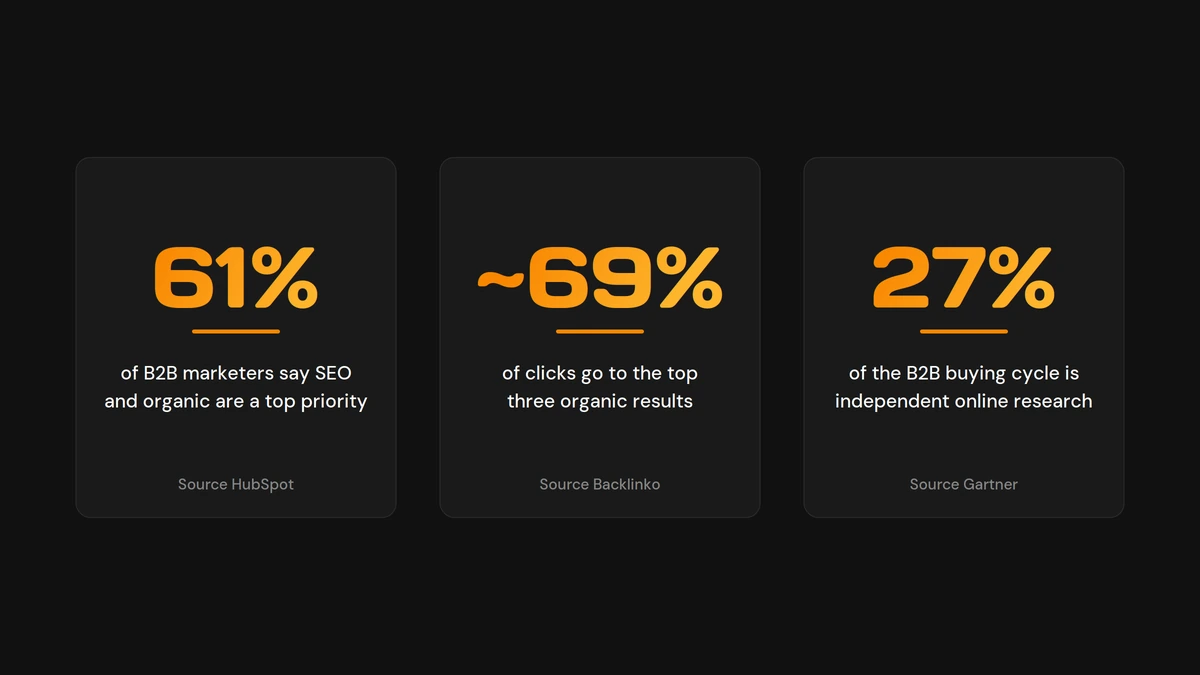
If your business isn’t found among the top results, making the sales you want is challenging. It’s also hard to convince prospects that your products or services are credible. By following B2B SEO best practices, you build the credibility that grows organic traffic over time.
What is the Difference Between B2C and B2B SEO?
The basics are the same for both. Whether you reach consumers or other businesses, you discover what people search for, develop content with your audience in mind, and optimize it so Google can show it for relevant queries.
Google uses the same ranking algorithm for both, so the best SEO practices for B2C apply to B2B as well. The differences are in audience and approach:
B2B Sales Funnels and Complex Sales Cycles
Marketing to professionals differs from marketing to consumers: B2B purchases involve more research and more stakeholders. Choosing the best local SEO services for your niche, for instance, takes more consideration than buying a designer shirt.
B2B sales cycles are longer and more complex, especially for industrial and manufacturing companies with multi-month procurement. You need search visibility from the awareness phase all the way to the closed deal, so B2B marketers must go a step further than B2C marketers to understand their audience for a more targeted reach.
B2B Targets Low-Volume Keywords
Prospects in B2B use many different terms to find a product or service, which often means lower-volume keywords than B2C. Covering that long tail of specific, intent-rich terms matters more than chasing raw search volume.
B2B Should Demonstrate Expertise
B2B buyers want to work with a company that can demonstrate confidence and expertise, and provide the right solution before they even inquire. Thought leadership (content that answers the complex questions your audience is asking) is one of the best ways to prove you’re a reputable expert in your field.
B2B SEO Has Lower Conversion Than B2C
B2B SEO has a lower click-to-sale conversion rate than B2C. A successful strategy attracts traffic genuinely interested in your products or services by defining your niche, learning about your audience, and demonstrating that your solution is the best fit for their needs.
B2B Ecommerce SEO
If you sell to other businesses through an online store, B2B ecommerce SEO blends classic ecommerce optimization with B2B intent. You’re still optimizing category and product pages, site structure, and technical health. The difference is that keywords skew toward specifications, bulk and wholesale terms, part numbers, and procurement-driven queries, and the funnel is longer.
Prioritize clean, crawlable product and category pages, unique product descriptions, and content that answers the technical and comparison questions buyers research before requesting a quote. Our ecommerce SEO work applies the same revenue-first thinking to B2B catalogs.
Steps for an Effective B2B SEO Strategy
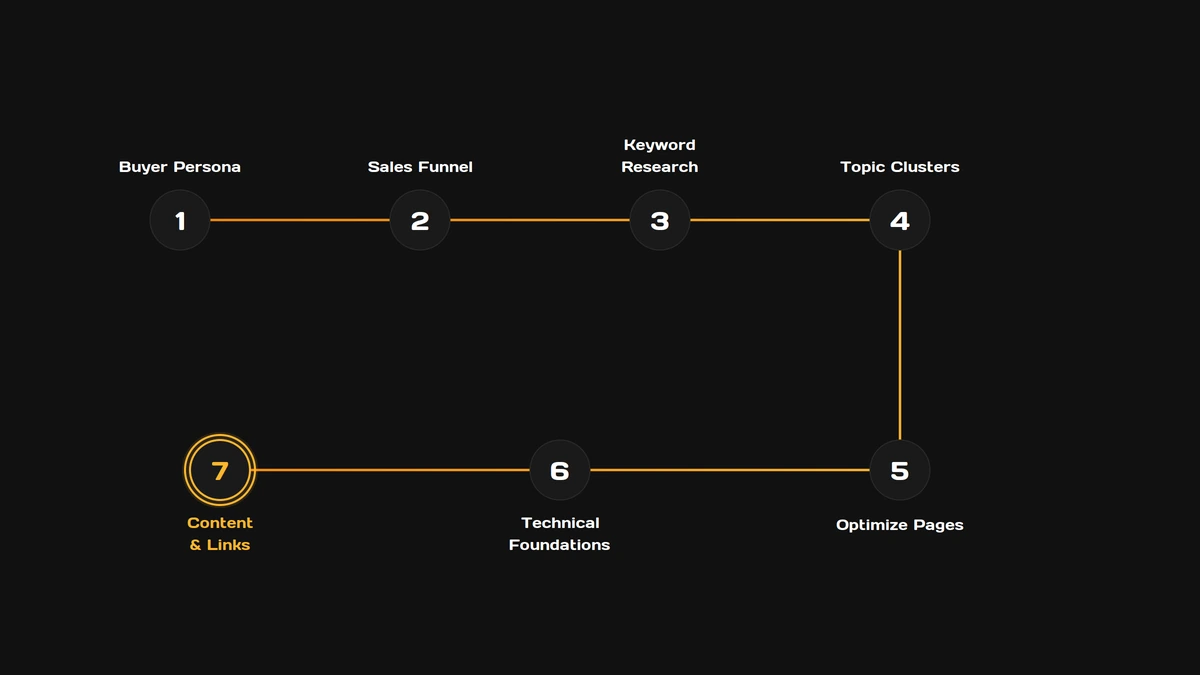
Knowing where to start is half the battle. Here is a step-by-step guide to building an effective B2B SEO strategy. At AlchemyLeads we help clients create winning strategies, so if you need help, don’t hesitate to contact us.
-
Build a Detailed Buyer Persona
A buyer persona is a research-based description of someone who represents your target audience, grounded in qualitative and quantitative data from market and competitor research. Because prospects buy for different reasons, create more than one persona, each with distinct demographics, behaviors, and interests.
To build them, conduct thorough audience research, define customer goals and pain points, and think about how you can help, grouping people with common characteristics together.
-
Define Your Sales Funnel
Before researching the keywords your personas use, understand how your unique sales funnel works. Ask your sales team about the most successful touch points, analyze your sales and analytics data to see how customers find you, and study key stats like average purchase time and customer lifetime value.
Once you understand the funnel, you can choose your bottom-of-the-funnel keywords.
-
Conduct Persona Keyword Research
There’s no SEO without keyword research. Look for the terms clients use at every stage of the funnel, and include informational queries, not just commercial ones, because search intent matters.
Ask what problems your decision-makers face, what terms they use, how you can solve their pain points, and which keywords drive your competitors’ traffic.
The free Seed Keywords Engine Tool and Google autocomplete help surface real terms and long-tail variations. Tools like SEMrush reveal the terms and competitor keywords driving the most organic traffic.
-
Use Topic Clusters to Target Buyers at Different Stages
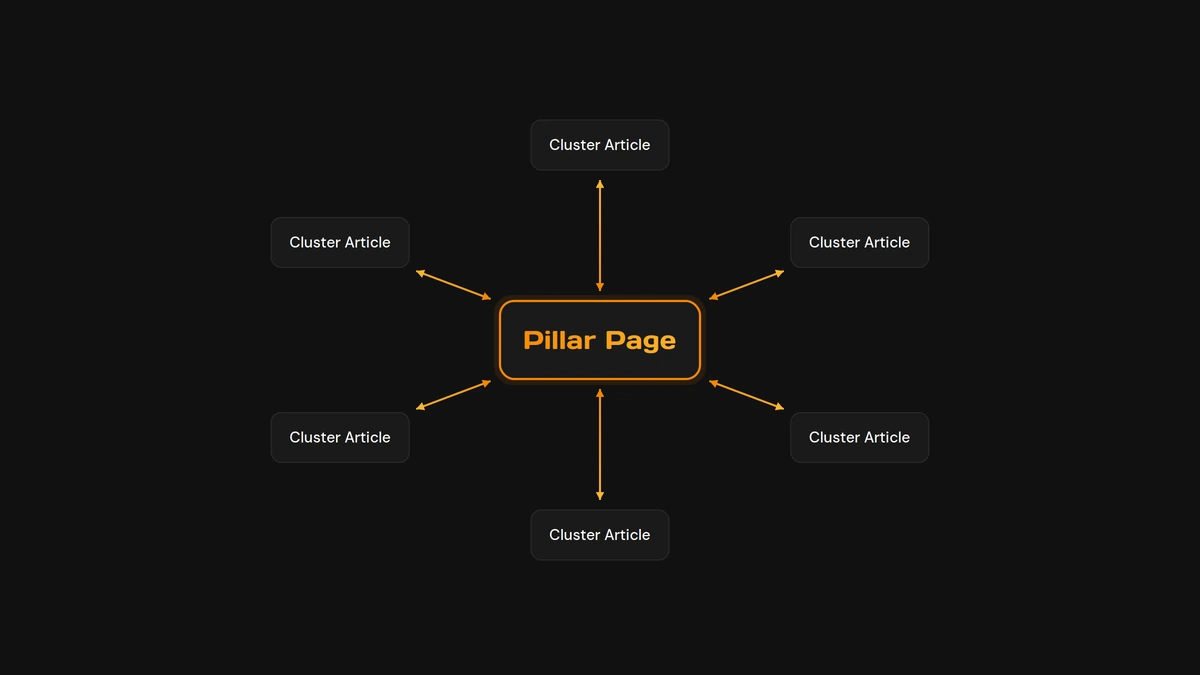
Develop a keyword strategy and top-of-funnel topics that target buyers at every stage. A topic cluster is a group of content around a topic that links to and from a pillar page, demonstrating expertise and creating internal-linking opportunities.
Top-of-funnel searchers aren’t ready to buy yet, but they outnumber bottom-of-funnel searchers, so ignoring them limits your traffic. Capture them with valuable content, then nurture them (for example, into your email list) until they convert.
-
Optimize Your Product and Service Pages
The goal of B2B marketing is to drive conversions, so optimize your money pages for the bottom-of-the-funnel keywords you found.
- Ensure your content is unique. Duplicate content hurts rankings; make sure every landing page is original, even when pages target similar services or different cities.
- Create long-form content. Thin pages are hard to rank because there isn’t enough for search engines to understand. Aim for depth: the average Google first-page result is well over 1,000 words (Backlinko), as long as the content is valuable and relevant.
- Avoid keyword stuffing. Include your target keyword in the H1 and title tag, in the URL, and high on the page, plus natural synonyms and variations, and write a unique meta description, without stuffing. Since on-page SEO is a big topic, see our on-page SEO service if you need help.
-
Cover Your Technical Foundations
None of this ranks if search engines can’t crawl and trust your site. Technical SEO is the background work that makes ranking possible: confirm your site is crawlable, decide which pages should be crawled, and keep a clean sitemap and image sitemap.
Check performance with Google PageSpeed Insights, and cover the key aspects: crawling, structured data, site structure, page speed, mobile, indexation, and site security (HTTPS). These take real expertise, so it’s often best to let a qualified specialist handle the technical work.
-
Create an Effective Content Strategy
A scalable content marketing strategy is essential, ideally a B2B blog where you publish high-quality, link-worthy content. Valuable content earns backlinks, establishes authority, and answers your prospects’ questions.
Don’t focus only on bottom-of-funnel terms; build awareness earlier than your competitors. Useful B2B formats include blog posts, videos, newsletters, case studies, podcasts, research studies, and white papers.
-
Build High-Quality Backlinks for Your B2B Site
Link building is a key ranking factor. One effective tactic to earn high-quality backlinks is creating relevant, high-quality content, then promoting it through email outreach and digital PR aimed at industry blogs and news.
Encourage journalists to cover your latest study, reclaim broken links, and ask sites to reference your content as a resource. Link building is continuous, so keep improving your content to earn more opportunities over time.
B2B Marketing Examples
Looking at sites with strong B2B SEO shows what works. Canva ranks at the top for terms like “template,” “brochure,” and “YouTube banner,” and pulls tens of millions of monthly organic visits, because it ranks for those terms and provides the solution behind them.
HubSpot is a classic B2B SaaS example, ranking on page one for terms like “market research,” “branding,” and “webinars.” The common thread: understand your audience and create content that solves their pain points.
B2B SEO Best Practices
To pull the strategy together, keep these B2B SEO best practices front and center:
Target the full funnel
Target the full funnel: informational, comparison, and bottom-of-funnel keywords, not just commercial terms.
Write for decision-makers
Write for decision-makers and demonstrate expertise with thought leadership, original data, and case studies.
Strengthen money pages
Keep product and service pages unique, in-depth, and conversion-focused.
Maintain technical health
Maintain strong technical health: crawlability, site speed, structured data, and HTTPS.
Earn authoritative links
Earn authoritative, industry-relevant backlinks through content and digital PR.
Stay consistent
Be patient and consistent. B2B SEO compounds over six to 12 months and beyond.
B2B SEO FAQs
What is B2B SEO?
B2B SEO (business-to-business search engine optimization) is the practice of improving a B2B company’s visibility in search so it reaches other businesses, decision-makers, and buyers across a longer, multi-stakeholder buying journey, rather than individual consumers.
Why is SEO important for B2B?
Most B2B buyers research independently online before contacting sales, so ranking for the terms they use puts your company in front of them early, builds trust, and feeds a pipeline of qualified leads at a lower cost than paid channels.
How is B2B SEO different from B2C SEO?
B2B SEO targets lower-volume, higher-value keywords tied to complex, multi-person sales cycles and emphasizes expertise and trust, while B2C SEO targets high-volume consumer terms and faster purchases.
What is a B2B SEO strategy?
A B2B SEO strategy is a systematic plan that combines buyer-focused keyword and topic research, on-page and technical optimization, funnel-stage content, and authoritative backlinks to rank for and convert business buyers.
How long does B2B SEO take?
B2B SEO is a long-term investment; meaningful ranking and lead gains typically take several months, because they depend on building content depth, technical health, and authority over time.
B2B SEO: Wrapping Up
A lot goes into a successful B2B SEO strategy. The most important parts are consistency in optimization and link building, brand clarity, and an audience-led approach that informs your content and earns backlinks. Together, these raise awareness, increase visibility, and boost organic traffic and sales.
Need help with your B2B SEO strategy? Contact us today, or work with our B2B SEO services team and we’ll help you win.
Suggested
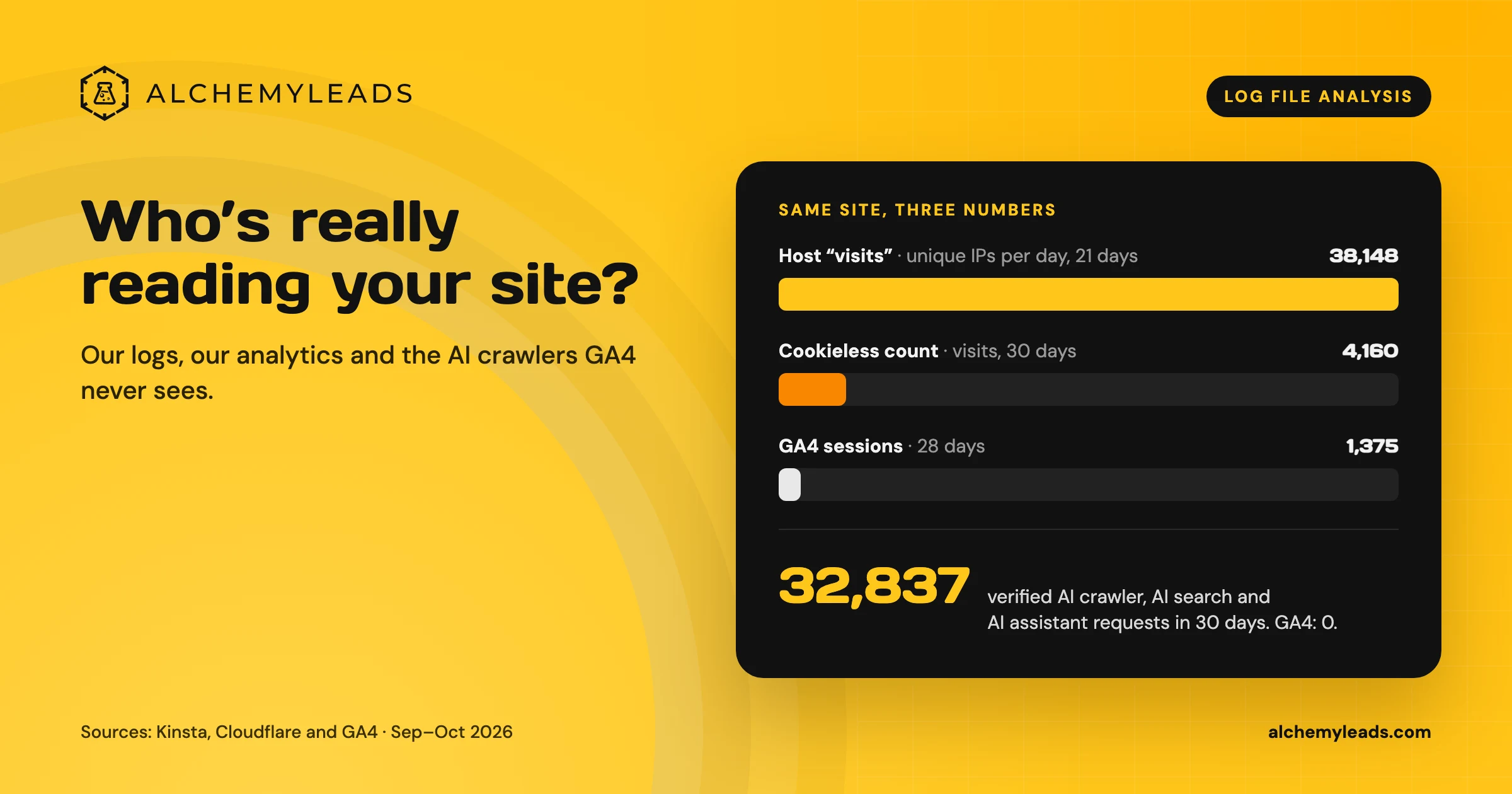
Log File Analysis for AI Search: Our Logs Showed 38,148 Visits. GA4 Showed 1,375.
Our host logged 38,148 visits. GA4 logged 1,375 sessions. We opened the server logs to see who was really there, and what AI crawlers read.
October 16, 2026
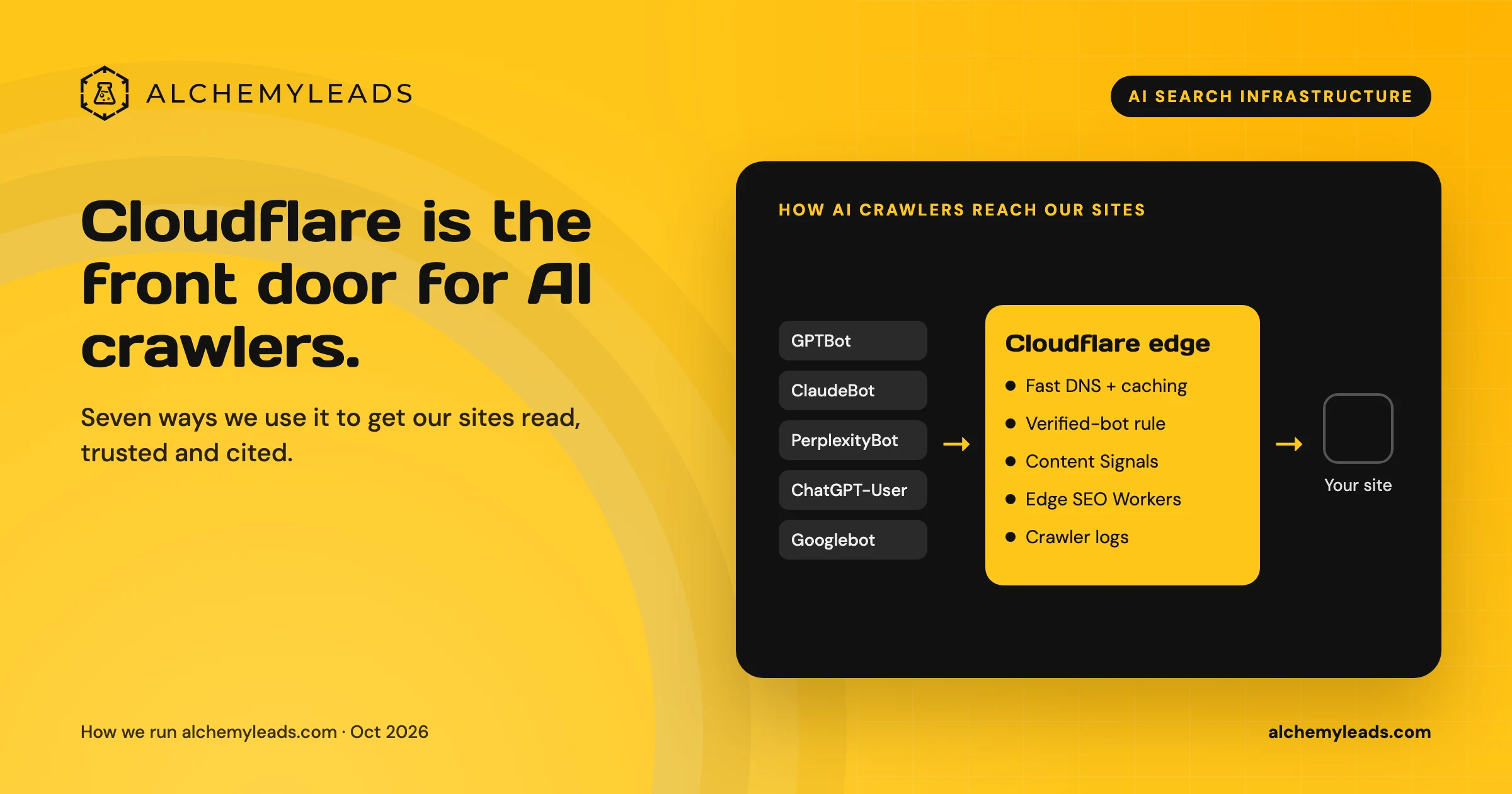
Why We Love Cloudflare for AI Search: 7 Ways We Use It for GEO and AEO
How we use Cloudflare DNS, bot rules, Content Signals and Workers to make our sites fast, crawlable and citable for ChatGPT, Claude and Perplexity.
October 16, 2026
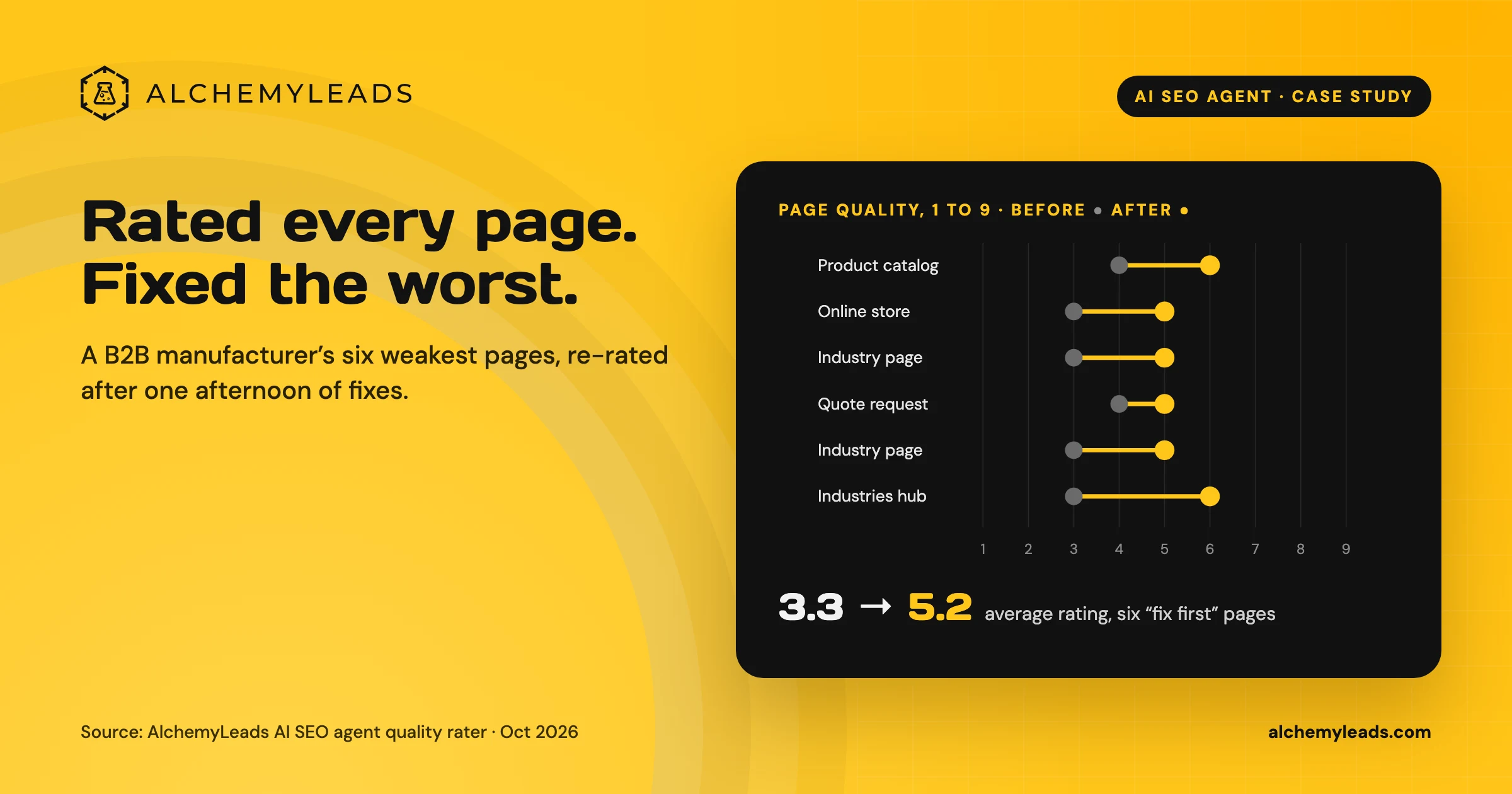
Our AI SEO Agent Rated Every Page on a Manufacturer’s Site, Then Fixed the Worst Ones in an Afternoon
Our AI SEO agent rated 40 pages of a B2B industrial equipment manufacturer’s site against a Quality Rater Guidelines-style rubric, joined the ratings to Search Console data, and lifted the six weakest pages from an average of 3.3 to 5.2 out of 9 in one afternoon.
October 16, 2026
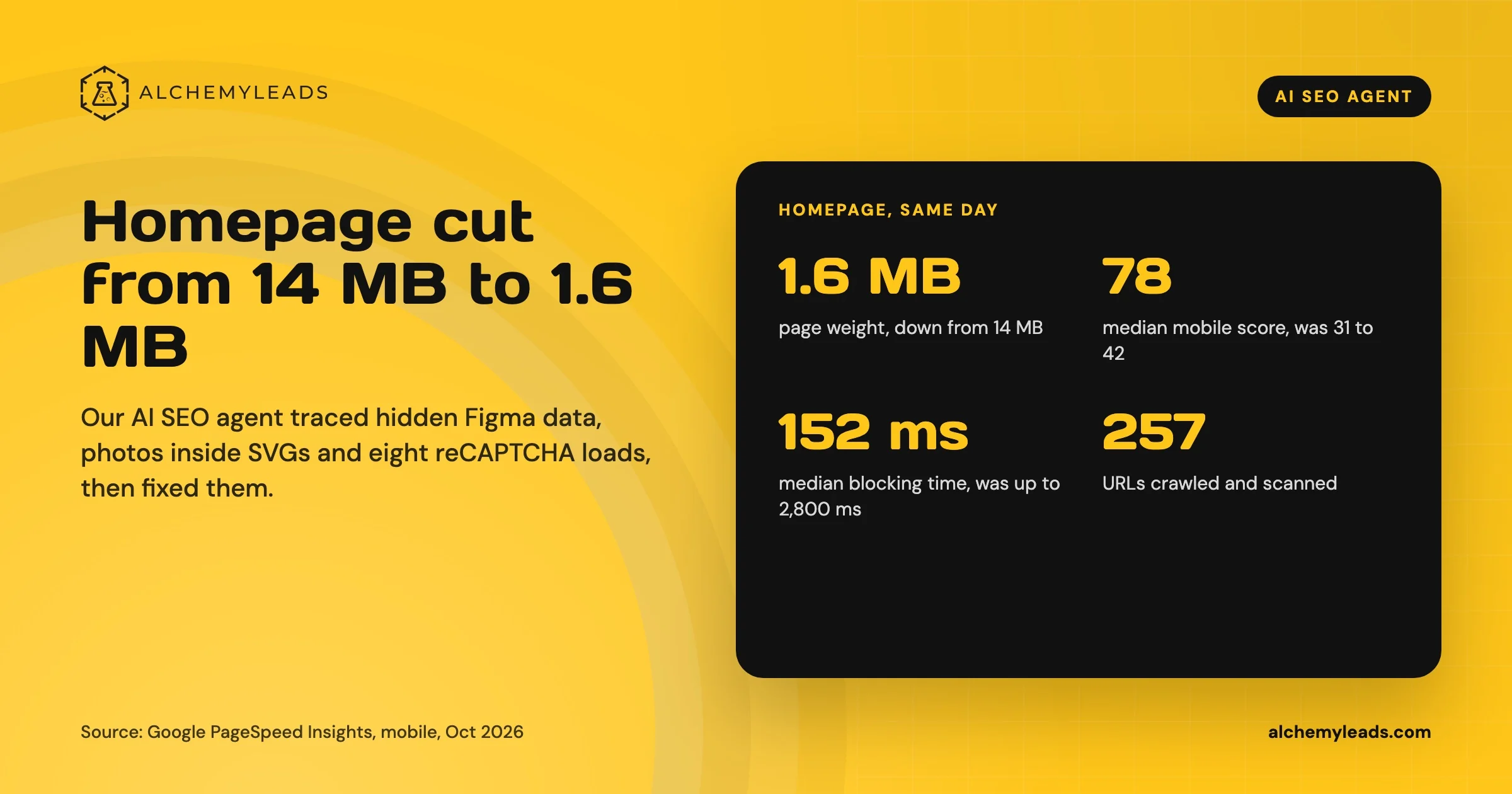
Our Homepage Went From 14 MB to 1.6 MB. Here’s What Our AI SEO Agent Found.
How our AI SEO agent cut our homepage from 14 MB to 1.6 MB: hidden Figma data, photos inside SVGs, a preloading video, eight reCAPTCHA loads, and the code behind each fix.
October 15, 2026
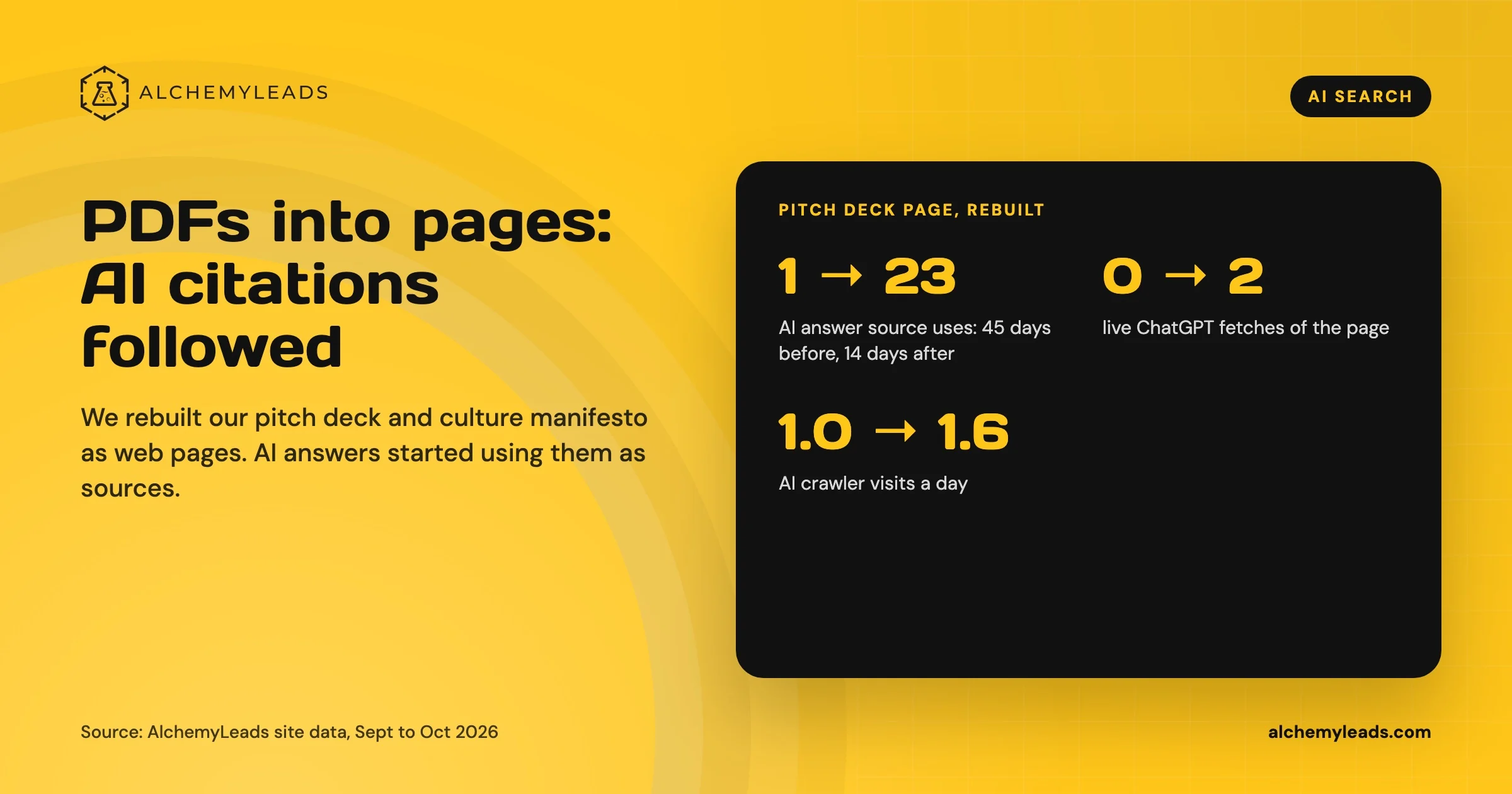
Gated Content and AI Search: Why We Turn PDFs Into Web Pages
Gated content and PDFs hide your best information from AI search. Our before-and-after data from rebuilding two embedded files as web pages, and how to keep PDF downloads as a conversion.
October 14, 2026
Contact us
We value your privacy and won't share your email with others.
We'll only contact you with curated content.
