
AI SEO agent case study
A specialty coffee equipment retailer on Shopify had more than a thousand structured data errors, a dozen 404s and 155 links to broken pages. Our AI SEO agent traced them to four root causes, and our team shipped the fixes the same day.
The short answerAhrefs flagged the symptoms. The agent read the Ahrefs exports in seconds, found the four causes behind them and wrote the fix plan. Our team approved each change and applied it in the Shopify admin. By the evening re-crawl, structured data errors went from 1,186 to 0, 404 pages from 12 to 0, links to broken pages from 155 to 0, and the Ahrefs health score from 90 to 91. It had been in the 70s in July.
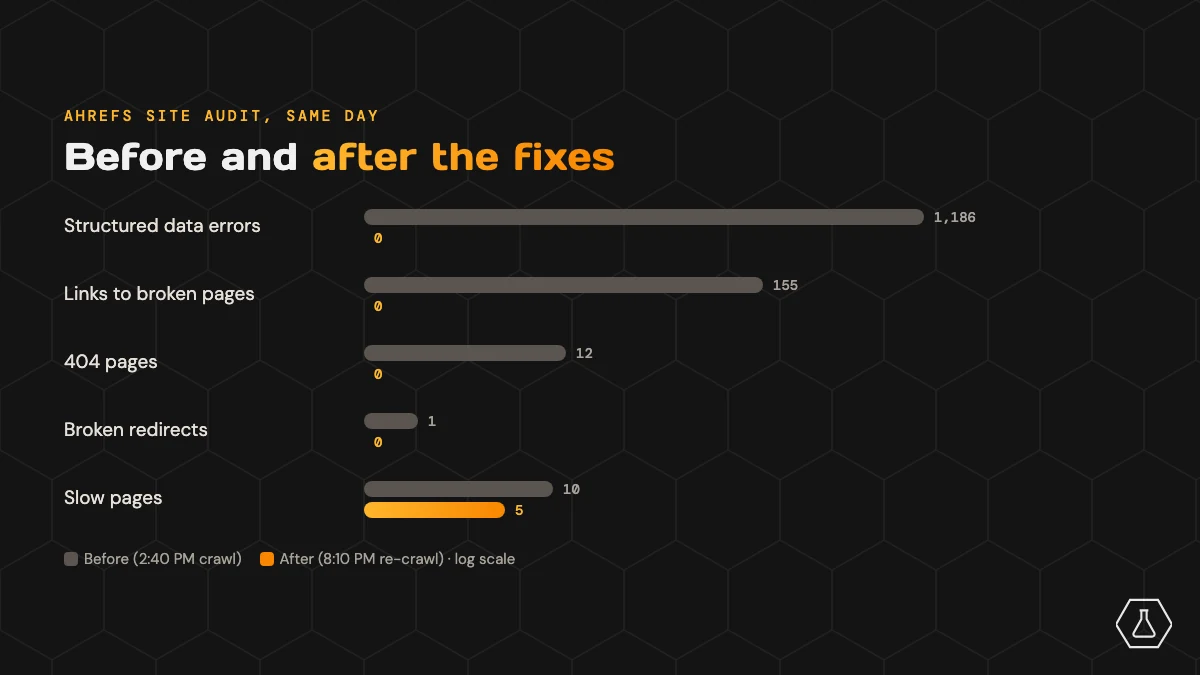
| Ahrefs issue | Before (2:40 PM) | After (8:10 PM) |
|---|---|---|
| Structured data has schema.org validation errors | 1,186 | 0 |
| Links to broken pages | 155 | 0 |
| 404 pages | 12 | 0 |
| Broken redirects | 1 | 0 |
| Slow pages | 10 | 5 |
| Ahrefs health score | 90 (70s in July) | 91 |
Source: Ahrefs Site Audit, two crawls of the same store on the same day. Image compression, meta lengths and heading fixes are the next pass, so those rows haven’t moved yet.
Inputs
The agent is only as good as the data it can see
An AI agent can’t fix what it can’t measure. Ours works from a lot of sources at once, and it chooses the fastest one for each job.
Crawl data
Ahrefs
Site Audit exports list every error, page and link. The agent turned nine exports into a fix plan in about five seconds.
Its own crawl
Manual checks and crawls
When exports are stale, the agent crawls the store politely itself (332 URLs in about 25 minutes) and checks every fix on the live site.
Search and revenue
Search Console, GA4 and Merchant Center
Which pages earn impressions, traffic and sales decides what gets fixed first. Product feed health comes from Google Merchant Center.
AI visibility
Searchable, GeoToolbox and QueryBurst
Where the brand shows up, or doesn’t, in AI answers, and which prompts and sources matter.
Trends
SEOGets
Search Console and GA4 trends over time, so we can see whether a fix moved anything.
Speed
PageSpeed Insights
Core Web Vitals for each page template, combined with Ahrefs page weights to rank the speed fixes.
Diagnosis
Four root causes behind 1,300+ errors
Fixing errors one URL at a time would have taken weeks. The agent grouped them by cause instead:
- A theme schema that guessedThe theme’s Product markup copied any barcode into a GTIN field, including internal SKUs that aren’t GTINs at all. It also sent an empty category, a plain-text brand and a property schema.org doesn’t recognize. That one template produced most of the 1,186 errors.
- Review badges with orphan ratingsThe reviews app printed rating markup on every product card in collection grids. Those ratings weren’t attached to a product, so every grid page failed validation.
- Links to renamed productsProduct descriptions still linked to old product URLs. Because descriptions also render on collection and search pages, one mistyped link alone had 64 inlinks.
- Leftovers from an uninstalled appAn SEO app removed years ago left six HTML sitemap pages and a footer link behind, holding 71 dead or redirected links.

The structured data row in Ahrefs before the fixes.
The schema fix
Rebuilding the product schema without faking anything
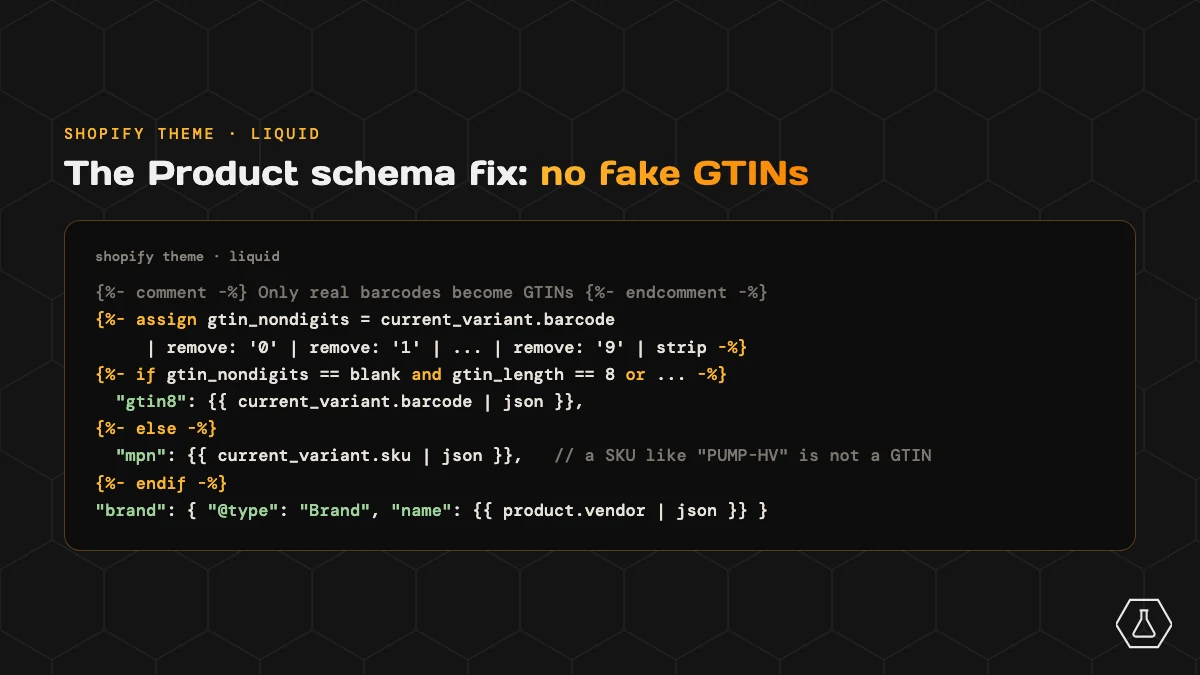
Schema was the biggest problem, and the easiest one to get wrong. Here is how we fixed it:
- Back up firstWe duplicated the live theme before touching a file, so the whole change can be undone in one click.
- Only real barcodes become GTINsThe Product markup now outputs a GTIN only when the barcode is all digits and a valid GTIN length. Anything else becomes an
mpn. We never invent a GTIN, because a fake one can get products pulled from Google Shopping. - Fix the fields Google readsBrand is now a proper Brand object, empty categories are left out, the unrecognized property is gone, and Product markup only prints on product pages.
- Ratings that match what shoppers seeThe star rating in the markup now comes from the same review data the widget shows. We turned off the reviews app’s own rating markup and filtered it out of the product card badges.
- Add the missing contextCollection pages now describe themselves as a collection with an item list, and product, collection and article pages carry breadcrumbs.
- Verify on the live storeEvery template was checked on the live site. Product and article pages show zero schema issues, and the ratings in the markup match the widget.
Links and redirects
404s, redirects and broken links
- 25 redirectsOld product and page URLs now redirect to their closest live match, matched word by word so a filter never redirects to the wrong part. That includes one redirect pointing at a deleted collection.
- 34 links rewritten at the sourceLinks inside 20 product descriptions, 2 pages and 6 blog articles now point straight at the live URL. A final catalog scan found none of the old links left.
- App leftovers retiredThe six orphaned sitemap pages are hidden and redirected, and their footer link is gone.
Agent plus team
Who did what
The agent did most of the finding and planning. It read the exports, grouped the errors by cause, ranked the fixes and drafted each change. Our team gave it the detailed instructions for this store, approved every change, and applied the theme and admin edits by hand while checking each one live.
The guardrails stay the same on every client:
Undo
Every change is reversible
Theme backups, logged redirects and a snapshot before each write.
Approval
A person signs off
Content and bigger changes wait for approval. Prices, specs and certifications are never touched.
Honesty
No invented data
GTINs come only from real barcodes, and ratings only from real reviews.
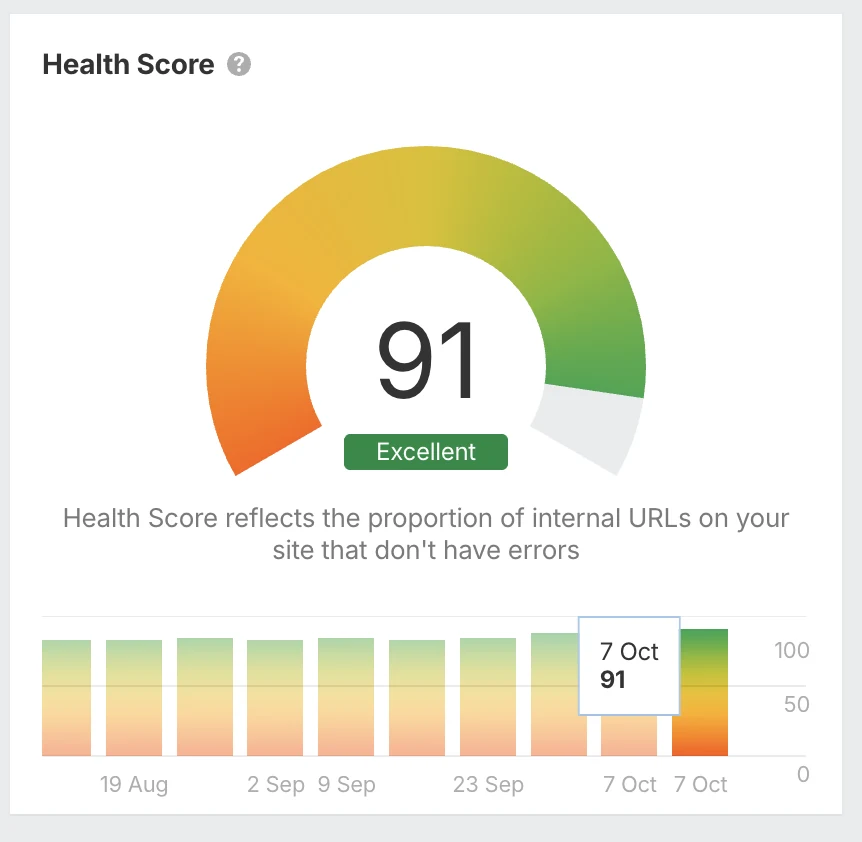
The evening re-crawl: health score 91.
What’s next
The next pass
Day one went to errors that affect how Google and AI assistants read the store. Next up are 166 oversized product images, meta descriptions and titles that run long, and a few pages with more than one H1. Those changes affect copy and media, so they go through approval first.
For more on how the agent works, see our AI SEO agent. For the same work on our own site, read how the agent took our Ahrefs health score from 74 to 96.
FAQs
Straight answers
Can an AI SEO agent fix Shopify site audit errors?
Yes, for most of them. Our agent reads Ahrefs exports or crawls the store, groups errors by root cause and drafts the fixes. A person approves each change, and theme or content edits are checked on the live store before we call them done.
Why did the store have so many structured data errors?
Most came from one theme template that copied any barcode into a GTIN field and sent fields schema.org doesn’t accept. The rest came from a reviews app printing ratings on product cards without a product attached.
Do you add GTINs when a product doesn’t have one?
No. A GTIN is only output when the product has a real barcode with valid digits. Otherwise the schema uses the part number as an mpn. Made-up GTINs can get products pulled from Google Shopping.
How long did the fixes take?
One day. The plan came from Ahrefs exports in seconds, the fixes went in during the afternoon, and an evening re-crawl confirmed the results.
Does the health score capture all of the work?
No. Ahrefs health score is the share of pages without errors, so it moved from 90 to 91. The bigger change is in the error counts: 1,186 structured data errors and 155 links to broken pages went to zero.
Your store next
Find what’s behind your site audit
Send us your Ahrefs or Semrush export. We’ll show you the root causes and what to fix first.
Suggested
Our Ahrefs Health Score Went From 74 to 96. Here’s What Our AI SEO Agent Found.
Seven problems our AI SEO agent found on our own site, from leads GA4 never recorded to 195 pages linking through redirects, and how we fixed them.
October 8, 2026
How Our AI SEO Agent Cleared 1,186 Schema Errors in One Day
How our AI SEO agent and team took a Shopify store from 1,186 structured data errors, 12 404s and 155 broken links to zero in one day.
October 8, 2026

How to Integrate HubSpot and Tripleseat: Lessons From 9 Builds
A step-by-step guide to connecting HubSpot and Tripleseat: forms, OAuth 2.0, field and stage mapping, multiple locations, documents and monitoring, with real lessons from nine production integrations.
October 4, 2026
Answer-First Content: The Inverted Pyramid (∇) for AI Search
The inverted pyramid (∇) puts the answer first and the detail after. Here is how answer-first writing serves busy buyers and AI systems that quote short passages, with examples, common mistakes, and a checklist.
October 3, 2026

Retrieve-for-Train explained: how Google Research is speeding up AI search fan-out
Google Research’s Retrieve-for-Train method trains a small diffusion model to fan out search queries in one pass. Here is how it works, what it reports, where it stops, and our cautious read for brands.
October 3, 2026
Contact us
We value your privacy and won't share your email with others.
We'll only contact you with curated content.
