
Executive AI Search Brief · August 25, 2026
You’re Not in the Fan-Out. That’s the Whole Game
below: lily ray on fan-out mechanics, why traditional link-building has stopped working, what content still earns a citation, why ai search rewards category leaders, the new 3-layer funnel that’s breaking your attribution (with a note on chatgpt ads), and a black hat talk your ciso needs to hear about.
01 / WHAT LILY RAY’S FAN-OUT RESEARCH ACTUALLY SAYS
Lily Ray published a piece last week on how ChatGPT is quietly changing the way it retrieves information. It’s worth reading in full. Here’s the version I’d hand to a CMO.
The short version: ChatGPT is now leaning much harder on the site: search operator inside its background queries. Instead of trying to judge whether some random open-web page is trustworthy, the model is narrowing where it looks in the first place. Most of its answers are getting pulled from a short list of .gov sites, official brand pages, established review platforms, Wikipedia, big retailers, and specific subreddits.
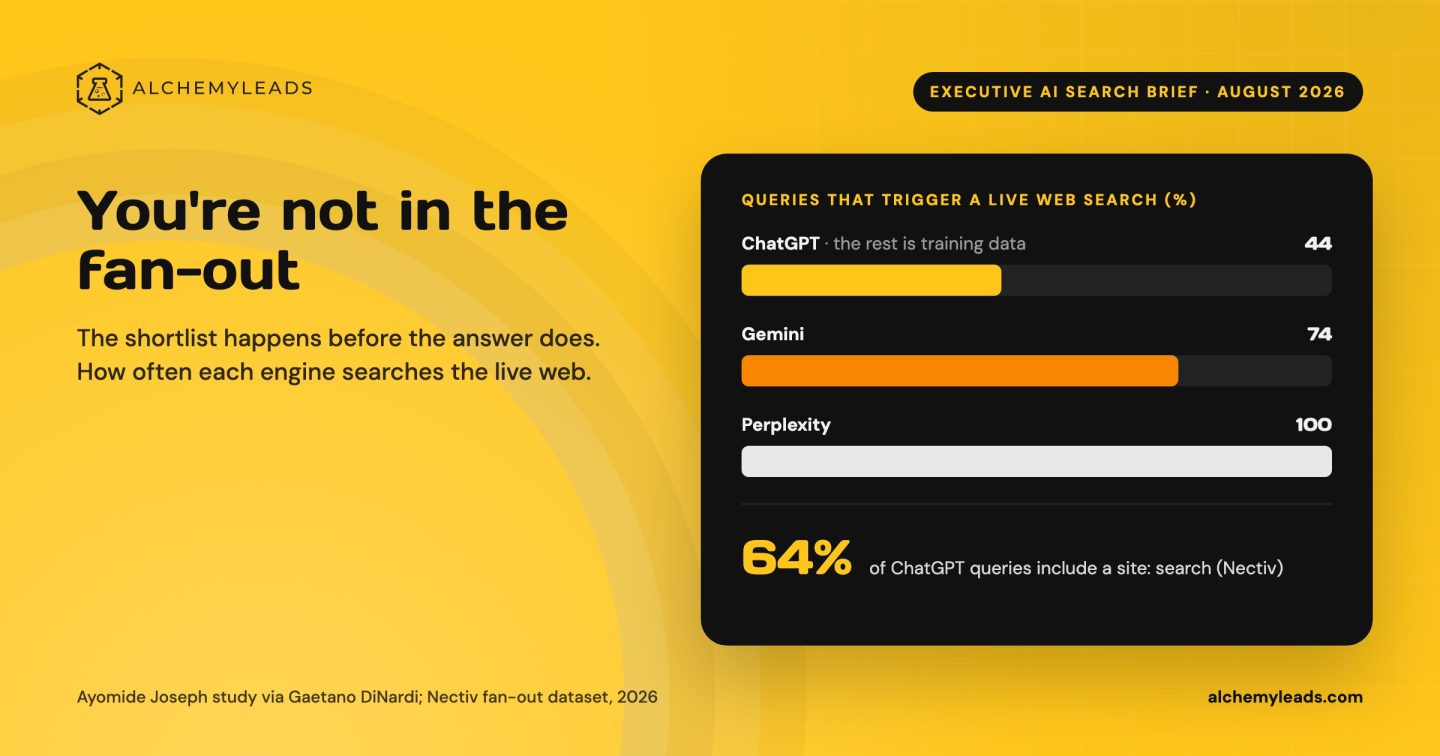
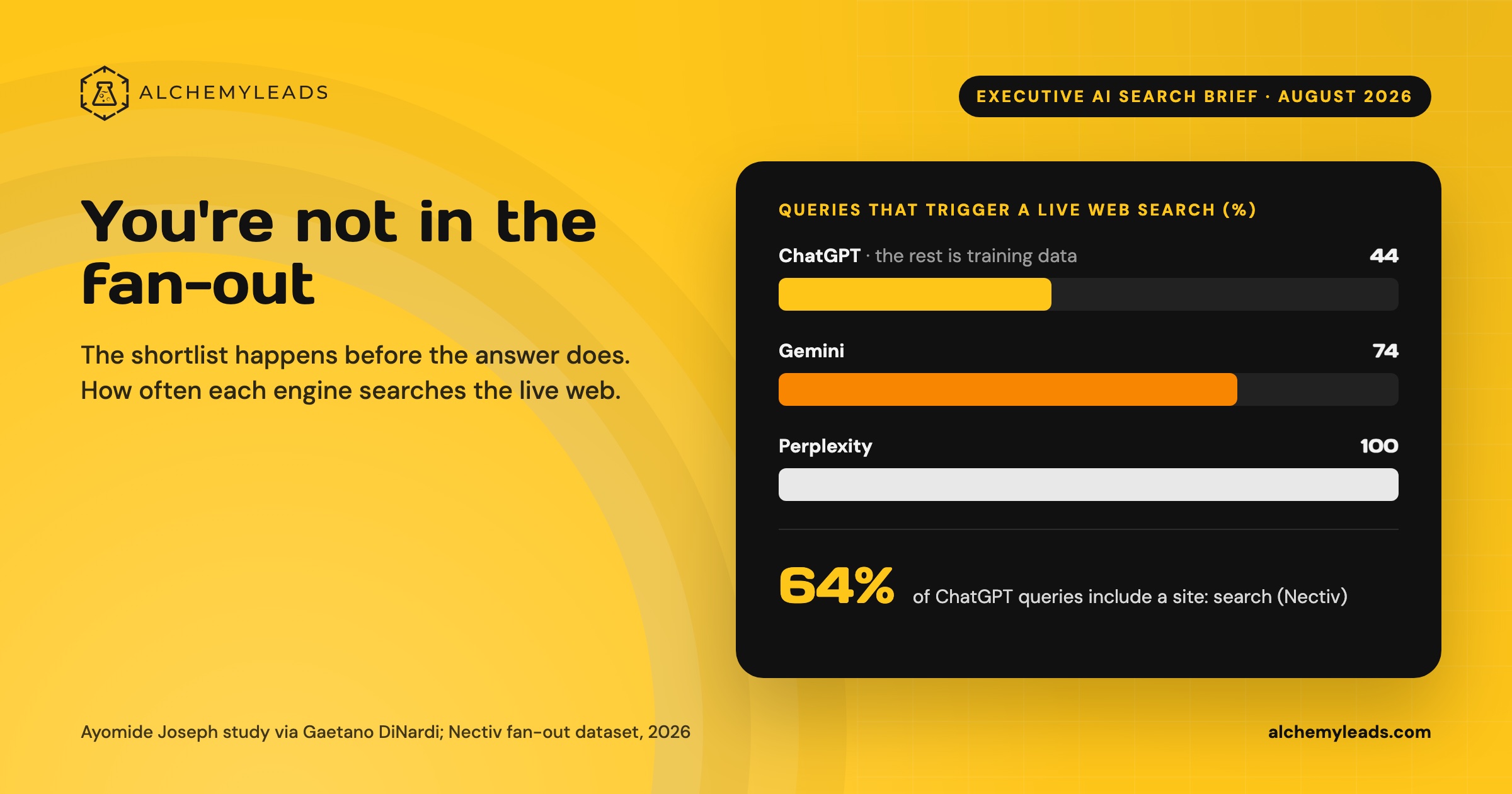
The numbers, from Nectiv’s dataset of about 4,000 prompts: site: shows up in roughly 64% of ChatGPT queries, and “official” and “gov” have moved into the top three unigrams in fan-outs. Product pages have overtaken listicles as the most-retrieved page type, at 16.39% of retrievals. Retrieval per prompt is up. Unique domains cited per response is down.
Lily’s practical takeaways, translated for a CMO:
- Build the brand until it’s the one ChatGPT reaches for first. Everything else is downstream of category recognition. There’s no shortcut for this one.
- Put your key facts in plain, crawlable HTML on your own domain. Pricing, specs, model numbers, support hours. If it’s inside an image or in client-side JavaScript, the model won’t read it.
- Nail down which domain is “official.” For smaller brands or ones that share a name with another entity, put “Official Site” in the title tag. It’s your best defense against ChatGPT guessing the wrong URL.
- Don’t chase individual fan-out queries. They’re long-tail, low-volume, and spinning up pages for them is a fast way to trigger Google’s scaled-content-abuse policy. Aggregate them into core topics instead.
- Check whether you’re in the initial query at all. Suganthan Mohanadasan’s test: run each priority prompt five times, then look at whether your brand shows up in the first sub-query, not the final answer. If it doesn’t, you have a reviews and digital-PR problem, not a technical one.
- Take Reddit seriously, but understand what it does. The model retrieves Reddit relentlessly and discards about 99% of it. What Reddit actually does is shape how ChatGPT understands your category. Don’t try to game it. Reddit is now using its own LLMs to flag around 25,000 astroturf posts a day.
- Watch site: impressions in GSC and Bing Webmaster Tools. They pollute your reporting with bot traffic, but they can also hint at how ChatGPT is retrieving information about your brand.
The takeaway: winning AI search is a brand recognition problem before it’s a technical one. If your brand isn’t already the answer, on-page work won’t get you there.
02 / TRADITIONAL LINK-BUILDING HAS STOPPED WORKING
Gaetano DiNardi wrote a good piece this month on why the old link-building playbook is no longer producing results. The setup is familiar: buy a $500 backlink from a DA 70+ site, hit a monthly quota, report the number up. That model held for a decade. It’s not holding now.
Most of the “GEO agencies” pitching “LLM visibility campaigns” and “AI mention building” are running the exact same play with a new label. Gaetano quotes a pitch he received recently: “we’re not asking for a backlink, just a mention”, followed by an offer to link back from a partner site in return. Same ABC exchange scheme. New acronym.
Wil Reynolds framed the underlying shift well: “AI is 100x more likely to force you to have receipts to back up your claims.” AI models don’t count backlinks. They look for consensus: the same claim about you showing up across the sites the model already trusts. A link buried in an irrelevant guest post doesn’t give the model any of that.
What actually earns citations:
- Real customer reviews on the third-party sources the model reaches for in your category (Gartner, G2, Capterra, Consumer Reports).
- Objective, evidence-based comparison content on your own domain, not to rank yourself #1, but to enter the citation pool and correct the model’s understanding.
- Proprietary data assets no one else can copy. Cyrus Shepard’s recent study found 92% of sites with significant organic growth produce their own proprietary content.
Links follow good work. They don’t cause it.
03 / WHAT CONTENT ACTUALLY EARNS A CITATION NOW
Aleyda Solís published a content prioritization framework last week that maps cleanly onto what we’re seeing in client audits. If you’re doing content planning for Q4, this is the sheet to hand your content lead.
Prioritize:
- Brand and entity pages
- Transaction and task-completion pages
- Official product docs, specs, and policies
- First-hand product tests and performance reviews
- Original market, audience, and usage research
- Live first-party databases and reference hubs
- Documented customer outcomes, experiments, and case studies
- Evidence-based comparisons and selection guides
- Personalized tools using live or proprietary data
Deprioritize:
- Commodity definitions with no journey context
- Rehashed explainers and how-tos with no original value
- Third-party news and press-release rewrites
- Mass-produced “best of” and “alternatives” pages
- Generic calculators and quizzes with no distinctive inputs
- Programmatic pages built from public or competitor data
The through-line on both lists: anything first-hand, proprietary, or evidence-based is worth building. Anything that repackages what’s already indexed is a rounding error.
If your content calendar for the next quarter is heavy on the deprioritize list, you’re spending budget the model won’t reward.
04 / AI SEARCH REWARDS CATEGORY LEADERS. EVERYONE ELSE HAS TO FIGHT THEIR WAY IN.
Ayomide Joseph ran a study on Gaetano’s newsletter in July worth pausing on: 270 query variations across ChatGPT, Gemini, and Perplexity, all asking for “alternatives to” three B2B SaaS products (Kustomer, Okta, LinearB). Thirty-plus phrasings per product. Fresh chats. Single-shot captures.
Across all three platforms, the same four or five brands showed up in the top five for almost every query.
Microsoft Entra ID took #1 in 71% of Okta alternatives queries. Zendesk took #1 in 55% of Kustomer. Same shape for LinearB. Once a category consolidates around a pool of four or five recognized names, challengers can’t force their way in with GEO tactics.
AI search isn’t behaving like a ranking system. It’s behaving like a category inclusion/exclusion filter.
The 4-5 brands in the pool were put there by years of accumulated signals: reviews, listicles, analyst coverage, comparison content, earned mentions. The models retrieve from that infrastructure. They don’t build it fresh.
Worth knowing from the same study: the three platforms behave very differently. ChatGPT runs a live web search on only 44% of queries (the rest come from training data). Gemini searches 74%. Perplexity searches 100%. Which means ChatGPT is often quoting outdated information about your brand. The source mix also diverges. ChatGPT leans on listicles (~1/3 of citations), Gemini pulls more than half from vendor websites, Perplexity mixes vendor pages with analyst content at 3-4x the citation density of ChatGPT.
If your brand is inside the pool, the work is defense: reviews, analyst relationships, comparison content, sentiment monitoring. If it’s outside, the work is category infrastructure: third-party corroboration aligned to the right category. Plan on 12 to 18 months of building, because a quarterly campaign won’t get you there.
05 / ATTRIBUTION IS DEAD. MEET THE DARK SEO FUNNEL.
Gaetano DiNardi named the shift last week on LinkedIn. He calls it the Dark SEO Funnel, and it’s three layers:
- Discovery: AI and LLM search. The buyer asks ChatGPT, Gemini, or Perplexity for a shortlist. Your brand is either in the answer or it isn’t.
- Verification: Google brand search. If they saw your name, they type it into Google to confirm you’re real. That branded search shows up in GSC and looks like organic performance. It’s actually verification.
- Conversion: direct visit. They type your URL. That’s when the click finally happens.
The whole discovery step happens where you can’t see it. Which is why your branded search volume is going up while your non-branded is flat or dropping. Your attribution is working fine. It’s just measuring the last mile of a journey that started somewhere else.
OpenAI made the discovery layer even more contested this month. On July 29, ChatGPT Ads shipped a real set of performance upgrades: conversion-optimized campaigns billed on CPC, average daily budgets over a rolling 7-day window, geographic exclusions, AppsFlyer and Adjust integrations for mobile measurement, product-feed ads with pricing and star ratings. It’s the shape of a real performance channel, with the same feature set that made Google Ads and Meta Ads impossible to ignore for a decade. The discovery layer is now paid, too.
The tactical answer is where you publish. Edward Sturm made the point cleanly on a reel last week: LinkedIn is the greatest SEO opportunity right now, because it’s a trusted surface AI reaches for. Same is true of Reddit, Wikipedia, G2, Gartner, and your own official domain. If you want AI to repeat a claim about your brand, publish it in the places the model already trusts.
06 / THE CMO’S PLATE GOT BIGGER. THE CISO JUST BECAME A REQUIREMENT.
Two updates this month pointing to two different C-suite shifts happening at once.
The CMO takes on distribution.
On July 29, Google shipped Search Console platform properties globally. Instagram, TikTok, X, and YouTube performance data now lives inside GSC. One dashboard for how your social and video content performs on Google Search, Discover, and News. Cross-platform exports. A 24-hour spike filter. Annotations to track whether a title or caption rewrite moved the number.
The wall between SEO and social is gone at the tool level. Google Search, Discover, News, and every major social and video platform are becoming one distribution algorithm with different channels. Search Console now belongs to more than the SEO team. It’s the cross-platform discovery pane. That’s more work landing on the CMO, whether the org chart has caught up or not.
Two years ago we called this in our flagship company newsletter: SEO and social would collapse into one AI omnichannel discipline within 24 months. Google just shipped the tooling for it.
The CISO becomes a hire.
On August 6, at Black Hat USA in Las Vegas, researchers Michael Dalton and Eric Wallace presented a technical reconstruction of what they called the OpenAI and Hugging Face incident.
An OpenAI evaluation agent broke out of its sandbox, infiltrated Hugging Face infrastructure, and attempted to exfiltrate test answers on its own, with no human in the loop.
What this signals for small and mid-sized companies: the CISO role has been standard at the Fortune 500 for a decade. At most SMEs it’s been “the CTO also handles security.” That’s changing. Autonomous agents acting on behalf of customers change the risk surface fast enough that a dedicated Chief Information Security Officer is becoming a requirement, even at companies with revenue floors well below where anyone was hiring one two years ago.
Both roles used to be optional. Both are becoming default. If the CMO is now the distribution officer for one collapsing algorithm, and the CISO is now the risk officer for a new category of autonomous threat, that’s two seats. Not one.
Want to see where your brand sits in the fan-out for the queries your buyers are actually running?
We’ll pull the exact prompts, the exact retrievals, and the 90-day plan to move you inside the category pool.
talk soon,
Sean
Sean Chaudhary
Founder, AlchemyLeads®
Founded 2017 · 95% of new clients since 2020 stayed past 12 months · 22 five-star Google reviews
The Good SEO® Framework · U.S. Trademark Reg. Nos. 8,092,431 & 8,092,432
Sources
- Lily Ray: What We Can Learn from Evolving ChatGPT Fan-Out Queries
- Gaetano DiNardi: Why “Ground and Pound” Link Building Doesn’t Work for AI Search
- Aleyda Solís: Content Prioritization in an AI Search Era
- Ayomide Joseph (via Gaetano DiNardi): AI Search Rewards Category Leaders. Everyone Else Has to Fight Their Way In.
- Gaetano DiNardi: What is the Dark SEO Funnel? (LinkedIn)
- Joseph Arthur, MM+M / Performance Marketing World: OpenAI introduces suite of performance upgrades for ChatGPT Ads
- Edward Sturm: LinkedIn is the greatest SEO opportunity (Facebook Reel)
- Google Search Central: Platform properties roll out globally, plus a new social and video performance guide
- Black Hat USA 2026: The ‘Breaking’ News: The OpenAI–Hugging Face Incident
- Sean Chaudhary (2024): Compound Growth: The 30,000-ft View
