
A few years ago, SEO was more about keywords and how to use them within content to achieve higher rankings. Today, it’s about understanding the user intent, providing valuable content, and ensuring a good user experience. Predictive SEO involves analyzing vast amounts of data to identify search patterns and predict changes to help create an effective SEO strategy, and machine learning offers a fast and efficient way to achieve that. Read along to learn more about predictive SEO with machine learning.
What is Predictive SEO?

Imagine if you could know everything before it happens. You’ll have a chance to get everything right and be unstoppable. This is the idea behind predictive SEO.
Predictive SEO involves predicting customers’ future actions. It’s about observing customer behavior and analyzing consumer data to understand what customers want and provide it before they need it. Ideally, predictive SEO uses past data and insights to create content that will perform better in the future.
This unique approach is different from the reactive approach that most marketers use. Normally, content marketers wait for a topic to become popular to start creating content around it. Predictive SEO takes the opposite direction—it provides ideas on how to create and optimize content for the future so you can be ahead of the curve. This comes with several benefits, including:
- Gives competitive advantage: By creating and optimizing content before the topics trend, you remain ahead of your competitors who follow a reactive approach to SEO and content.
- Helps in content planning: Identifying the topics likely to trend in the future will help you plan your content months ahead.
- Better resource allocation: By predicting what your target audience wants in the future, you can efficiently allocate time, effort, and resources.
The Role of Machine Learning in Predictive SEO
Machine learning involves using algorithms to analyze the available data and make predictions without necessarily being programmed. Regarding predictive SEO, machine learning algorithms can use historical data on user behavior, website performance, and search engine rankings to predict future trends.
For example, machine learning can analyze the impact of past Google algorithm updates on websites to predict how future updates could impact your website’s rankings. The insights you get will help you proactively adjust your SEO strategy instead of waiting until the updates hit you.
Machine learning can also help analyze data on past queries to get insights into future search trends. For example, a seasonal retail clothing business can use predictive AI to analyze past customer behavior and predict product demand. The information will help them know what to add to their inventory and what to reduce.
Key Components
Data Collection
Machine learning can help analyze tons of data on content results, website performance, user behavior, and other SEO metrics. Key metrics to focus on include website traffic, keyword rankings, engagement, conversion, and bounce rates.
Historical Analysis
Machine learning models are used to analyze the historical patterns and trends of the data collected. This will provide insights into how different factors have influenced user behavior and Google rankings in the past.
Feature Selection
The next step is to select features that significantly impact SEO performance, including content quality, user experience metrics, on-page elements, social signals, backlink profiles, etc.
Algorithm Selection
Various advanced machine learning algorithms do different predictive tasks. For example, neural networks can help in image and speech recognition and predictive analytics. Regression analysis is a statistical method to predict continuous outcomes. Applications include risk assessment, price prediction, trend analysis, etc.
Clustering algorithms like K-means group similar data based on specific features, with common applications including document clustering, market segmentation, and social network analysis. Others include ensemble methods, decision trees, support vector machines, etc. Ideally, the best algorithm depends on what you want to achieve.
Training
Once you select the algorithm, the next step is to train it using historical data. Learning can include search patterns, relations between the selected features, and the goal, such as search engine rankings.
Testing
Testing the predictive models with separate datasets is crucial to help catch issues that may have been missed during the training stage.
Predictions and Action
You can use the trained and tested model to predict upcoming SEO results. Use the insights to streamline your content strategies, allocation of resources, and prioritization of tasks with the most impact on search engine rankings.
Predictive AI in Action for SEO
Keyword Research
Predictive SEO can help identify search queries before they become competitive. It allows you to analyze huge amounts of data quickly and efficiently and detect trends that signal potential keywords.
You can then use the keywords in your blogs, videos, images, and other key areas in your website to gain the lead before other marketers jump in.
Content Optimization
AI tools can help you gain useful insights into user intent and interests and create optimized content that speaks to those issues before they experience them. Specifically, predictive AI can help:
Interpret nuances of user intent to identify keywords to create and optimize your content to match the users’ needs.
Analyze search data and user behavior to understand search trends and create content that users want.
Use the data you’ve collected and keywords discovered to create proactive content that people and search engines will love.
Link Building Optimization
Your site architecture and internal linking can impact your SEO efforts and user experience. Predictive AI can help understand how users navigate a website and suggest an internal link structure that ensures an easy user journey. Also, understanding the user flow patterns can help create a user-friendly site architecture and enhance your SEO.
Click-Through Rate (CTR) Prediction
Predictive AI can also forecast CTR. For example, you can predict CTR based on various characteristics, titles, meta descriptions, keywords, or content. The predictions can help optimize your campaigns and allocate resources more effectively to achieve a higher ROI.
Competitive Analysis
Predictive SEO can help analyze competitor data and market trends to get insights into competitors’ actions. By forecasting your competitors’ strategies, you can enhance your strategy and outdo their campaigns.
Popular Tools for Predictive SEO
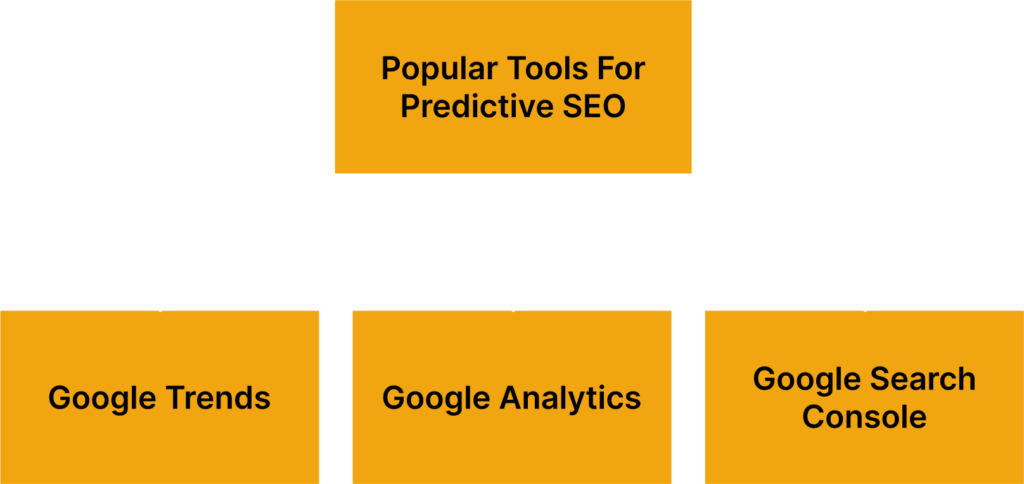
Google Trends
Google Trends can give you real-time insights into the users’ interests. With Google Trends, you can analyze search trends, compare search terms, predict regional search behavior, and monitor competitor interest.
Google Analytics
With Google Analytics, you can get insights into user demographics, track user flow, and measure content engagements and conversions. This information will help you identify where the most valuable traffic originates so you can focus your SEO efforts there for better ROI.
Google Search Console
This valuable tool provides useful information about your site’s performance in search results. Specifically, Google Search Console can help you discover queries that bring searchers to your site, track whether important pages on your site are indexed, and analyze underperforming pages, meta titles, and descriptions.
Predictive SEO for Your Business Growth
AI-powered predictive SEO can help you stay ahead of your competitors and achieve growth. By understanding user behavior, anticipating changes in search engine algorithms, and tracking competitor strategies, you can make real-time adjustments to your content and SEO strategies to remain relevant and visible to your audience.
But tools alone won’t help you achieve the results you want from your SEO efforts. That’s why you should partner with a reputable SEO agency that knows the ins and outs of creating and implementing a successful SEO strategy. If you need help creating an effective SEO and content strategy that gives results, AlchemyLeads can help. Contact us below, and we’ll get back to you.
Suggested

AI Reputation Management: What LLMs Say About Our Brand, and What We Do About It
Our real AI sentiment data: what ChatGPT, Perplexity and Google AI Overviews get right and wrong about AlchemyLeads, and how we manage LLM reputation.
October 13, 2026

The Dark Funnel: Why Direct Traffic Spikes When AI Search Visibility Grows
Direct traffic doubled and nobody can explain it? That is the dark funnel. Why AI search hides attribution, how to rule out other causes, and the client data that shows what it is worth.
October 13, 2026

Industrial Marketing for the Builders: Why We Bet on Hard Tech
Why AlchemyLeads put industrial and hard tech companies at the center of its work in 2023, what reindustrialization changes, and who we’re built for now.
October 12, 2026

Our Ahrefs Health Score Went From 74 to 96. Here’s What Our AI SEO Agent Found.
Seven problems our AI SEO agent found on our own site, from leads GA4 never recorded to 195 pages linking through redirects, and how we fixed them.
October 8, 2026

How Our AI SEO Agent Cleared 1,186 Schema Errors in One Day
How our AI SEO agent and team took a Shopify store from 1,186 structured data errors, 12 404s and 155 broken links to zero in one day.
October 8, 2026
Contact us
We value your privacy and won't share your email with others.
We'll only contact you with curated content.
