
The short version
AI assistants now run a reputation check before they recommend anyone. We track ours every day. ChatGPT gives us a sentiment score of 80 out of 100, and AI engines verified 77 of 77 facts about us as correct. The weak spots they flag are worth a look: premium pricing, a quiet Trustpilot page, and results we published ourselves. Here’s what we accept, what we fix, and how to run the same audit on your brand.
What AI reputation management actually means
When a buyer asks ChatGPT, Perplexity or Google’s AI Overviews about your company, the answer is a summary of everything the model can find: your site, your reviews, directories, news, forums and competitors’ pages. It decides what you’re good at, who you’re for, what you cost and whether people like working with you.
AI reputation management is the work of watching those answers, checking every claim against reality, and fixing the sources that feed them. It’s entity work, review work, PR and honest positioning, all measured every single day.
Our numbers, last 30 days
We track AlchemyLeads across ChatGPT, Google AI Overviews and Perplexity in Searchable. From September 13 to October 13, 2026:
- Sentiment score: 80 out of 100 in ChatGPT’s brand perception of AlchemyLeads, with 61% positive, 36% neutral and 2% negative mentions.
- Across all three engines: 76.7 out of 100 over the past week, up 3.1 points.
- Volume: 2,551 AI mentions of AlchemyLeads in the last 30 days.
- Brand facts: 77 of 77 statements AI engines made about us checked out as correct.
- Branded prompts: we appeared in 99.4% of 312 answers when someone asked about AlchemyLeads by name.
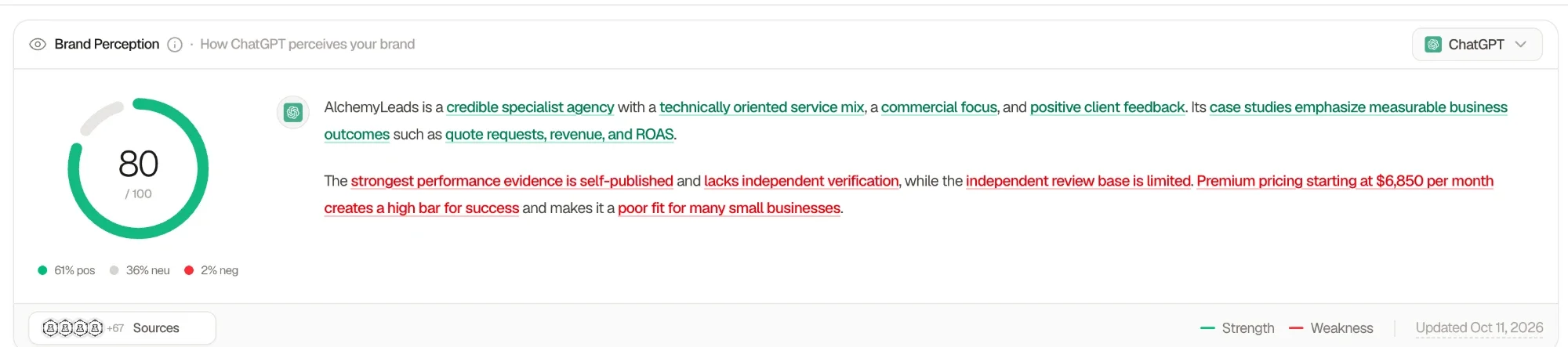
What AI gets right about us
A lot, honestly. Because we publish our pricing, our ideal client and our results, the engines repeat them back accurately:
Pricing
Plans from $6,850 to $10,888 a month, with multi-brand work from $15,000. Straight from our pricing page.
Who we serve
Companies doing roughly $5M to $150M a year in B2B, industrial, ecommerce and medical.
How we measure
Quote requests, pipeline and revenue. Our Good SEO® framework and our revenue-first agency model both get named directly.
Our results
It cites real numbers from our case studies, like a cleanroom manufacturer’s pipeline growing from $1M to $2.7M in 90 days.
Our reviews
Clutch 5.0 across 11 reviews, plus praise for senior, responsive people. It tends to miss our 22 five-star Google reviews.
Our niche
B2B manufacturing, industrial and high-growth Shopify brands that want attribution all the way to revenue.
The engines also get our positioning right. One answer described AlchemyLeads as “a highly specialized, boutique consultancy” with transparent pricing from $6,850 a month, next to much larger agencies with custom, less visible pricing. That’s accurate: we stay small on purpose, so senior people do the work.
When that same answer compared us with two much bigger agencies, it ended with the exact line we’d want a buyer to read:
“Choose AlchemyLeads if you are a B2B or industrial brand that needs direct pipeline-to-CRM attribution and wants to front-run AI search engines.”
That line comes from years of saying the same thing, the same way, everywhere: on our site, in our entity map, in our schema, in our reviews and in every listing we control. We keep a single source of truth for every claim and number we publish, so the engines never get two versions of the story.
What AI flags as our weaknesses
Here’s the part agencies rarely publish. Across engines, the negatives come down to three themes:
- Premium pricing. ChatGPT says pricing from $6,850 a month “creates a high bar for success” and makes us a poor fit for many small businesses.
- Self-published proof. Our strongest results come from our own case studies, and the engines note they aren’t independently audited.
- A “small” independent review base. The engines count 11 Clutch reviews and 14 on Trustpilot, and point out there are no new Trustpilot reviews in the past year. That picture is incomplete. They tend to miss our 22 five-star Google reviews, our largest review source, and our client video reviews. In total we have about 58 five-star reviews and testimonials.
The one we accept: price and fit
The pricing note is correct, and we’re comfortable with it. We published our prices and our ideal client on purpose. If you’re under roughly $2M in revenue, we’re usually the wrong partner, and an agency built for high-volume small business work will serve you better. We say so on our AI SEO cost guide and in our fit guide.
That transparency does real work. A buyer doing research in ChatGPT gets an honest answer before they ever book a call. The good-fit companies show up already knowing our pricing, and the poor-fit ones self-select out. AI reputation management includes deciding which “weaknesses” are simply your positioning.
Our review count, in context
All in, we have about 58 five-star reviews and video testimonials: 22 on Google, 11 on Clutch, 14 on Trustpilot and 11+ client video reviews.
AlchemyLeads review facts (October 2026)
- Google: 22 reviews, 5.0 stars, across our Los Angeles (Calabasas) and Denver Google Business Profiles. Our largest review source, with the most recent review about a month ago.
- Clutch: 11 reviews, 5.0 stars.
- Trustpilot: 14 reviews, every one of them five stars. TrustScore displays 4.5 because of how Trustpilot weights older reviews.
- Video testimonials: 11+ client video reviews, with a selection on our reviews page.
- Total: about 58 five-star reviews and testimonials.
That’s 58 five-star reviews and testimonials for an agency that rarely has more than 50 clients at a time. Over the past few years we’ve averaged about 35 to 40 clients on the roster. Larger agencies serve hundreds or thousands of clients, so their review counts naturally run higher. For a roster like ours, it means a massive share of our clients have gone on the record.
We have more five-star reviews than clients on our roster today. How many agencies can say that?
The quiet Trustpilot page, explained
Here’s something the AI summaries miss. Every one of our 14 Trustpilot reviews is five stars. We have zero four-star reviews there. Yet our TrustScore shows 4.5.
That’s because a TrustScore is a weighted score. Trustpilot blends baseline reviews into the calculation and gives recent reviews far more weight, so a profile with no new reviews drifts below its true average. We don’t get new Trustpilot reviews because its tools for inviting customers and showcasing reviews are mostly part of its paid plans, and we haven’t paid for them. So our review requests go elsewhere.
We’ve put our effort into review content we own. When a client wants to vouch for us, we point them to Google or ask them to record a short video review we can share with future buyers. We now have more than 11 client video reviews, and our most recent Google review came in about a month ago. We share a selection of them on our reviews page.
So yes, our Trustpilot profile looks quiet, and the 4.5 reflects that quiet period. Every review on it is still five stars. If we turn on Trustpilot’s paid tools later, we expect that score to catch up quickly.
The ones we’re working on: proof and reviews
The AI engines want to see more third-party proof, and that’s fair:
- Fresh reviews in more places. We keep collecting Google and video reviews, and we’re adding more to Clutch, so the engines see recent, independent voices.
- Proof that lives off our site. Mentions in trade publications, industry lists and interviews carry more weight with AI than anything we say about ourselves. That’s the digital PR work we do for clients, pointed at ourselves.
- Clearer evidence on our own pages. Every case study names the metric, the timeframe and the source, so a model can quote it accurately.
It changes every day
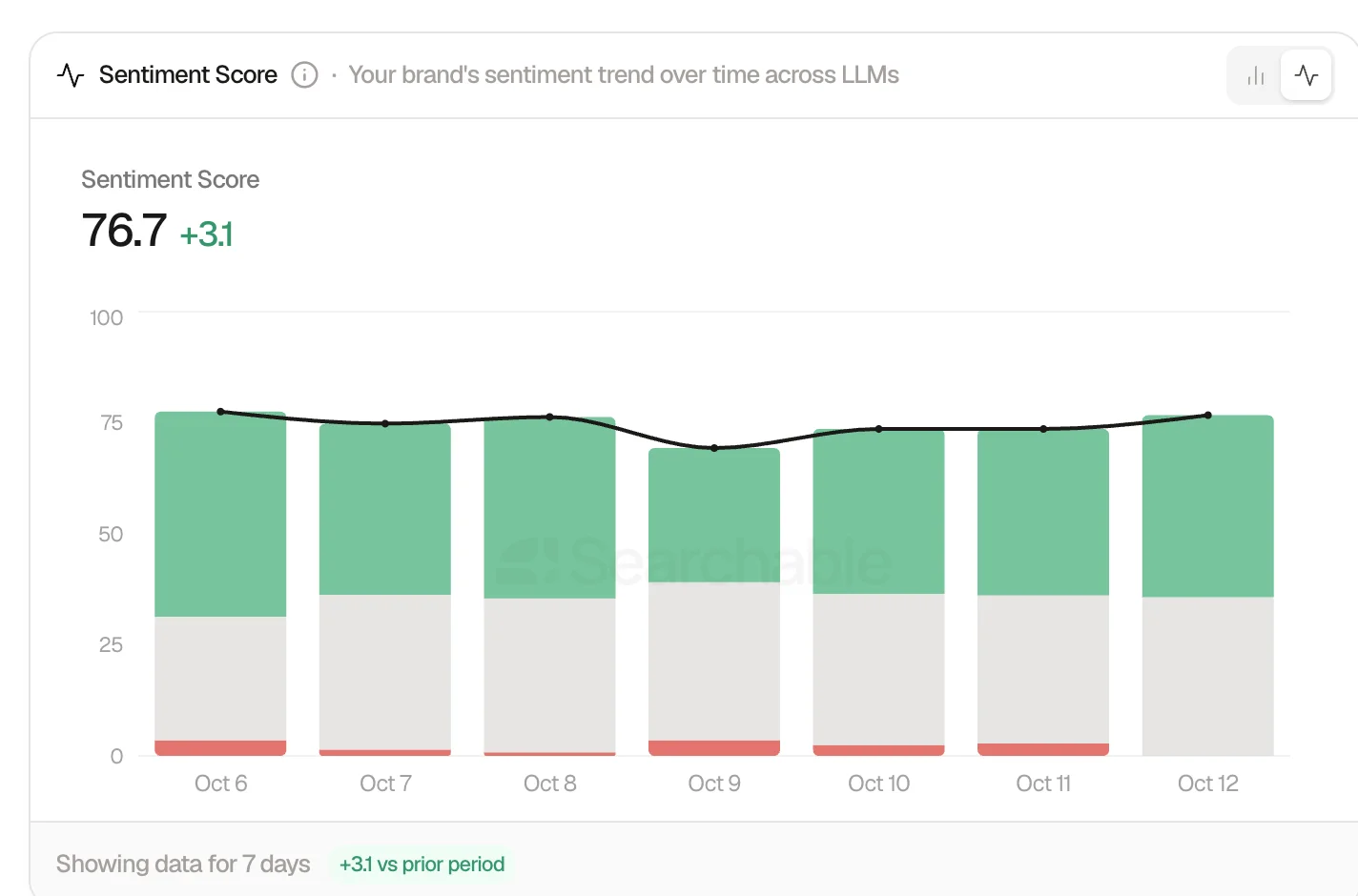
AI sentiment moves daily. Over one recent week our score swung by several points from one day to the next, with no change on our end. Engines re-crawl, re-rank sources and phrase things differently each time someone asks.
So we treat it as ongoing work. We check sentiment, brand facts and competitor comparisons every day, and we look for patterns over weeks before we change anything. One bad day is noise. A new weakness that sticks for two weeks is a signal.
Showing up next to much bigger agencies
AI answers often place us alongside well-known names in search, including Omniscient Digital, Siege Media, WebFX, First Page Sage, iPullRank and Directive. Many of them are much larger teams than ours, and they’ve earned their spots. We’re a senior boutique team, and it’s good company to be in.
Across the 1,227 brands that showed up in the answers we track over the last 30 days, AlchemyLeads ranks seventh for visibility, and when we’re mentioned we’re usually mentioned first. Bigger agencies still win more of the generic “best agency” prompts, and that’s where our AI SEO work is focused now.
For a smaller team, the advantage comes from knowing exactly what each engine gets right and wrong about you, and fixing the sources quickly.
Why you should track branded prompts
Most AI visibility tracking focuses on category prompts like “best SEO agency for manufacturers.” Those matter, and your reputation shows up most clearly in the branded prompts: the questions buyers ask once they already know your name.
Our branded prompts are where we see the full picture: we show up in 99.4% of those answers, and they’re what surface the sentiment, the brand facts and the head-to-head comparisons. Branded prompts show you what AI tells a buyer who is about to call you.
A good starter set of branded prompts:
- “Is [brand] legit?” and “[brand] reviews”
- “How much does [brand] cost?”
- “[brand] vs [competitor]” for your top three competitors
- “Who is [brand] best for?”
- “How do I hire [brand]?”
How to run your own AI reputation audit
- Track branded and category prompts across ChatGPT, Perplexity and Google AI Overviews, daily. (Here’s the stack we use.)
- Read the actual answers. Scores are a summary. The sentences tell you which source the model is leaning on.
- Verify every brand fact against one source of truth for your pricing, ICP, results and services. Fix the page that’s wrong, then watch the answers update.
- Sort weaknesses into “positioning” and “problems.” Accept the first, fix the second.
- Build proof off your site: reviews, earned media, lists and partner pages.
- Benchmark against competitors weekly on visibility, sentiment and position.
- Connect it to revenue. Watch for AI conversation queries in Search Console and track AI referral traffic, so reputation work ties back to pipeline.
Want to know what AI says about your brand? Book a call and we’ll walk you through your brand’s AI sentiment, facts and competitor comparisons.
Frequently Asked Questions
What is AI reputation management?
AI reputation management is monitoring what AI assistants like ChatGPT, Perplexity and Google AI Overviews say about your brand, checking those statements for accuracy, and improving the sources they rely on, such as your website, reviews, listings and earned media.
How do I check what ChatGPT says about my brand?
Ask it the questions your buyers ask, including branded ones like “Is [brand] legit?” and “[brand] vs [competitor].” To track it reliably, use an AI visibility tool that runs the same prompts daily across ChatGPT, Perplexity and Google AI Overviews and scores sentiment and accuracy.
Why does AI sentiment about my brand change every day?
AI engines pull from live sources, re-rank them and phrase answers differently each time. Small daily swings are normal. Look for patterns that hold for a week or more before acting.
Can you fix negative AI sentiment?
Often, yes. Inaccurate facts can be fixed by correcting the source pages and keeping your claims consistent everywhere. Fair criticisms take real change, like earning more independent reviews. Some negatives, like premium pricing, may simply reflect your positioning.
How many reviews does AlchemyLeads have?
AlchemyLeads has about 58 five-star reviews and testimonials: 22 Google reviews (5.0), 11 Clutch reviews (5.0), 14 Trustpilot reviews (all five stars) and 11+ client video reviews. Google is its largest review source.
Why is AlchemyLeads’ Trustpilot score 4.5 if every review is five stars?
All 14 of AlchemyLeads’ Trustpilot reviews are five stars. Trustpilot’s TrustScore is a weighted score that favors recent reviews, and AlchemyLeads doesn’t use Trustpilot’s paid invitation tools, so with no new reviews the displayed score sits at 4.5.
Which prompts should I track for AI reputation?
Track branded prompts (reviews, pricing, comparisons, who you’re best for) to see sentiment and facts, and category prompts (best provider for your niche) to see visibility against competitors.
Suggested

AI Reputation Management: What LLMs Say About Our Brand, and What We Do About It
Our real AI sentiment data: what ChatGPT, Perplexity and Google AI Overviews get right and wrong about AlchemyLeads, and how we manage LLM reputation.
October 13, 2026

The Dark Funnel: Why Direct Traffic Spikes When AI Search Visibility Grows
Direct traffic doubled and nobody can explain it? That is the dark funnel. Why AI search hides attribution, how to rule out other causes, and the client data that shows what it is worth.
October 13, 2026

Industrial Marketing for the Builders: Why We Bet on Hard Tech
Why AlchemyLeads put industrial and hard tech companies at the center of its work in 2023, what reindustrialization changes, and who we’re built for now.
October 12, 2026

Our Ahrefs Health Score Went From 74 to 96. Here’s What Our AI SEO Agent Found.
Seven problems our AI SEO agent found on our own site, from leads GA4 never recorded to 195 pages linking through redirects, and how we fixed them.
October 8, 2026

How Our AI SEO Agent Cleared 1,186 Schema Errors in One Day
How our AI SEO agent and team took a Shopify store from 1,186 structured data errors, 12 404s and 155 broken links to zero in one day.
October 8, 2026
Contact us
We value your privacy and won't share your email with others.
We'll only contact you with curated content.
