
TL;DR
To get your company cited by ChatGPT, Perplexity and Google AI Mode, do five things in order: let each engine’s search crawler reach your site (OAI-SearchBot, PerplexityBot and Googlebot), get your key pages indexed, publish the clearest and most specific answer to the questions your buyers ask, earn genuine mentions on the pages these engines already cite, and track citations engine by engine. Most of the work is shared across all three. The differences come down to which crawler you allow and where each engine’s index comes from.
Every mechanic below comes from what Google, OpenAI and Perplexity publish in their own documentation, checked on October 26, 2026. The lessons come from the AI search work we run for industrial, manufacturing, aerospace, med-tech and high-AOV ecommerce companies. For a deeper look at a single engine, see our guides to getting cited by ChatGPT and getting recommended by Perplexity, or the full AI search platforms hub.
How do ChatGPT, Perplexity and Google AI Mode choose which sources to cite?
All three search the web at answer time, read a short list of pages and cite the ones that answer the question best. Google’s AI Mode and AI Overviews draw on Google’s own Search index and ranking systems. ChatGPT and Perplexity each run a dedicated search crawler: OAI-SearchBot and PerplexityBot.
Google is the most explicit about this. Its guide to optimizing for generative AI features says a page “must be indexed and eligible to be shown in Google Search” with a snippet, and that AI Overviews and AI Mode use the same core ranking and quality systems as regular Search. Both features can also use query fan-out: they run several related searches across subtopics and cite pages found along the way. We explain the retrieval side in how AI search works and query fan-out for GEO.
| Engine | How it finds sources | Crawler to allow | Where its index comes from | What it cited for this question |
|---|---|---|---|---|
| ChatGPT | Searches the web when a question needs current information, then cites the pages it used | OAI-SearchBot (search). ChatGPT-User fetches pages a person asks about. GPTBot is for training only. |
OpenAI’s own crawl by OAI-SearchBot | Official documentation: OpenAI’s help center, Google Search Central and Perplexity’s crawler docs |
| Perplexity | Runs a live search for each question and writes an answer with numbered citations | PerplexityBot (search). Perplexity-User fetches pages a person asks about. |
Perplexity’s own crawl by PerplexityBot | The widest spread: ten domains, including agency blogs, LinkedIn articles, ZDNet and Search Engine Land |
| Google AI Mode and AI Overviews | Uses Google Search ranking, grounding and query fan-out across subtopics | Googlebot. Google-Extended has no effect on Search AI features. |
The Google Search index | Google’s own optimization guide, a vendor GEO guide, a Medium post and a YouTube video |
Sources: OpenAI crawlers overview, Perplexity crawlers, Google AI features and your website, all checked October 26, 2026. Last column: the domains each engine cited when we asked “How do I get my company cited by ChatGPT, Perplexity and Google AI Mode?” in an AI visibility run on October 23, 2026.
That last column is worth a second look. On the same question, ChatGPT leaned on primary documentation, Perplexity spread its citations across ten publishers, and Google AI Mode mixed its own guide with independent content and video. Each engine rewards a slightly different mix of owned pages and third-party coverage, which is why the plan below covers both. Gemini, Claude and Microsoft Copilot follow the same pattern with their own crawlers and indexes; see our guides to Gemini, Claude and Microsoft Copilot.
The five-step plan to get cited across AI search engines
Work through these in order. A page that a crawler can’t reach can’t be indexed, and a page outside the index can’t be cited, however good it is.
- Access. Let OAI-SearchBot, PerplexityBot and Googlebot through robots.txt, your CDN and your firewall.
- Index. Get your key pages into Google’s index and the sources ChatGPT and Perplexity search, with snippets allowed.
- Be the best answer. Publish specific, answer-first pages that cover the questions and sub-questions buyers ask.
- Get mentioned where AI already looks. Earn genuine mentions on the lists, directories, reviews and publications that engines cite for your prompts.
- Measure. Track citations, crawler visits and AI referrals per engine, then tie them to pipeline.
Step 1: How do I let AI search crawlers reach my site?
Allow the three search crawlers by name in robots.txt, then confirm your CDN and firewall let them through. The search crawlers are OAI-SearchBot for ChatGPT, PerplexityBot for Perplexity and Googlebot for Google AI Mode and AI Overviews.
OpenAI is direct about the stakes: sites that opt out of OAI-SearchBot “will not be shown in ChatGPT search answers”, per its crawler documentation, though a bare navigational link can still appear. Perplexity says the same about PerplexityBot, and describes it as a search crawler kept separate from AI model training. A minimal robots.txt that keeps you visible looks like this:
User-agent: OAI-SearchBot
Allow: /

User-agent: PerplexityBot
Allow: /

User-agent: Googlebot
Allow: /

Sitemap: https://www.example.com/sitemap.xml
Training crawlers are a separate decision. GPTBot collects content that may train OpenAI’s models, and Google-Extended governs training and grounding in some of Google’s other AI systems. Google states that Google-Extended has no effect on Search, AI Overviews or AI Mode, and OpenAI treats GPTBot and OAI-SearchBot as independent settings. You can block training and stay eligible for citations in all three engines.
Two user-triggered fetchers, ChatGPT-User and Perplexity-User, visit a page when someone asks about it. Both companies say robots.txt rules may not apply to these visits, since a person requested them. OpenAI adds that ChatGPT-User plays no part in deciding search inclusion.
The most common blocker sits in your CDN
A clean robots.txt is only half of access. In the AI visibility audits we run, one of the most common reasons a site goes missing from AI answers is a firewall or bot-management rule at the CDN that challenges or blocks verified AI crawlers. The robots.txt file looks perfect, the crawler gets a 403 or a challenge page, and nothing in the CMS shows the problem. One-click “block AI bots” settings and broad bot-fight rules are the usual cause.
Perplexity documents the fix for Cloudflare: a custom rule that allows requests where the user agent contains PerplexityBot or Perplexity-User and the source IP matches its published ranges. OpenAI and Perplexity both publish IP lists as JSON files (for example, openai.com/searchbot.json and perplexity.com/perplexitybot.json), so you can allow the real crawlers and still stop impostors that spoof the user agent. Both say robots.txt changes take about 24 hours to apply. We walk through the Cloudflare side in Cloudflare and AI search, and you can confirm what crawlers actually receive with log file analysis for AI search.
Last, keep the answer in the page itself. Google processes JavaScript as long as it is accessible, and Google’s guide recommends standard JavaScript SEO practice for script-heavy sites. Our rule of thumb for the other engines is to put key facts in the initial HTML, outside PDFs, forms and embeds. Our own test of this is in gated content and AI search.
Step 2: How do I get my pages into each engine’s index?
Get indexed in Google with snippets allowed, keep your sitemap clean so OAI-SearchBot and PerplexityBot find new pages fast, and make sure the search providers ChatGPT draws on can see you too. Each engine can only cite what sits in the index it searches.
- Google AI Mode and AI Overviews. Google’s AI features documentation says that beyond being indexed and snippet-eligible, “There are no additional technical requirements.” Check key URLs with URL Inspection in Google Search Console. Preview controls such as
nosnippet,data-nosnippet,max-snippetandnoindexlimit what Google can show, so audit them on your money pages. - ChatGPT. OpenAI’s crawler documentation ties ChatGPT search eligibility to OAI-SearchBot access and recommends allowing both the bot and its published IP ranges. Robots.txt changes take about 24 hours to apply. Our ChatGPT guide goes deeper on how ChatGPT finds pages.
- Perplexity. PerplexityBot builds Perplexity’s index of linkable pages. Allowing it, plus a current XML sitemap and strong internal links, is the whole job here.
Optional files help some systems and skip others. Google says it ignores llms.txt and similar AI text files for Search, while noting you may keep them for other services. We keep one, along with an entity map, and treat both as extras on top of a crawlable, indexed site.
Step 3: How do I become the best answer for AI to cite?
Publish the most specific, quotable answer to each question your buyers ask, and cover the sub-questions an engine generates when it fans out. AI engines cite passages, so a page wins when one short section can stand on its own as the answer.
Google’s advice is consistent with its classic guidance. John Mueller’s post on succeeding in AI search puts it plainly: “Meeting the technical requirements covers you for search generally, including AI formats.” From there, quality decides. Here is what we build into every page meant to earn citations:
- Answer first. The first one or two sentences under each heading answer that heading’s question. We call the pattern the inverted nabla pyramid.
- Specific facts. Numbers, ranges, timeframes, named methods, tables and dates. A sentence like “lead time is 6 to 8 weeks for runs under 500 units” gets quoted, and “fast turnaround” gets skipped.
- Fan-out coverage. A buyer’s question splits into sub-queries about cost, alternatives, fit and risk. Cover those on the page or link to pages that do. The AI Query Classifier finds the long, conversational queries already showing up in your Search Console data, and we run this analysis every quarter for our AI SEO clients.
- Consistent entity facts. Your name, location, category, products and proof should read the same on your site, your profiles and third-party listings. See entity-based SEO for AI search.
- First-hand evidence. Google asks for unique, non-commodity content with expert perspective. Your own data, photos, specs and case results are things competitors can’t copy.
Depth beats volume. For one industrial ground monitoring manufacturer, we earned 4,500 AI citations across just 18 pages in six months. Google also warns against mass-producing pages for query variations, which can fall under its scaled content abuse policy, so a small set of excellent pages is both safer and more effective.
Step 4: How do I get mentioned on the pages AI already cites?
Find the third-party pages each engine cites for your target prompts, then earn a genuine place on them. When an engine trusts a list, directory, review site or trade publication, being named there puts you inside the answer even on prompts where your own site goes uncited.
Start with the evidence. Run your buyer prompts in each engine (or a tracker), export the cited URLs and group them by type: “best X” lists, directories, review platforms, Reddit and LinkedIn threads, YouTube videos and industry press. For the question this post answers, Perplexity alone cited ten different domains. Each of those pages is a candidate for a correction, an inclusion request, an expert quote or a guest contribution. Our guide to fetched, cited and mentioned content explains why a mention can matter as much as a link.
Keep it authentic. Google’s guide lists seeking inauthentic brand mentions across the web among the tactics to avoid, and buyers can spot a planted review. The mentions that last come from real customers, real coverage and real expertise, which is the focus of our digital PR work.
Owned pages and third-party mentions compound. For a custom contract-furniture brand, AI answers went from citing 0 to 20 of the brand’s own pages, with 794 AI citations of its website.
September 17 to October 9, 2026 vs. the previous period. Source: Searchable AI visibility tracking.
Step 5: How do I measure AI citations engine by engine?
Track three things per engine: whether you are cited for your target prompts, whether its crawlers reach your pages, and what the resulting visits turn into. One blended “AI visibility” score hides the engine where you are missing.
Citations
Track a fixed set of buyer prompts across engines in Searchable, Scrunch or GeoToolbox. Our free AI Visibility Checker gives a quick first read.
Crawler access
Count OAI-SearchBot, PerplexityBot, Googlebot and user-triggered fetches in your server or CDN logs, and watch for 403s and challenges.
Visits and pipeline
Segment AI referrals in GA4 or PostHog and follow them into your CRM. ChatGPT tags referral links with utm_source=chatgpt.com.
For Google, clicks from AI Mode and AI Overviews count toward overall search traffic in Search Console, and Google’s guide points to a Generative AI performance view for its AI features. Expect part of your AI-driven demand to land as direct traffic, since many buyers copy a name from an answer and type it in later. It is worth the effort: industry studies from Similarweb and Semrush show AI-referred visitors convert 2 to 5x better than classic organic visitors.
What can I skip when optimizing for AI search?
Skip tactics that the engines say they ignore or penalize. Google’s guide names several directly, and they apply well beyond Google.
Special AI markup
Google says structured data is optional for generative AI search and no special schema is needed. Keep schema that matches visible content for rich results.
Chunking and AI rewrites
Google handles multi-topic pages, so there is no need to split content into fragments or rewrite it in a special style for AI.
Pages for every variation
Hundreds of near-duplicate pages for long-tail phrasings risk Google’s scaled content abuse policy and dilute your best answer.
Google also cautions that third-party tools have no access to its internal AI systems, so treat any tool’s “AI ranking factor” claims with care and check them against the official documentation linked in this post.
Can an AI SEO agent make these changes on my website safely?
Yes, with human approval on anything that matters. An AI SEO agent is software that reads your search and analytics data, spots problems such as blocked crawlers or missing answers, and drafts or applies fixes. The safe version keeps a person in charge of every consequential change.
Our AI SEO agent works in Slack, reads Google Search Console and GA4, and drafts proposals. Content, plans and bigger changes need human approval, and safe fixes are undoable. It draws on more than 1,000 AI SEO skills we built and tested on our own sites and others, always under strict human supervision, and every rollout starts with a supervised trial period. Steps 1, 2 and 5 above, such as checking crawler access, finding indexing gaps and watching citations, are exactly the kind of repeatable checks it handles well.
Frequently Asked Questions
How long does it take to get cited by ChatGPT, Perplexity or Google AI Mode?
Access fixes apply fast: OpenAI and Perplexity both say robots.txt changes take about 24 hours. Citations take longer because pages must be crawled, indexed and judged the best answer. For the contract-furniture brand above, the period with 20 owned pages cited came about four months after kickoff. See how long AI SEO takes for typical timelines.
Does blocking GPTBot or Google-Extended remove my site from AI answers?
No. GPTBot and Google-Extended control model training. ChatGPT search depends on OAI-SearchBot, and Google AI Mode and AI Overviews depend on Googlebot and the Search index. You can block both training crawlers and remain eligible for citations, as long as the search crawlers stay allowed.
Do I need llms.txt or schema markup to get cited by Google AI Mode?
No. Google says Search ignores llms.txt and similar AI text files, and that structured data is optional for its generative AI features. Indexing, snippet eligibility and a strong answer matter far more. Other services may read llms.txt, so keeping one costs little.
Why is my site missing from Perplexity when robots.txt allows PerplexityBot?
The usual cause is a CDN or firewall rule that challenges the crawler before it reaches robots.txt. Check your logs for PerplexityBot requests with 403 or challenge responses, then add an allow rule that matches its user agent and its published IP ranges, as Perplexity’s documentation describes.
Can I pay to be cited by ChatGPT or Perplexity?
Citations inside the answer are earned. ChatGPT sells ads, and OpenAI says they are labeled and kept separate from answers. Being cited depends on crawler access, a strong page and credible mentions elsewhere.
Is AlchemyLeads a good fit for getting my company cited in AI search?
AlchemyLeads is a revenue-first AI search agency for industrial, manufacturing, aerospace, medical device and med-tech companies and high-AOV Shopify brands with $5M to $150M in annual revenue. We are selective and only take engagements with a strong probability of success, and 95% of clients who joined since 2020 stayed longer than 12 months (38 of 40). See our AI SEO and GEO services, results on our client reviews and case studies page, and plans on our pricing page.
Suggested
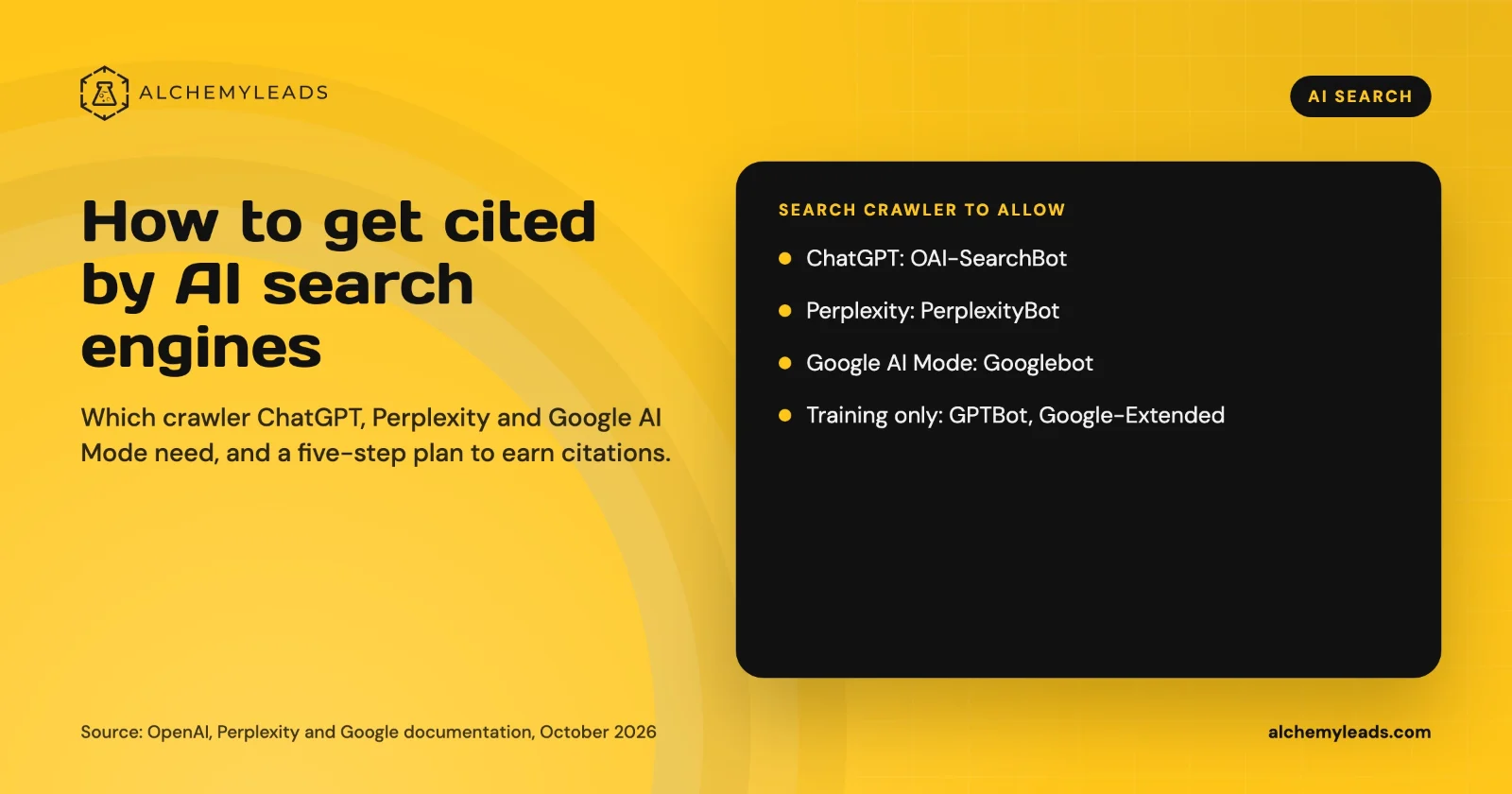
How to Get Cited by ChatGPT, Perplexity and Google AI Mode
How ChatGPT, Perplexity and Google AI Mode choose sources, which crawlers to allow, and a five-step plan to get your company cited, based on official docs.
October 26, 2026
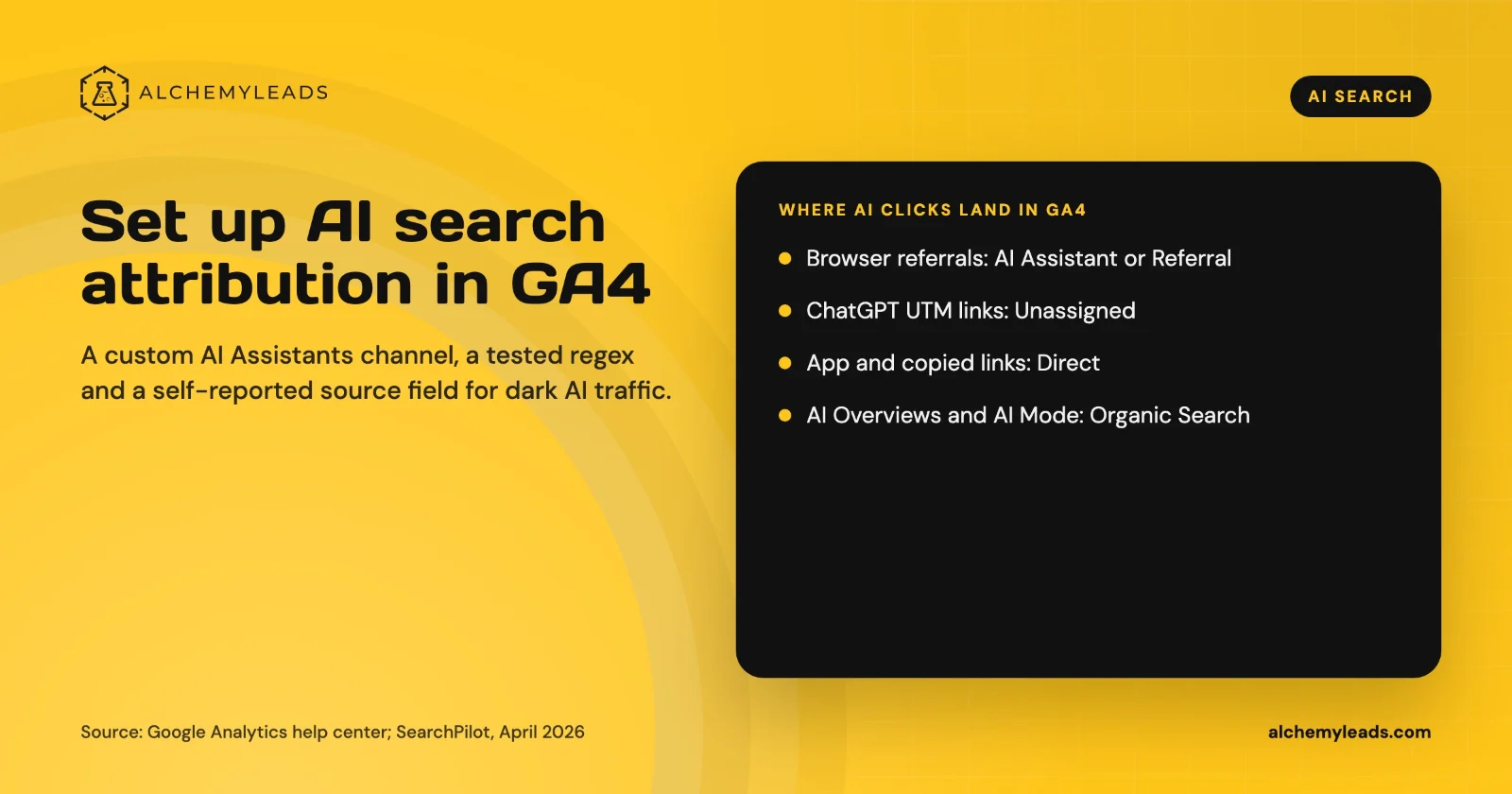
How to Set Up AI Search Attribution in GA4: A Step-by-Step Guide for 2026
Step-by-step GA4 setup for AI search attribution: an AI Assistants channel, a copy-paste regex, ChatGPT UTM fixes and a self-reported AI source field.
October 26, 2026
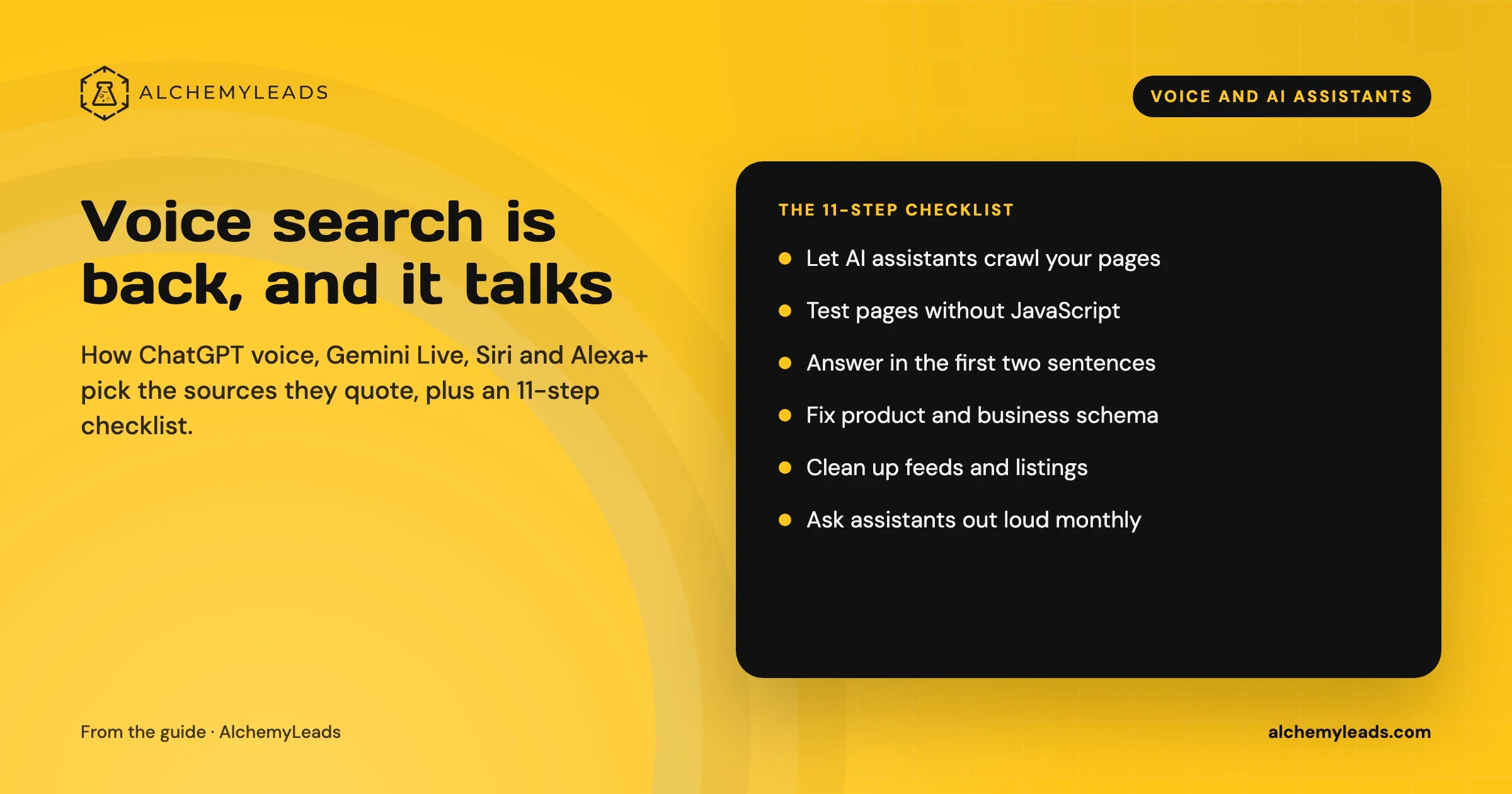
Voice Search in 2026: How AI Assistants Pick Their Sources
We first wrote about voice search in 2022, when the question was whether “Hey Siri” and “OK Google” would change how people shop. Four years later, voice is back in a bigger form. People now talk to ChatGPT, Gemini, Siri, Alexa+ and Copilot the way they talk to a knowledgeable friend, and those assistants answer by reading the web in
October 17, 2026
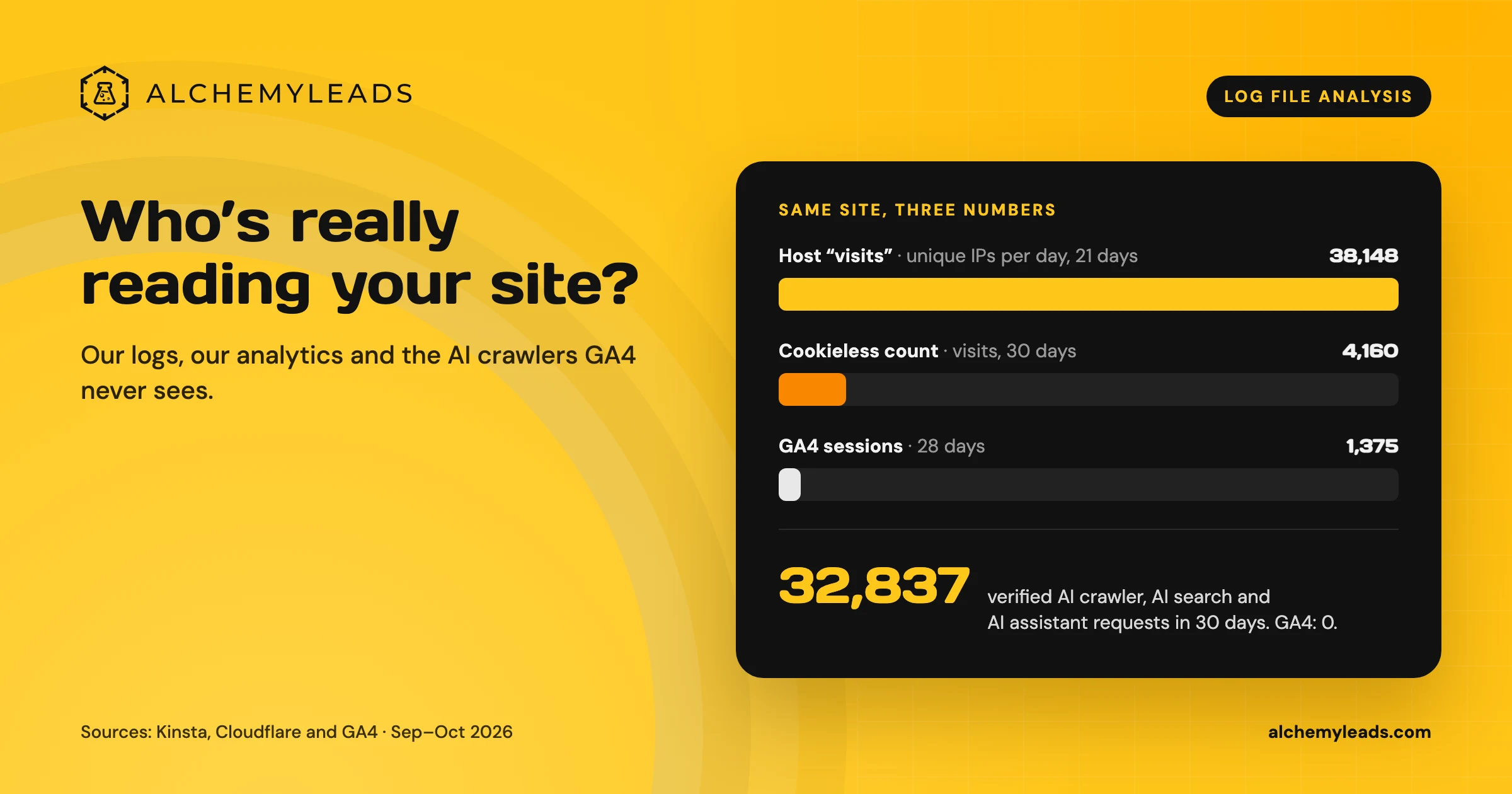
Log File Analysis for AI Search: Our Logs Showed 38,148 Visits. GA4 Showed 1,375.
Our host logged 38,148 visits. GA4 logged 1,375 sessions. We opened the server logs to see who was really there, and what AI crawlers read.
October 16, 2026
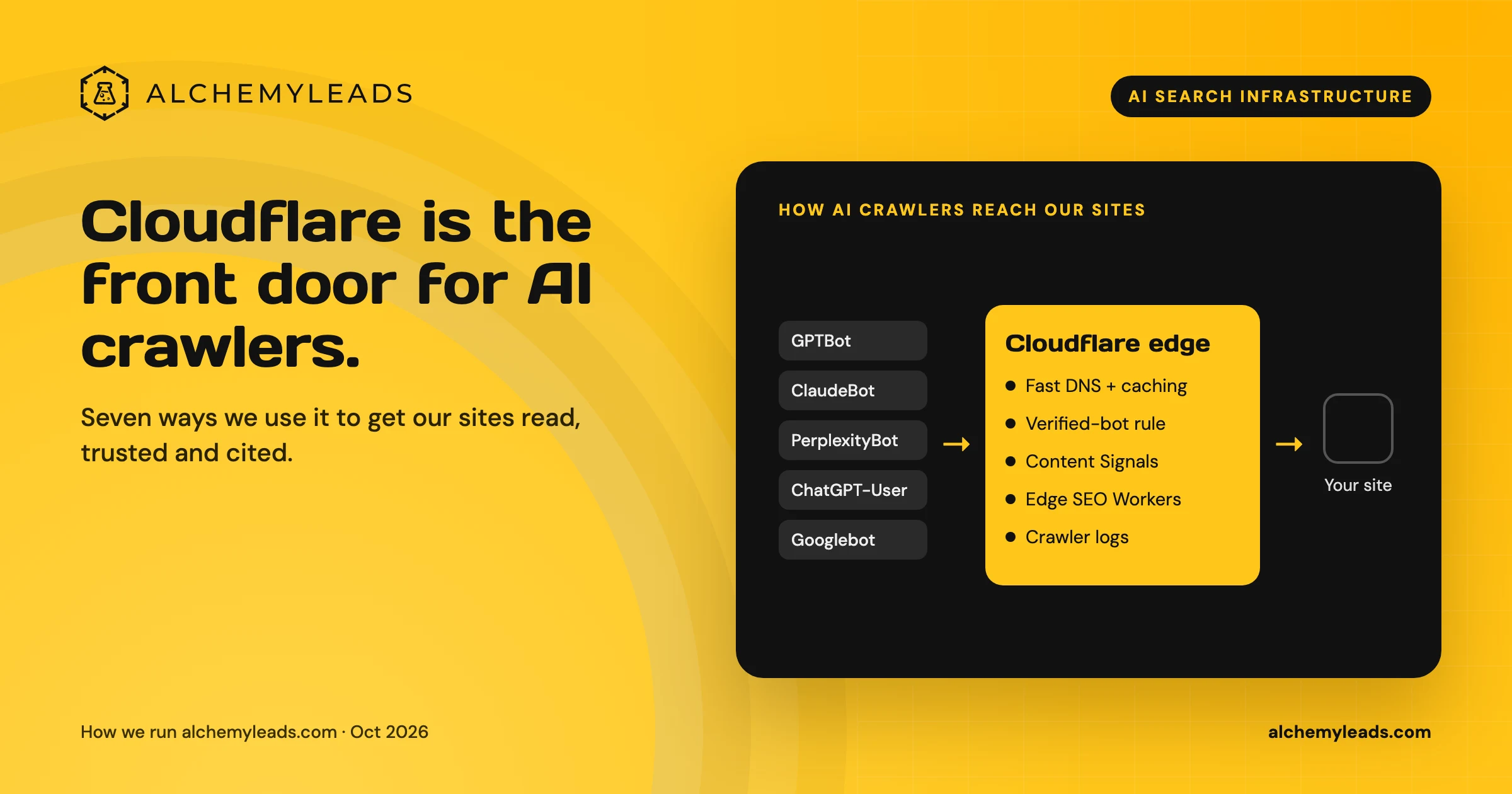
Why We Love Cloudflare for AI Search: 7 Ways We Use It for GEO and AEO
How we use Cloudflare DNS, bot rules, Content Signals and Workers to make our sites fast, crawlable and citable for ChatGPT, Claude and Perplexity.
October 16, 2026
Contact us
We value your privacy and won't share your email with others.
We'll only contact you with curated content.
