
Your AI search work is paying off. People are finding you in ChatGPT and Perplexity, your brand shows up in the answers, and demand feels warmer than it did last year. Then you open your analytics. The channel that grew is “Direct.” The report says AI sent you almost nothing.
That gap is not a traffic problem. It is an attribution problem. The customers are real. Your funnel just cannot see where they came from. Here is why that happens, what the numbers actually look like, and how to fix the measurement without guessing.
Why AI Search Breaks Your Funnel
Picture how a buyer really moves. They ask ChatGPT for the best tool in your category. Your brand comes up. They do not click the small source link. They open a new tab, type your name into Google, and land on your site. Last-click attribution sees a branded search or a direct visit and files the credit there. The AI answer that started the whole thing gets nothing.
It gets worse from there. When someone does click a link out of an AI tool, the referrer often gets stripped. People copy the URL and paste it into a browser, which drops the source. The mobile apps sandbox referral data on their own. So even the clicks that should show up as AI traffic land somewhere else.
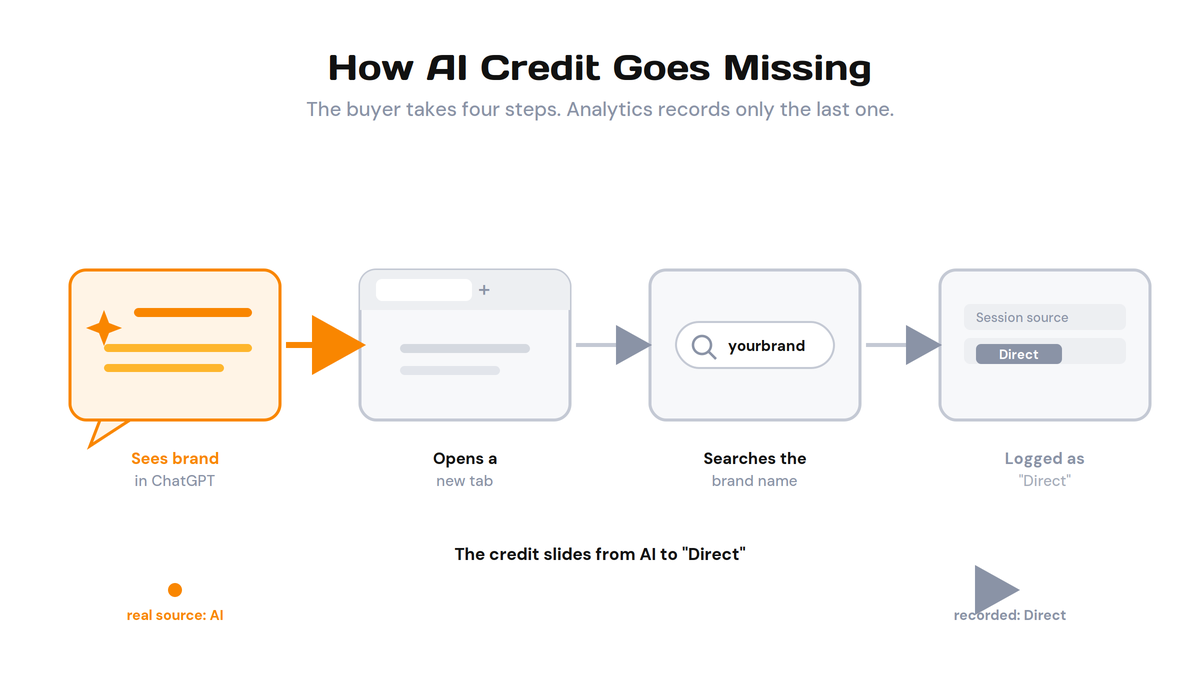
Run the test yourself. Ask ChatGPT to recommend a tool in your space, click through to one of the brands it names, and watch where you land. Open your own analytics in real time and the visit often reads as Direct, with no hint an assistant sent you. The trail is gone before the page finishes loading.
The result is a blind spot you can measure. One analysis found that 70.6% of AI-driven traffic shows up in GA4 as “Direct” rather than tied to its real source. Your fastest-growing channel is hiding inside the one bucket that tells you nothing.
The Gap, in Real Numbers
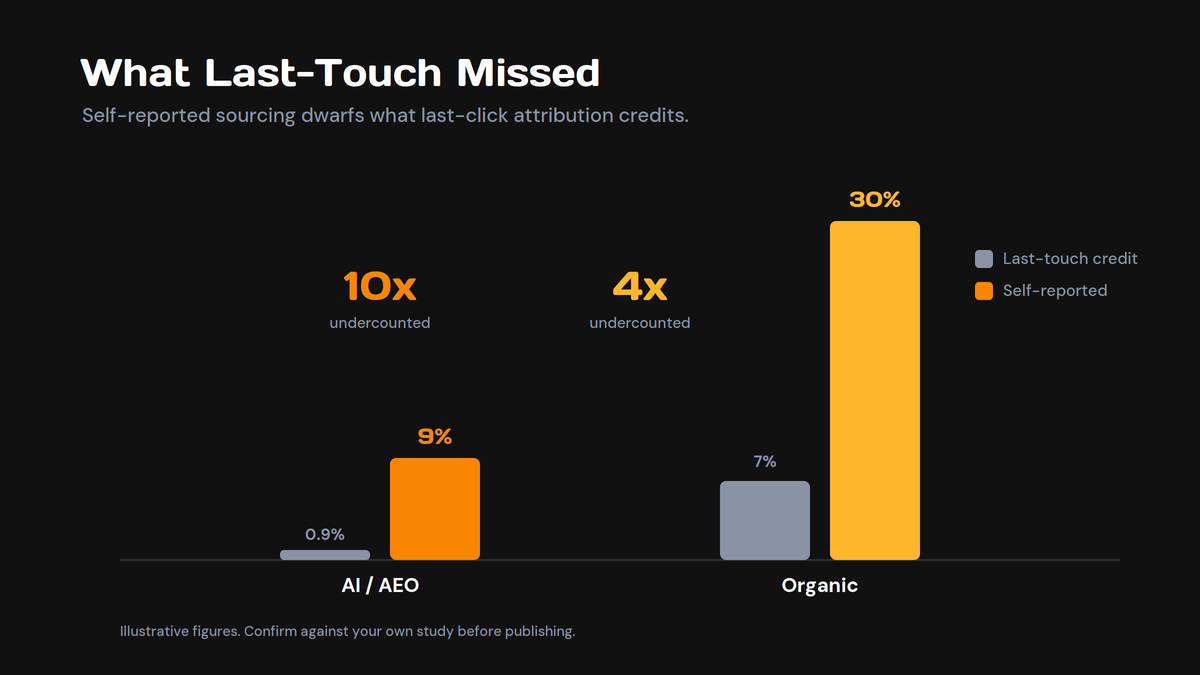
A case study on the automation tool n8n put a number on the blind spot, and it is bigger than most teams expect. The team compared two ways of measuring the same conversions: standard last-touch analytics, and a “How did you hear about us” survey filled in by buyers themselves.
| Channel | Last-Touch Said | Buyers Said | Gap |
| AI / AEO | 0.9% of conversions | 9% of conversions | 10x |
| Organic search | 7% of conversions | 30% of conversions | 4x |
Read the top row again. Last-touch gave AI credit for under 1% of conversions. The buyers themselves credited AI with 9%. That is a tenfold undercount of a channel you are spending real money to win.
The buyers were not confused. They remembered the AI answer that introduced them. The tracking simply had no way to record it, so the work looked like it was failing when it was working.
The organic row tells the same story in a quieter voice. Last-touch gave search 7% of conversions; buyers gave it 30%. Four times the credit, sitting unseen. When AI and organic get undercounted by multiples, the channels soaking up the credit are the last-touch ones, direct and branded search, the very visits that AI and SEO created upstream.
Why This Costs You More Than a Clean Report
A measurement gap sounds like a reporting nuisance. It is a budget risk. If finance looks at last-click and sees AI driving 0.9% of conversions, the AI program is first on the chopping block. You would defund the channel right as it starts to pay back.
The traffic you cannot see is some of your best. One study found that dark AI visitors converted at about 4.1 times the rate of other traffic. These are buyers who arrived pre-sold, already told by an assistant that you are a strong pick. Lose visibility into them and you lose the case for the work that produces them. That is the same logic behind treating AI search as real demand, which we covered in our piece on non-commodity content.
The Two-Layer Fix
You will never track AI search perfectly. You can close most of the gap with two layers working together: capture what the data can see, then ask buyers for what it cannot.
| Layer | What It Catches | How It Works |
| Detection | Clicks that keep their source | A GA4 rule that sorts AI referrers into their own channel |
| Self-report | Visits that lost their source | A post-purchase survey that asks the buyer directly |
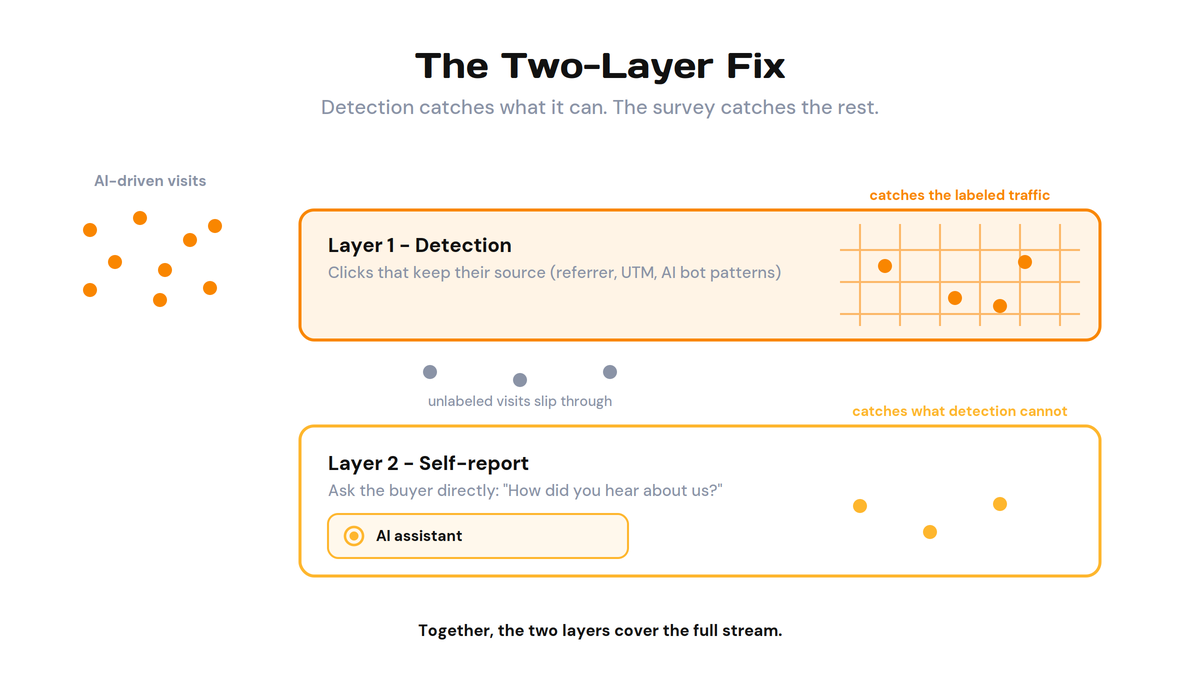
Neither layer is enough on its own. Detection misses every copy-paste and sandboxed app. Self-report misses the buyer who forgot. Run them together and the picture sharpens fast.
Layer One: Detect the AI Traffic You Can
Some AI clicks do keep their referrer. Catch those first. In GA4, build a custom channel group that sorts known AI sources into a bucket of their own. Match the referral domains for the major assistants, the ones like chatgpt.com, perplexity.ai, and the Google and Microsoft AI hosts.
Set it up in the admin area, under the channel group settings. Create a new group, add a channel called something like AI Search, and define it by referral source. List every assistant domain you can find, and revisit the list each quarter as new tools show up. The work takes an afternoon once and runs on its own after that.
Once those visits sit in their own channel, you stop losing them inside “Referral” or “Direct,” and you can watch the trend over time. This is plumbing the same way query fan-out is plumbing, the background mechanics most teams never look at. We broke that side down in our guide to query fan-out for GEO.
Detection has a ceiling. It only ever catches the clicks that survived with their source intact, which is the minority. That is why you need the second layer.
Layer Two: Just Ask
The strongest signal for AI search is the buyer’s own memory. A “How did you hear about us” survey captures the journeys your analytics threw away.
One detail decides whether this works: show the survey after the conversion, not before. A modal that interrupts a checkout or a signup costs you sales. A short question on the thank-you page, after the buyer has already converted, costs you nothing and still catches the answer fresh.
Keep the question plain and the options few:
How did you hear about us?
- A search engine like Google or Bing
- ChatGPT or another AI assistant
- A friend or coworker
- A podcast, video, or newsletter
- Somewhere else (tell us)
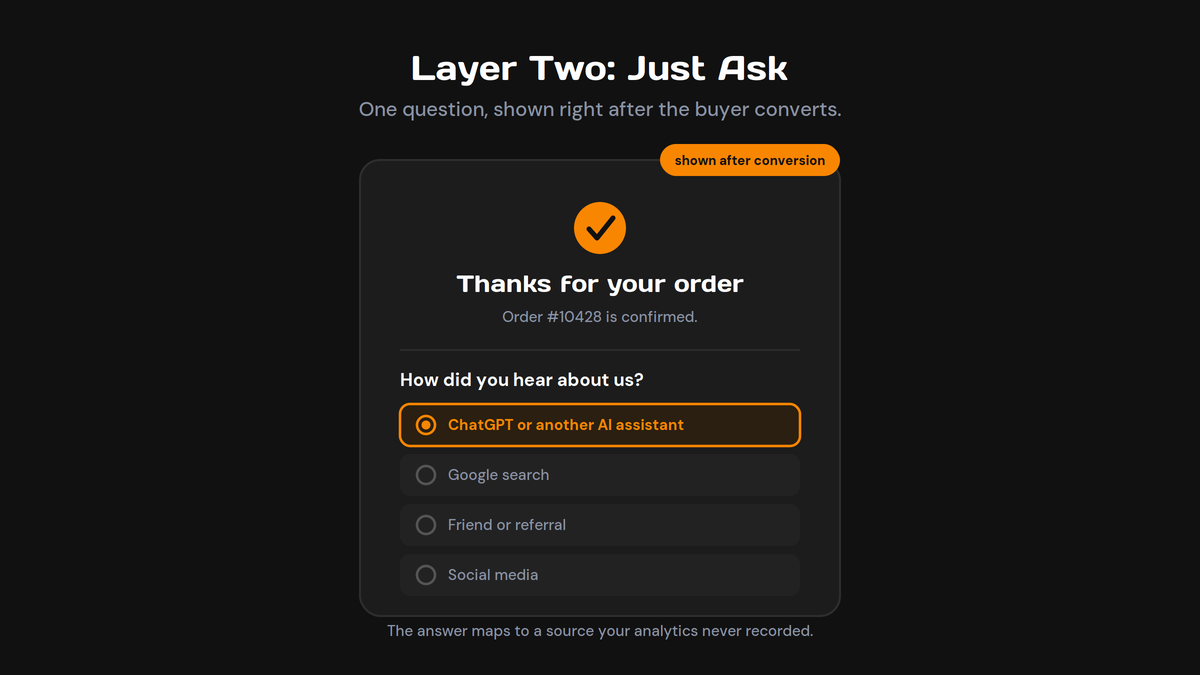
Pipe the answers into the same place you track conversions, so you can line them up against what last-click reported. The free-text option matters more than it looks. It catches the sources you forgot to list and the wording buyers use for themselves.
Keep it to one question for most sites. Every extra field cuts the share of buyers who finish it. If you want more, add a single optional follow-up that appears only when someone picks the AI option, asking which assistant they used. Store each answer against the order or signup it came from, so a real conversion sits behind every data point. Give it a few hundred responses before you trust the split, since small samples swing hard.
Tag the Links You Own
Detection and surveys cover the traffic you cannot control. There is a slice you can. Anywhere you place your own link inside content an AI might read, add tracking tags to it. Your directory listings, your profiles, the links in articles you publish, the citations you can influence.
A tagged link carries its source even after a copy and paste, so those visits land in the right channel instead of Direct. You will not tag every path a buyer takes, yet the ones you do tag become clean, countable proof. It is the one part of the AI funnel you get to label yourself, so label it.
Reconciling the Two Stories
Now you have two numbers for the same channel, and they will not match. That is the point. Treat last-click as your floor and the survey as your reality check, then size the truth somewhere between them.
If last-click says AI drove 1% and your survey says 9%, the honest read is that AI is materially undercounted, and the real figure sits closer to the survey. You do not need a perfect number to make the call. You need enough to stop defunding a channel that is pulling its weight.
Watch for double counting. A buyer who clicks an AI link and later fills in the survey can land in both layers. When you report, lead with the self-reported view for the big picture and use detection for the week-to-week trend. Two lenses, one funnel.
When you take this to leadership, show the two numbers and the distance between them. The gap is the story. A slide that says last-click sees 1% and buyers report 9% makes the case for the channel better than either figure alone. Update it monthly, so the trend drives the budget talk instead of a single snapshot.
The Honest Limits
Self-reported data is not clean truth. People misremember. Recency bias pushes them toward whatever touched them last, so the channel right before the purchase gets over-credited and the one that planted the seed gets shortchanged. Buyers travel through many touches too, and a single-answer survey flattens all of that into one pick.
So hold the survey numbers loosely. They point you in the right direction without claiming precision. A flawless model was never the goal here. The goal is to drag a hidden channel into the light so it stops looking like zero. A rough nine percent beats a precise, confident, wrong nine-tenths of a percent every time.
Start Where the Money Is
You do not need a new analytics stack to begin. Add the AI channel group in GA4 this week. Turn on a one-question survey on your thank-you page next week. Give it a month, then compare the two stories side by side. The gap you find is the size of the case you have been unable to make.
The brands that measure AI search early are the ones who keep funding it as competitors cut it blind. That is the heart of our AI SEO work: tie the work to revenue, then prove it.
Want help building the attribution layer for your funnel, so AI search stops hiding in your direct traffic? Book a call and we will set it up with you.
Suggested

Our Ahrefs Health Score Went From 74 to 96. Here’s What Our AI SEO Agent Found.
Seven problems our AI SEO agent found on our own site, from leads GA4 never recorded to 195 pages linking through redirects, and how we fixed them.
October 8, 2026

How Our AI SEO Agent Cleared 1,186 Schema Errors in One Day
How our AI SEO agent and team took a Shopify store from 1,186 structured data errors, 12 404s and 155 broken links to zero in one day.
October 8, 2026

How to Integrate HubSpot and Tripleseat: Lessons From 9 Builds
A step-by-step guide to connecting HubSpot and Tripleseat: forms, OAuth 2.0, field and stage mapping, multiple locations, documents and monitoring, with real lessons from nine production integrations.
October 4, 2026
Answer-First Content: The Inverted Pyramid (∇) for AI Search
The inverted pyramid (∇) puts the answer first and the detail after. Here is how answer-first writing serves busy buyers and AI systems that quote short passages, with examples, common mistakes, and a checklist.
October 3, 2026

Retrieve-for-Train explained: how Google Research is speeding up AI search fan-out
Google Research’s Retrieve-for-Train method trains a small diffusion model to fan out search queries in one pass. Here is how it works, what it reports, where it stops, and our cautious read for brands.
October 3, 2026
Contact us
We value your privacy and won't share your email with others.
We'll only contact you with curated content.
