
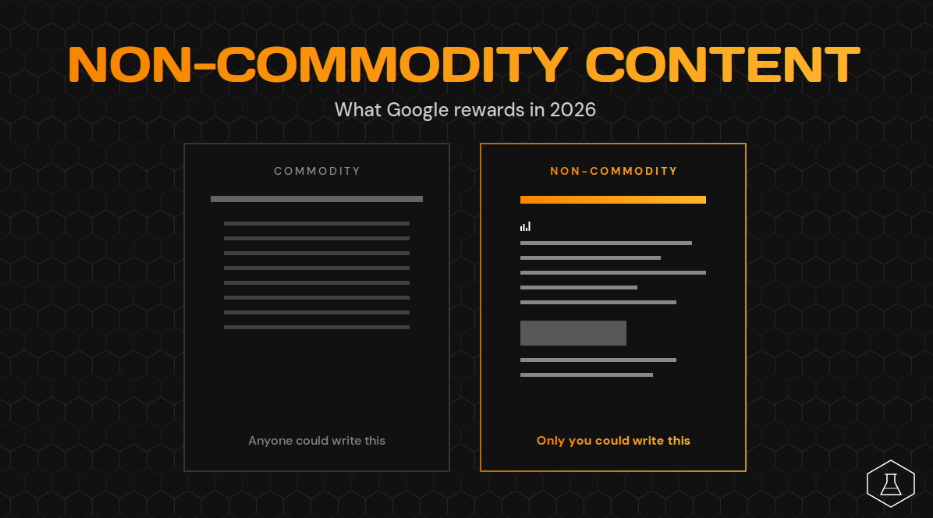
Google just gave the SEO industry a new term. Non-commodity content. Danny Sullivan introduced it at Search Central Live Toronto in April 2026, and Google’s updated AI Search guide put it in writing in May. The framing is sharp. Commodity content is anything someone with a content brief and an internet connection could write. Non-commodity content is the stuff only you can produce.
Here’s where the takes split. Half the industry read the announcement and decided to scrap their content calendars. The other half wrote that nothing has changed. Both reactions miss the point. The change isn’t binary, it’s a budget reframe.
This piece walks through what non-commodity content actually is, why Google drew the line now, and how mid-market marketing teams should adjust their content investment without throwing out the part that still works.
What Is Non-Commodity Content?
Non-commodity content is content only you can write.
That’s Google’s framing, and it’s the cleanest version we’ve seen. The official AI Search guide breaks it down. Commodity content has the same value regardless of who produces it. Non-commodity content carries something specific to the source: first-hand experience, real client work, original data, or a viewpoint someone else can’t lift without crediting you.
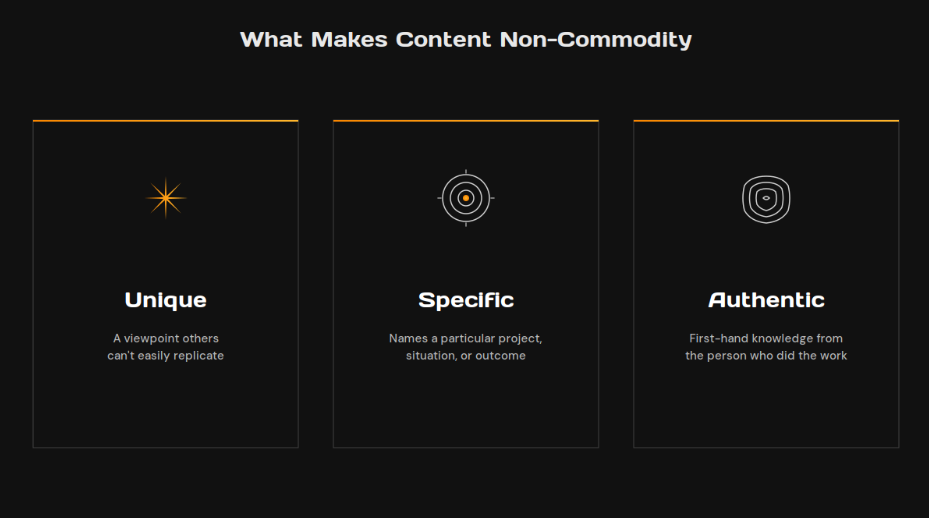
Three attributes show up across Google’s framing:
- Unique. The viewpoint isn’t easily replicated by another writer working from public sources.
- Specific. It covers a particular situation, project, or instance, not just the general rules.
- Authentic. It demonstrates first-hand knowledge from someone who actually did the work.
The contrast example Danny Sullivan used: a real estate agent writing “7 Tips for First-Time Homebuyers” produces commodity content. The same agent writing “We Waived the Inspection and Saved $15,000: What We Found in the Sewer Line” produces non-commodity content. Same author, same topic space. One is repeatable, the other is not.
If your blog reads like the fifteenth blog repeating the same five tips, that’s commodity content. Useful sometimes, but not the thing that wins AI citations or builds brand authority in 2026.
Why Google Drew This Line in 2026
This isn’t a rebrand of Helpful Content. It’s a sharper standard for the AI era.
When Google’s AI Overviews, AI Mode, or any LLM-powered search experience builds an answer, the system has to pick which sources get cited. Pages that summarize public information get summarized themselves. Pages that contain unique observations, first-hand experience, or original data become the sources the AI cites by name.
That’s the structural shift. AI engines are good at compression. They can rewrite “7 Tips for First-Time Homebuyers” into a four-sentence summary without crediting any single page. They can’t do that with a piece that carries a specific story, a proprietary dataset, or a perspective only one person has. The compression breaks down, and the page becomes a quotable source.
Google’s stated position in the May 2026 AI Search guide is direct. AEO and GEO are “still SEO,” and the work that earns AI visibility is the work that earns search visibility in general: non-commodity content, proper indexing, semantic HTML, page experience. The full implications for AI Overviews and SGE ran in detail in our earlier breakdown. The short version: Google is telling site owners which content earns a seat at the citation table.
The Commodity vs Non-Commodity Divide in Practice
Sullivan offered several contrast pairs at Search Central Live. We’ve added one from our own B2B work.
| Topic Space | Commodity Content | Non-Commodity Content |
| Real estate | “7 Tips for First-Time Homebuyers” | “We Waived the Inspection and Saved $15,000: What We Found in the Sewer Line” |
| Running shoes | “Top 10 Things to Consider When Buying Running Shoes” | “Why This Customer’s Shoes Collapsed After 400 Miles: A Wear Pattern Analysis” |
| Kitchen design | “2024 Kitchen Trends You Need to See” | “How We Solved Cabinet Misalignment in a 1920s Brownstone Remodel” |
| B2B industrial cleanrooms | “What Is an ISO Class 7 Cleanroom?” | “How We Diagnosed a 933-Page Localization Issue During a Cleanroom Manufacturer’s Migration” |
Three patterns hold across the rows. Commodity titles use general numbers, broad topics, and the framing anyone could publish. Non-commodity titles name a specific situation, a specific outcome, and the perspective of someone who actually did the work.
This is the part of the framing AI engines respond to. A search query about cleanroom localization has a tiny pool of pages with real first-hand expertise. The AI engine picks from that pool. A query about color trends has thousands of summary pages and a handful with original research or named designers. AI picks from the few.
The takeaway for marketing teams isn’t “stop writing commodity titles.” Commodity content still serves real reader intent at the top of the funnel. The takeaway is that the percentage of your content calendar that’s non-commodity is the input variable for AI visibility. Most teams skew heavily toward commodity content. The brands winning AI citations are running a materially higher mix of non-commodity.
Why You Still Need Both Types
Some teams read Google’s guidance as a green light to delete every “ultimate guide” on the blog. That’s a mistake.
Commodity content still has a job. It captures top-of-funnel intent at a cost point that scales. A reader googling “what is HVAC commissioning” doesn’t want a war story. They want a clean definition. If your page is the cleanest definition on page one, you get the click, the time-on-page, and the chance to introduce your brand. That click won’t turn into an AI citation, but it might turn into a return visit and eventually a lead.
The mistake is calling commodity content the whole strategy. If your blog is 100% summarized public knowledge, AI engines will summarize you the same way they summarize Wikipedia: as background, not as a cited source. You can rank, take some traffic, and still lose the citation race.
The both-and answer is the right one. Topical authority still requires commodity coverage of the breadth questions in your space. Non-commodity content earns the citation moments inside that breadth. The brands winning in 2026 publish both, but they fund them differently. Commodity content scales on a writer-per-piece model. Non-commodity needs interviews, original data, video, and named expert authorship.
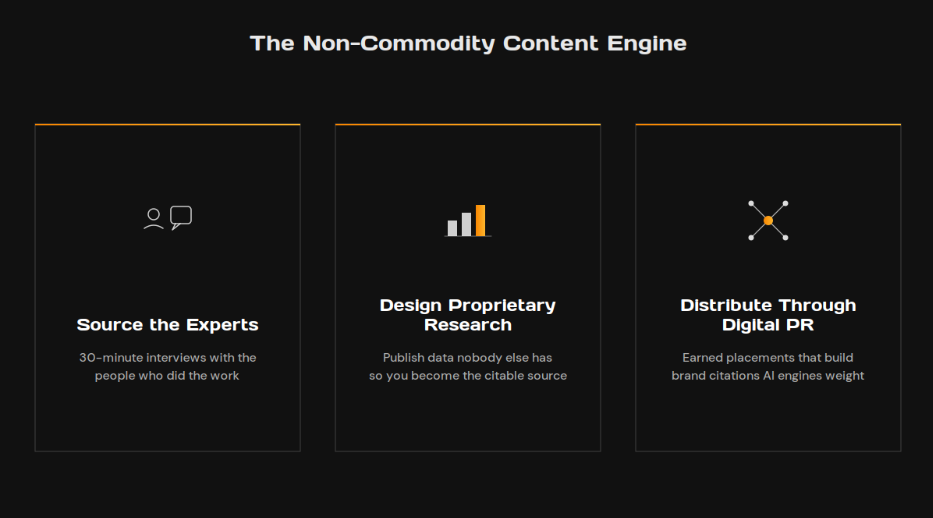
Same calendar, two budgets. That’s the operational answer most teams haven’t built yet.
The Real Cost: Non-Commodity Doesn’t Fit Standard Content Budgets
Here’s where it gets concrete.
A standard mid-market content budget assumes one writer can produce one piece per week. The piece gets researched, drafted, edited, and published in a predictable cycle. Cost-per-piece holds steady. Volume targets are set by total spend divided by per-piece cost.
Non-commodity content breaks that model. Original research takes weeks, not days. Subject-matter expert interviews require senior people who don’t write blog posts. Video components add production costs. Original data needs internal logs you haven’t structured for publishing yet, paid research panels, or partnership with primary sources. The cost-per-piece on a true non-commodity post often runs several times what a standard blog post costs.
Two outcomes follow when the budget reframe doesn’t happen.
One, the content team gets told to “make the content non-commodity” without new headcount, tooling, or budget. They keep doing the writer-per-piece model and stamp the output with marketing language about expertise. The audience and the AI engines see through it. Citation share stays flat.
Two, the team quietly shifts to fewer pieces overall and watches volume targets drop. Quarterly reporting gets uncomfortable, leadership pulls back, and the experiment ends inside two quarters.
Neither outcome moves revenue. The fix is a budget line that names non-commodity content as a separate workstream with separate unit economics, the same way paid media and organic SEO live in separate buckets. That’s the conversation Revenue First SEO under a no-retainer model was built for.
How AlchemyLeads Builds a Non-Commodity Engine
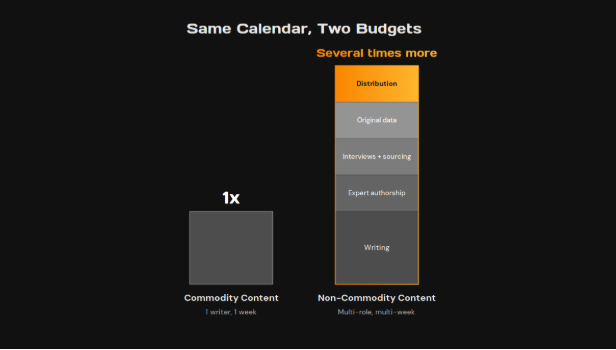
Three workstreams show up on almost every non-commodity engagement we run.
Source the Experts
We map the internal subject-matter experts who carry the institutional knowledge. Usually a few people: senior engineers, founders, account managers who’ve seen the patterns across hundreds of clients. We design a 30-minute interview format that pulls specific stories, not opinions. The interviews become the raw material for non-commodity posts. The expert doesn’t write, they talk. The agency writes.
Design Proprietary Research
The fastest way to become a quotable source is to publish data nobody else has. We help clients design proprietary research: small benchmark studies, customer survey panels, internal data audits that produce shareable charts. Each study earns months of citations since it answers questions the rest of the web is guessing at.
Distribute Through Digital PR
Non-commodity content needs distribution that’s earned, not paid. We pitch the research and the expert pieces to industry publications, podcasts, and newsletters through digital PR work. Each placement builds the brand citations AI engines weight more heavily than self-published content.
These three workstreams form the core of our Good SEO® approach. Same source content gets repurposed across Google, AI Overviews, ChatGPT, Perplexity, and the long tail of AI surfaces. Built once, distributed everywhere, cited in the answer surfaces your buyers actually use. Topical maps supply the infrastructure that ties the pieces together.
Two Engagements Where Depth Content Moved Revenue
The math is real when the work happens.
A B2B Industrial Cleanroom Manufacturer
This B2B SEO engagement started with a thin non-branded footprint and a heavy reliance on branded queries. The audit surfaced 933 mixed-language pages and 307 404 errors. We fixed the technical foundation, then shipped 32 new blog posts targeting question-shape queries that only an engineer at this client could write authoritatively about. Topics like cleanroom commissioning, ISO class transitions, and specific industry-grade troubleshooting. Each post was sourced from a subject-matter expert interview, not from public-domain summaries.
Result: 170% sales pipeline lift, from a $1M monthly baseline to $2.7M. Total leads grew 225%, from 20 to 54 quote requests per month. The 32 posts were non-commodity by design. None of them could be summarized away by an AI engine without crediting the source.
A Pet Pharmacy eCommerce Client
This client sold prescription pet medications. We built specific-intent content around drug-name queries that pet owners actually search: “apoquel for dogs,” “carprofen for dogs,” “rimadyl side effects.” These queries are non-commodity by definition. They require veterinary-authored content with real dosing information, not generic “best practices” posts.
Result: 1,118 first-page keywords on the specific drug-name targets, monthly organic traffic from 5,000 to 10,000 visits in 6 months, total revenue projected to grow 3x year-over-year. Same playbook. Depth content sourced from people with first-hand expertise.
Working With AlchemyLeads on Non-Commodity Content
Non-commodity content isn’t a tactic. It’s a new line item that needs the right team, the right cost model, and the right distribution.
That’s the work we scope for B2B and eCommerce brands every quarter. No retainers required. Real revenue numbers attached.
Book a strategy call with AlchemyLeads. We’ll map your commodity-to-non-commodity ratio in 45 minutes.
Related guide: how AI search retrieves, grounds and cites sources.
Suggested

Our Ahrefs Health Score Went From 74 to 96. Here’s What Our AI SEO Agent Found.
Seven problems our AI SEO agent found on our own site, from leads GA4 never recorded to 195 pages linking through redirects, and how we fixed them.
October 8, 2026

How Our AI SEO Agent Cleared 1,186 Schema Errors in One Day
How our AI SEO agent and team took a Shopify store from 1,186 structured data errors, 12 404s and 155 broken links to zero in one day.
October 8, 2026

How to Integrate HubSpot and Tripleseat: Lessons From 9 Builds
A step-by-step guide to connecting HubSpot and Tripleseat: forms, OAuth 2.0, field and stage mapping, multiple locations, documents and monitoring, with real lessons from nine production integrations.
October 4, 2026
Answer-First Content: The Inverted Pyramid (∇) for AI Search
The inverted pyramid (∇) puts the answer first and the detail after. Here is how answer-first writing serves busy buyers and AI systems that quote short passages, with examples, common mistakes, and a checklist.
October 3, 2026
Retrieve-for-Train explained: how Google Research is speeding up AI search fan-out
Google Research’s Retrieve-for-Train method trains a small diffusion model to fan out search queries in one pass. Here is how it works, what it reports, where it stops, and our cautious read for brands.
October 3, 2026
Contact us
We value your privacy and won't share your email with others.
We'll only contact you with curated content.
