
Is AI search just SEO? Half the industry says yes. The other half says no. Google says it’s all still SEO. Microsoft has been publishing posts that call it Generative Engine Optimization. Rand Fishkin at SparkToro pushes back on the new acronyms entirely. Two vendors have probably pitched you “GEO services” this quarter.
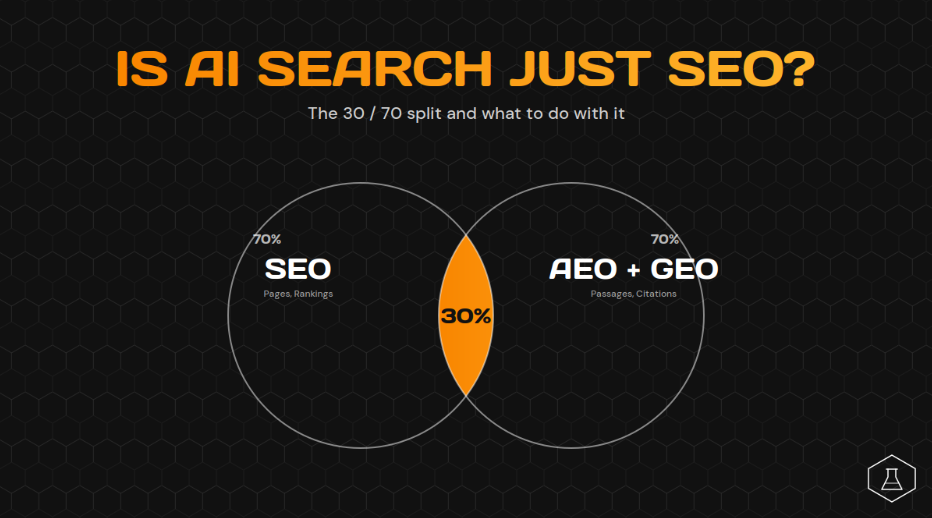
Here’s the honest answer. Yes and no. About 30% of AI search work is the same SEO motion you’ve been running for years. The other 70% is new, lives outside your current SEO budget, and decides whether your brand shows up inside ChatGPT, Perplexity, and Google AI Overviews. The marketing leads who win in 2026 won’t be the ones who picked a side in the argument. They’ll be the ones who reframed the budget conversation.
This piece walks through what carries over, what’s actually new, and what to do about it before your next quarterly review.
The Short Answer: Yes and No
Four acronyms keep showing up. One of them does double duty.
| Acronym | Stands For | What It Targets |
| SEO | Search Engine Optimization | Ranking pages in Google and Bing |
| AEO | Answer Engine Optimization | AI Overviews, Bing Copilot, featured snippets, People Also Ask |
| AEO | Agentic Engine Optimization | The agentic web, MCP-enabled tools, AI agents acting on a user’s behalf |
| GEO | Generative Engine Optimization | Citations inside ChatGPT, Perplexity, Claude |
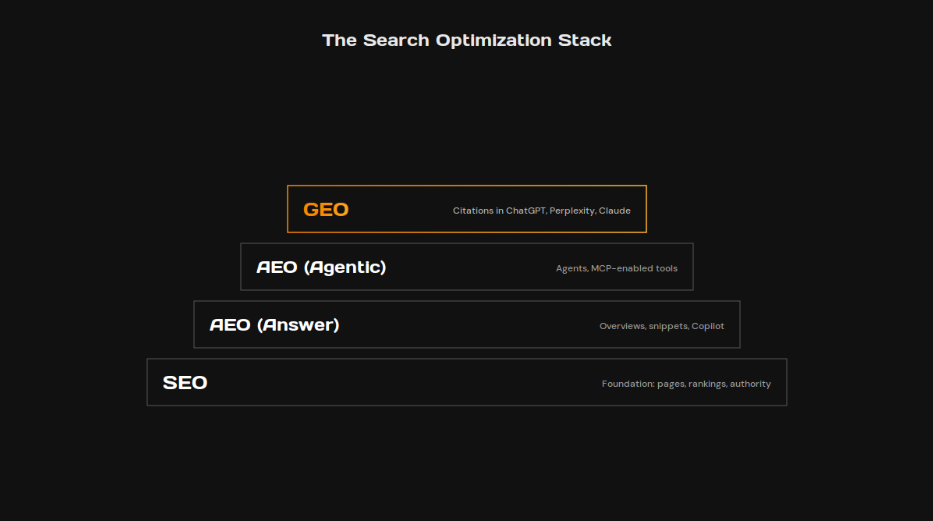
AEO is doing double duty in 2026. Some teams use it for Answer Engine Optimization, others for Agentic Engine Optimization (a term coined by Google’s Addy Osmani). We treat them as two distinct workstreams under the same letter.
So is AI search just SEO?
Yes, in the sense that strong SEO fundamentals carry over. Crawlability, page experience, structured data, and authority signals still matter. A brand with broken technical SEO won’t win at AEO or GEO either.
No, in the sense that the inputs, the outputs, and the org chart all change. You’re optimizing for retrieval systems that select passages, not pages. You’re competing in a citation game, not a ranking game. The shared layer is the foundation. The new layer is what decides if you show up in the answer.
The framing matters more than the label. Treating AEO and GEO as “still SEO” usually means they get the same budget and the same reporting. That’s where the math breaks.
What Carries Over From SEO
About 30% of the work doesn’t change.
AI engines don’t crawl a different web. They pull from the same pages Google indexes, plus earned-media sources like Wikipedia, Reddit, and major publishers. Broken canonicals, slow pages, or thin content lose the AEO and GEO race before it starts.
The carry-over list:
- Technical health. Crawlability, site speed, internal linking. Google’s crawler is also the input to most AI grounding pipelines.
- Structured data. Schema markup helps AI systems understand entities and relationships. Clearer data, easier citation.
- Content quality. Original, accurate, depth-signaled content wins on both surfaces.
- Authority signals. Backlinks from credible domains still matter. AI engines lean harder on earned media than Google does, so the signal compounds.
- Topical depth. Topic clusters feed the entity associations AI engines use to decide who counts as an authority.
This is the floor. If you’re running solid SEO services, you’ve cleared the bar. Nothing about AI search invalidates the playbook. The playbook just isn’t the whole game anymore.
What’s Actually New About AEO and GEO
About 70% of the work is new, and it’s the part that decides where your brand shows up in an AI answer. Here’s what shifts when you cross from SEO into AEO and GEO.
| Dimension | Traditional SEO | AEO and GEO |
| Unit of optimization | Whole page | Individual passage |
| Primary signal weight | Brand-owned content | Earned media (Wikipedia, Reddit, industry publications) |
| Measurement | Rankings, traffic | Mentions, citations, queries that triggered them |
| Information architecture | Your own site | Spans third-party sites you don’t control |
Passage-level retrieval changes the unit of analysis. SEO optimizes for a page ranking in position 1. AI search retrieves a passage and decides whether to cite it. The same 2,000-word post can rank well in Google and get zero citations in ChatGPT, since the passages aren’t tight enough to win the retrieval match. Writing for both surfaces means engineering content at the paragraph and section level, not just the page.
Earned-media weighting matters more in AI. Research on generative engines consistently finds AI platforms favor third-party authoritative sources over brand-owned content. Wikipedia. Reddit. Industry publications. Licensed data partners. Your own site is part of the signal, but it’s no longer the loudest input. That changes who needs to be involved. PR, brand, and partnerships sit at the table with SEO.
Brand citation tracking is a new measurement layer. SEO tracks rankings and traffic. AEO and GEO track mentions, citations, and the queries that triggered them across AI surfaces. Different tools, different dashboards, different KPIs. “Did the brand show up?” replaces “what position did the page rank?”
Information architecture spans third-party sites. Your Wikipedia entry, your Reddit footprint, your G2 reviews, the publications that quote you. These shape how AI engines describe you. None of that lives on yourcompany.com.
This is the work AI Overviews and SGE reshape for organic search. Pretending it’s “still SEO” is how the work goes undone.
What About “Search Everywhere Optimization”?
Some marketers want to skip the new acronyms entirely.
Ashley Liddell at Deviation coined Search Everywhere Optimization as a single rebrand. Keep the SEO acronym, redefine the E. The framing covers every channel where buyers look for information about your topic, from Google to ChatGPT to YouTube to Reddit to app stores. Michigan Tech’s marketing team frames it the same way.
The appeal is real. The acronym survives, the skill set carries over, no new buzzword to defend to the CFO every six months.
We agree the framing has merit. We also think it ducks the budget conversation. Calling everything SEO reads tidy on a slide, but on a P&L line it still means one team holding ten disciplines on one headcount. The label doesn’t unbundle the work.
Why the “Just SEO” Framing Costs Mid-Market Brands Money
Here’s where the budget conversation gets real.
When AEO and GEO live under SEO, they get SEO’s budget. That budget was negotiated years ago, scoped to one set of activities, and reports up through the marketing director. It funds keyword research, content production, technical fixes, and link building. It doesn’t fund PR campaigns to win Reddit threads. It doesn’t fund Wikipedia editing. It doesn’t fund passage-level content engineering across thousands of pages. It doesn’t fund citation tracking tools.
Two outcomes follow.
One, the work doesn’t get done. The SEO team gets handed AEO and GEO as additional scope, no additional headcount, no additional tooling, no executive cover for cross-functional asks. The work stalls. The brand quietly disappears from AI answers and still ranks well in Google.
Two, when leadership eventually notices a problem, they hire externally for “GEO services” and get sold a vendor-driven product that duplicates existing SEO work at a markup.
The fix isn’t a new buzzword. The fix is a budget line that names the work for what it is.
That’s why Revenue First SEO under a no-retainer model bundles AEO and GEO into engagements that report to the CFO, not the SEO manager. The work gets the cross-functional sponsorship it needs since the line item exists. Same playbook iPullRank and Bing have been arguing for. Different label, same operational reality.
What AEO and GEO Work Actually Looks Like on a Real Engagement
Three workstreams show up on almost every AEO and GEO engagement we run.
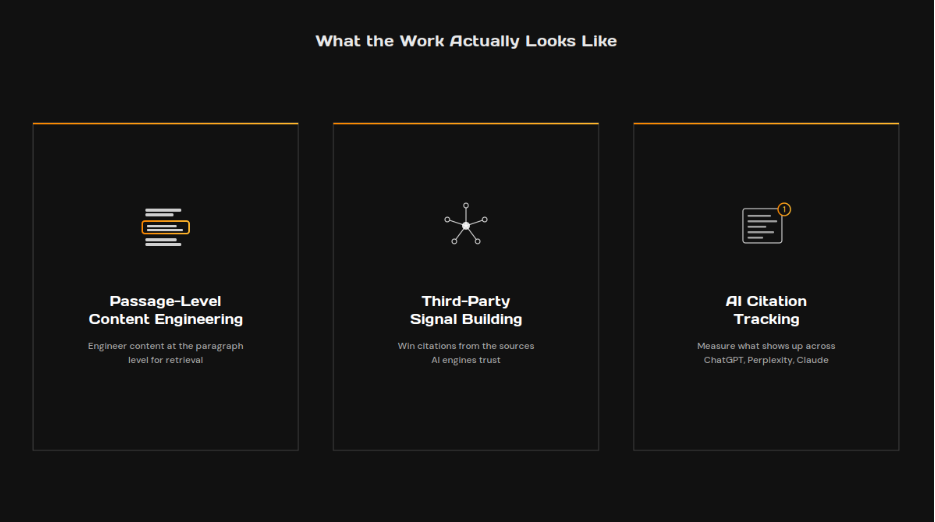
Passage-Level Content Engineering
We audit existing pages for retrievability, not just rankings. Every section gets reviewed for whether it answers a specific question cleanly and can stand alone if pulled out as a passage. Pages with answer paragraphs near the top of the page, right after the H1, get cited at materially higher rates than pages that bury the answer halfway down. This isn’t a rewrite of the whole site. It’s a surgical pass through the highest-impression, lowest-CTR pages where the answer is hiding.
Third-Party Signal Building
We map the citation graph for the brand’s key topics. Where do the AI engines pull their answers from when someone asks about your category? Usually it’s a mix of Wikipedia, the top three industry publications, Reddit threads in relevant subreddits, G2 and Capterra-type review sites, and a handful of niche authority sites. The work is getting the brand mentioned, quoted, or linked from those sources. That looks more like PR than traditional SEO, since it is.
AI Citation Tracking and Source-of-Truth Content
We instrument tracking across ChatGPT, Perplexity, Google AI Mode, and Claude. Every week we capture which queries cite the brand, which queries cite competitors, and which questions go answered by no one. The “no one” list is the content roadmap. Write the source-of-truth answer first, get it cited, and own the question for months before competitors catch up.
This is the SEO and AI tie-in most marketing teams haven’t operationalized yet. It’s why dedicated AEO and GEO scope exists.
Two Engagements Where This Work Moved Revenue
The math is real when the work happens. Two recent engagements, two different timelines, both moved revenue against the AEO and GEO playbook described above.
| Engagement | What We Did | Result | Timeline |
| B2B industrial cleanroom manufacturer | Technical cleanup, 32 question-shaped blog posts, 93 backlinks | 170% sales pipeline lift ($1M → $2.7M monthly), 225% lead growth (20 → 54 quote requests) | 90 days |
| 3PL eCommerce client | ~50 backlinks per month, passage-level rewrites of category and resource pages | 8,000+ first-page keywords, organic traffic 40,000 → 180,000 monthly, total revenue 3x prior year | 12 months |
A B2B Industrial Cleanroom Manufacturer
This client engaged AlchemyLeads with a heavy branded-traffic base and a thin non-branded footprint. The audit surfaced 933 mixed-language pages, 307 404 errors, and an answer-paragraph problem on every category landing page. We rebuilt the technical foundation, shipped 32 new blog posts targeting question-shaped queries, and earned 93 backlinks from credible industry sources in 90 days.
Result: 170% sales pipeline lift, from a $1M monthly sales opportunity baseline to $2.7M. Total leads grew 225%, from 20 to 54 quote requests. The work that moved the needle wasn’t pure SEO. It was the question-pattern content engineering, the third-party authority building, and the technical cleanup running in parallel. Exactly the B2B SEO motion the “just SEO” framing under-resources.
Where to Start in 30, 60, and 90 Days
First 30 Days
- Audit your 20 highest-impression pages in Google Search Console. Look for direct-answer paragraphs in the opening section right after the H1. If they’re missing, fix the worst three.
- Run brand citation checks in ChatGPT and Perplexity. Search your category’s top 10 questions. Note where you’re cited, where competitors are cited, and where no one is.
- Build a one-page budget memo separating SEO, AEO, and GEO line items. You don’t need new dollars yet. You need named work.
Days 30 to 60
- Identify 5 third-party authority sites your category uses. Pitch one piece of expert commentary or original data to two of them.
- Add or expand FAQ schema on 10 pages where you rank but don’t get clicks. AI engines pull from clean schema.
- Stand up a weekly citation report. Even a manual spreadsheet works. Track the queries, not just the brand.
Days 60 to 90
- Publish one source-of-truth piece per month on a question no competitor answers cleanly.
- Run a Wikipedia and Reddit audit. Both feed AI grounding. Both reward consistent presence.
- Revisit the budget memo with a 90-day outcome attached. Push for ROI sign-off.
For the financial side, calculating the ROI on SEO work covers the spreadsheet math.
Working With AlchemyLeads on AEO and GEO
AEO and GEO aren’t new acronyms. They’re new line items.
If your search work is still scoped, budgeted, and reported as if 2018 ranking factors run the show, you’re leaving citation share on the table. We rebuild that scope for B2B and eCommerce brands every quarter. No retainers required. Real revenue numbers attached.
Book a strategy call. We’ll map your AEO and GEO gaps in minutes.
Suggested
Our Ahrefs Health Score Went From 74 to 96. Here’s What Our AI SEO Agent Found.
Seven problems our AI SEO agent found on our own site, from leads GA4 never recorded to 195 pages linking through redirects, and how we fixed them.
October 8, 2026

How Our AI SEO Agent Cleared 1,186 Schema Errors in One Day
How our AI SEO agent and team took a Shopify store from 1,186 structured data errors, 12 404s and 155 broken links to zero in one day.
October 8, 2026

How to Integrate HubSpot and Tripleseat: Lessons From 9 Builds
A step-by-step guide to connecting HubSpot and Tripleseat: forms, OAuth 2.0, field and stage mapping, multiple locations, documents and monitoring, with real lessons from nine production integrations.
October 4, 2026
Answer-First Content: The Inverted Pyramid (∇) for AI Search
The inverted pyramid (∇) puts the answer first and the detail after. Here is how answer-first writing serves busy buyers and AI systems that quote short passages, with examples, common mistakes, and a checklist.
October 3, 2026
Retrieve-for-Train explained: how Google Research is speeding up AI search fan-out
Google Research’s Retrieve-for-Train method trains a small diffusion model to fan out search queries in one pass. Here is how it works, what it reports, where it stops, and our cautious read for brands.
October 3, 2026
Contact us
We value your privacy and won't share your email with others.
We'll only contact you with curated content.
