
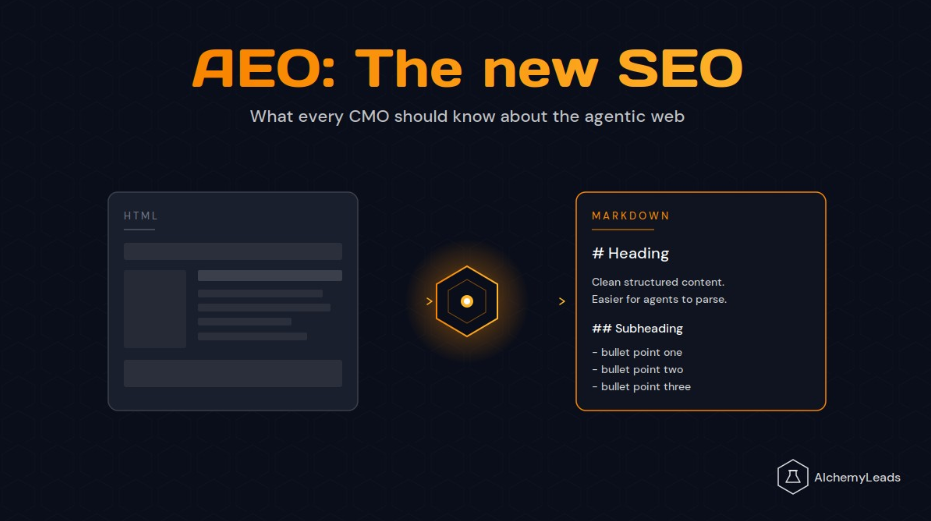
Every marketing leadership meeting in 2026 ends the same way. Someone says “AI agents.” The room nods. The meeting ends. Nothing on the site changes.
That gap is starting to cost real revenue.
AI agents are already on your site. They’re reading the docs, parsing the product pages, and deciding which brands to recommend to buyers who never see a search result page. Most brands have done nothing to prepare for that read.
This is the playbook. Six things marketing leaders should be learning, and acting on, right now if they want to stay visible in the agentic web. Pulled together from the best public research and from what we’re seeing across our own client base at AlchemyLeads.
What is AEO, and how is it different from SEO and GEO?
AEO is Agentic Engine Optimization. It’s the work that lets AI agents actually use your site, your docs, and your APIs to take action on a user’s behalf. The term was coined by Google engineer Addy Osmani.
We treat it as the third layer of the revenue first SEO stack:
| Term | Stands for | What it does |
| SEO | Search Engine Optimization | Gets you ranked on Google for human readers |
| GEO | Generative Engine Optimization | Gets your brand cited inside AI answers from ChatGPT, Perplexity, Claude, and Google’s AI Overviews |
| AEO | Agentic Engine Optimization | Gets your site usable by AI agents that take action on a user’s behalf |
A brand that’s invisible to agents loses three things: buyer research that happens inside an agent, tasks the agent could complete on the user’s behalf, and the recommendation slot the agent gives a competing brand instead.
#1: WebMCP, the markup that lets agents take action
WebMCP (Web Model Context Protocol) is a proposed web standard from Google and Microsoft that lets your site declare what it can do as a structured set of callable tools. Agents read those tools and call them directly. No DOM scraping. No screenshots. No guesswork. It shipped in early preview in Chrome 146 in early 2026.
A practical example: a travel site adds a few attributes to its existing flight search form. An AI agent visits, sees a tool called search-flights with origin, destination, and date as inputs, and books the flight without ever rendering the page visually.
The alternative today is messy. When an agent visits a site to book a demo, fill a form, or complete a checkout, it pulls the raw HTML, scrapes the DOM, fires screenshots at a vision model, and tries to figure out which button does what. It works, sort of. It also breaks the moment you ship a new design.
Why a CMO should care: brands that ship WebMCP early get picked by agents over the brands that don’t. The same way mobile-first sites pulled ahead of desktop-only sites in 2015, agent-ready sites will pull ahead of agent-blind sites in 2026 and 2027. This is the next mobile-first moment.
#2: Cloudflare Markdown for Agents
Cloudflare Markdown for Agents is a feature that converts your HTML pages to clean markdown on the fly when AI agents request it, cutting their token cost by up to 80%. It rolled out in February 2026.
Here’s how it works. When an AI agent sends a request with the Accept: text/markdown header, Cloudflare’s edge network pulls the HTML from your origin, converts it to markdown, and serves the lighter version to the agent. Humans still get the full HTML page.
Cloudflare ran the math on its own blog. The HTML version of one page consumed 16,180 tokens. The same page in markdown used 3,150 tokens. That’s the 80% drop.
The result: lower token cost for agents, higher chance your content fits inside their context window, and a stronger chance you get cited.
What it means for marketing leaders: if your site sits behind Cloudflare on a Pro, Business, or Enterprise plan, this is a one-toggle win. If you’re not on Cloudflare, the same thinking applies. Make a clean markdown version of your top-cited pages and serve it to agents that ask for it.
#3: Fan-out queries, why one search becomes 8 to 12
AI search engines don’t run your search. They rewrite it into 8 to 12 sub-queries, run all of them in parallel, and synthesize the results into one answer. This is called query fan-out.
A search like “best running shoes for flat feet” might get expanded into:
- best running shoes for overpronation
- arch support running shoes for flat feet
- stability running shoes 2026
- running shoes for low arches men
- best motion control running shoes
- running shoes for plantar fasciitis flat feet
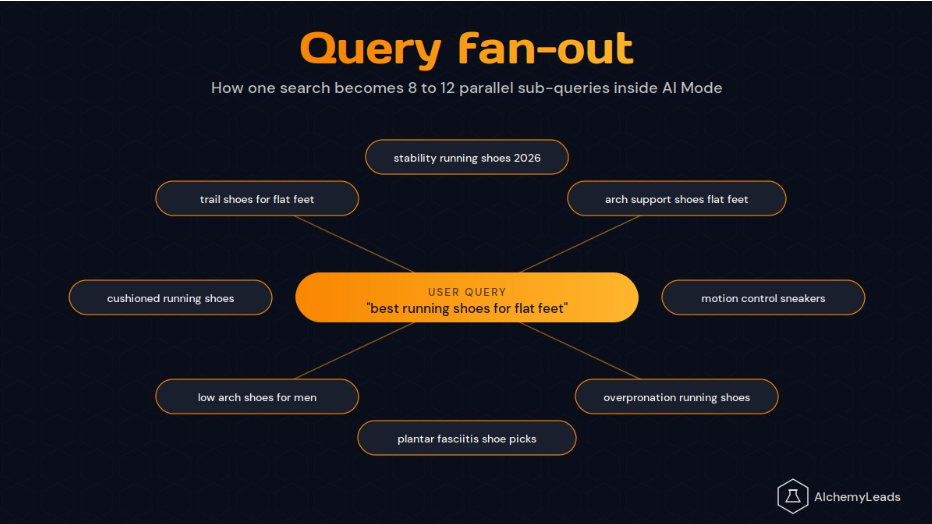
Two implications for the way you plan content.
First, you’re no longer optimizing for one keyword. You’re optimizing for a topic cluster of 8 to 12 keywords that the AI will generate on its user’s behalf. The page that wins is the one that covers more of the sub-questions clearly.
Second, the words AI uses to generate sub-queries are longer and more specific than the words humans type. They sound like product specs, not like a Google search. Match that vocabulary in your headings and your FAQ blocks.
Coverage across the cluster beats one strong page on the head term.
#4: The 2,000-word grounding budget
Each AI search query has a fixed grounding budget of about 2,000 words, split across all the sources the AI ranks for that query. Density beats length.
The numbers come from a Dejan AI study of 7,060 queries pulled from Google’s Gemini grounding pipeline.
Rank position decides your share of the budget:
| Organic position | Share of grounding budget | Words allocated |
| #1 | ~28% | ~531 |
| #5 | ~13% | ~266 |
Coverage from any one page also plateaus at around 540 words. After that, more content does not earn more selection.
Page length vs share of content used by AI:
| Page length | Share of content surfaced inside AI answer |
| 800 words | 50% or more |
| 4,000 words | ~13% |
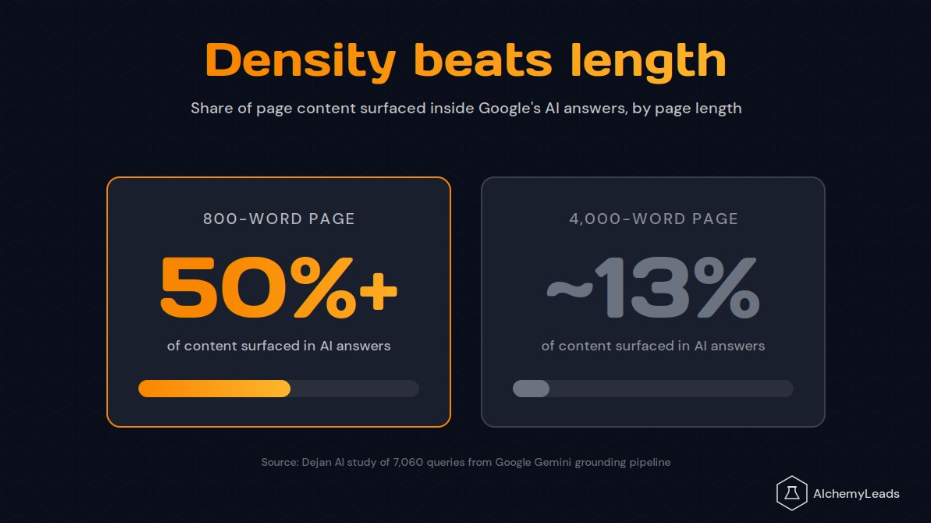
This breaks older SEO playbooks that pushed for 3,000 to 5,000-word pillar pages. Those pages still help on broad ranking, but they’re getting outperformed inside AI answers by shorter, denser ones.
The fix: lead with the answer. Front-load every section. Use sentences that stand on their own. Cut filler. If you want a deeper read on what AI search means for your traffic, our take on AI search optimization breaks it down further.
#5: Content structuring, tables and headings win citations
ChatGPT is 2.3x more likely to cite a page with a table than Google is to rank one (per a Nectiv data study). Format wins citations.
| Format choice | Citation impact | Source |
| Tables on page | 2.3x more ChatGPT citations than Google rankings | Nectiv data study |
| First 30% of page | 44% of all ChatGPT citations come from here | Search Engine Land summary |
| Sequential heading hierarchy (H1 to H2 to H3) | Higher citation rate than skipped or chaotic headings | Multiple studies |
| Q&A formatted sections | Pulled directly. H2 read as question, paragraph below as answer | Multiple studies |
Why it works: AI doesn’t read your page top to bottom. It chunks it. Tables, lists, FAQ schema, and well-structured headings are pre-built chunks. They’re easier for the model to extract, attribute, and reuse.
What this means for the production process: when a comparison can go in a table, put it in a table. When a question is in a heading, write a clean answer paragraph below it. Use schema where it helps.
This is a content design rule, not a writing rule.
#6: The infrastructure layer agents look for first
Before any of the above matters, agents have to reach your content. The most common blockers:
| Blocker | What happens | Fix |
| robots.txt blocks AI crawlers | Content never gets indexed by that AI. No errors, no alerts. Silent loss. | Audit robots.txt, allow GPTBot, ClaudeBot, PerplexityBot as appropriate |
| Content buried under JavaScript | Agent fetches HTML, never runs the JS, sees an empty shell | Server-render the content that matters most |
| CDN aggressively blocks bots | Legitimate AI crawlers get blocked alongside bad ones | Check CDN logs for axios, curl, ClaudeBot fingerprints |
Three new files are also starting to matter for brands that want to go further:
| File | What it is | Most relevant for |
| llms.txt | Flat markdown index of your most important pages, hosted at /llms.txt. A sitemap for AI. | Every site |
| AGENTS.md | Instruction file in your code repo that AI coding agents read on first contact | Developer products |
| skill.md | Capability declaration that tells agents what your product does, not how to call it | Products with APIs |
Get the basics right first. The new files matter less than the silent blockers.
What to do in your first 60 days
You don’t have to ship all six tomorrow. Sequence matters. Here’s the order we recommend:
- Audit robots.txt for AI crawler blocks. Ten minutes. Stops the silent leak.
- Run a content density check. Find your top 20 pages. Cut filler. Front-load the answer in every section.
- Reformat for citation. Add tables to comparisons, FAQs to high-intent pages, and tight Q&A sections to product pages.
- Map your topical clusters. Cover the sub-queries the AI is generating, not just the head term.
- Pick one new file to ship. llms.txt is the highest-leverage first step. WebMCP and skill.md come later.
These six things are not a future project. AI agents are already on your site, parsing content, and deciding what to recommend. Every week you wait is a week your competitors get cited and you don’t.
This is also the work AlchemyLeads is built for. Our Good SEO® Framework wraps SEO, GEO, and now AEO under one Revenue First SEO operating model. We’re running this exact stack with brands across B2B and ecommerce right now.
Ready to make your brand citable in AI search? Talk to AlchemyLeads.
Suggested

Our Ahrefs Health Score Went From 74 to 96. Here’s What Our AI SEO Agent Found.
Seven problems our AI SEO agent found on our own site, from leads GA4 never recorded to 195 pages linking through redirects, and how we fixed them.
October 8, 2026

How Our AI SEO Agent Cleared 1,186 Schema Errors in One Day
How our AI SEO agent and team took a Shopify store from 1,186 structured data errors, 12 404s and 155 broken links to zero in one day.
October 8, 2026

How to Integrate HubSpot and Tripleseat: Lessons From 9 Builds
A step-by-step guide to connecting HubSpot and Tripleseat: forms, OAuth 2.0, field and stage mapping, multiple locations, documents and monitoring, with real lessons from nine production integrations.
October 4, 2026
Answer-First Content: The Inverted Pyramid (∇) for AI Search
The inverted pyramid (∇) puts the answer first and the detail after. Here is how answer-first writing serves busy buyers and AI systems that quote short passages, with examples, common mistakes, and a checklist.
October 3, 2026

Retrieve-for-Train explained: how Google Research is speeding up AI search fan-out
Google Research’s Retrieve-for-Train method trains a small diffusion model to fan out search queries in one pass. Here is how it works, what it reports, where it stops, and our cautious read for brands.
October 3, 2026
Contact us
We value your privacy and won't share your email with others.
We'll only contact you with curated content.
