
Every quarter someone declares SEO dead. This year AI search is holding the knife. The logic sounds clean: if ChatGPT and Perplexity answer the question, nobody clicks a blue link, so why rank at all?
We wanted a real answer, not a hot take. So we ran the test. We sent 8 buyer-style “best tool” questions through Perplexity and logged every source and every recommendation. The result was almost dull in how clear it came back.
AI did not invent new winners. It recommended the same brands already sitting at the top of Google’s listicles. SEO is not dead. The thing you optimize just moved.
What We Found When We Asked AI to Recommend Tools
Across 8 commercial searches, Perplexity cited 79 sources. We sorted every one by hand.
62% of those citations were publisher listicles and roundups. The “15 best” and “we tested 13” articles. Only about a quarter pointed at the vendors’ own sites. The rest were forums and review hubs like Reddit, G2, and Capterra.
Then we checked the recommendations themselves. The tools the AI named were the same tools leading the top-ranking listicles for that query. Ask “best rank tracking software” and you get the names that fill page one of Google. Ask “best content optimization tool” and you get the same roster, in roughly the same order.
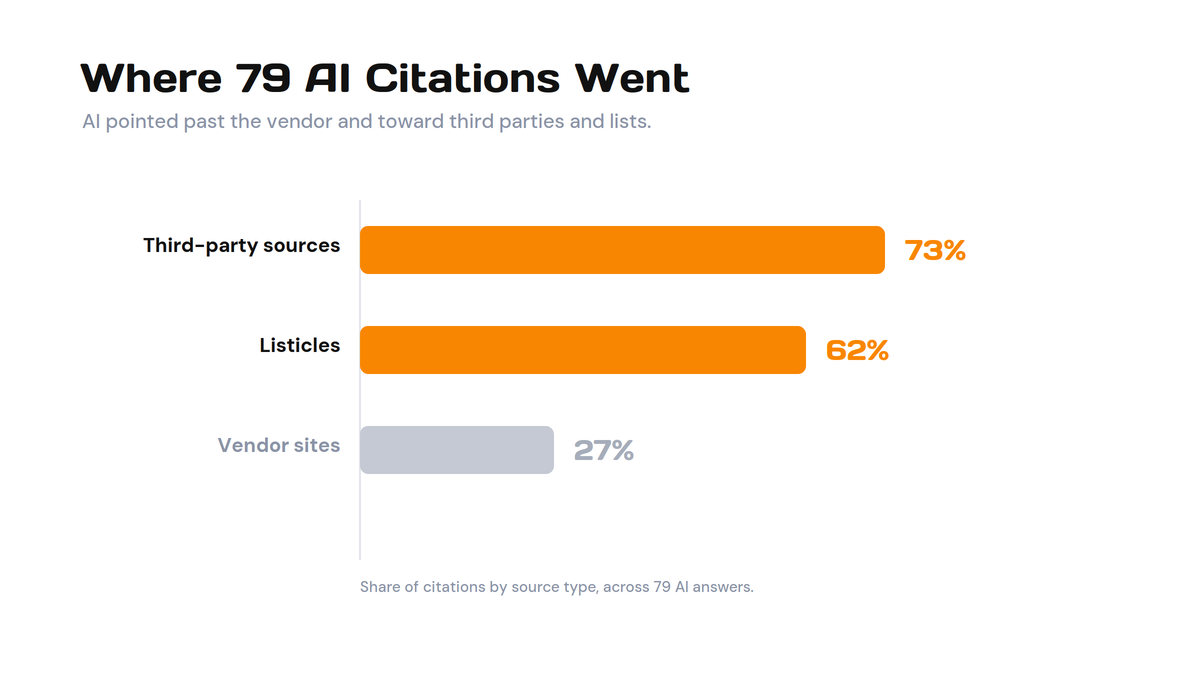
The AI is not scouting the open web for hidden gems. It reads the articles that rank, then hands you their consensus. Page one of Google is the raw material for the answer you get.
Why Listicles Run AI Search Now
This is the shift most brands miss. The format that wins AI citations is the listicle, and the trend is steep.
![Infographic showing a shift from a standalone page to ranking within a list, titled 'The Unit Just Changed' and 'Best Tools for 2026' with 'YOUR BRAND' in second place highlight] but keep concise.](https://alchemyleads.com/wp-content/uploads/2026/06/al-sid-unit-shift.png)
One analysis tracked how citation share by format changed across a single year. Listicles climbed from a small slice of citations in January to the dominant format by spring. Position inside the list mattered too: the tool ranked first in a “best of” roundup pulled far more citations than chance would predict, roughly two and a half times more in that study.
Our own numbers line up. 62% of the citations we logged were that exact format, and independent counts put listicles among the most-cited formats across AI search. The roundup is the unit AI trusts for “what should I buy.”
Think about what that means for a vendor. You can publish the best product page on earth and still lose the answer, since the model is not quoting product pages. It is quoting the article that ranked your competitor first. Getting into that article, and climbing inside it, is the new battleground. A spot in the top three of a ranking roundup is worth more to your AI visibility than a redesign of your own pricing page.
The Real Correlation: AI Re-Reads Page One
A master’s thesis out of the Technical University of Munich, shared publicly by its author, put numbers to this. The researcher analyzed more than 370,000 search results and over 13,000 citations across ChatGPT and other leading models. The headline finding, by the author’s count: roughly 80% of the products these models recommended lined up with what already ranked in traditional search.
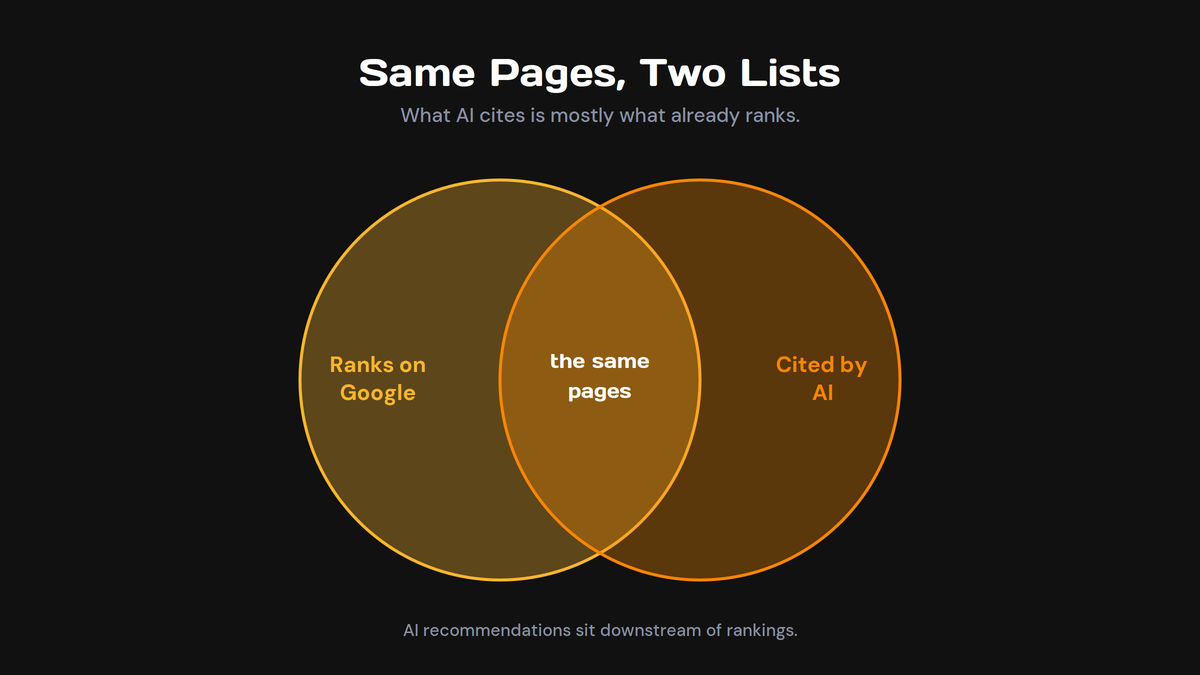
Independent data points the same way. One analysis of more than 120,000 Google queries found that three quarters of the links in AI Overviews came from the top dozen organic results.
| Source | What It Looked At | Finding |
| TUM master’s thesis (shared on LinkedIn) | 370,000+ results, 13,000+ citations | ~80% of AI picks matched top search rankings |
| Botify and DemandSphere | 120,000+ Google queries | ~75% of AI Overview links came from the top 12 |
| Our Perplexity test | 8 commercial “best tool” queries | ~1 in 3 cited pages already ranked; recommended tools near-total |
Our test was stricter, and the floor still held. When we compared the exact pages Perplexity cited against the top organic results we pulled, about a third matched outright, and most of the rest were listicles ranking a little deeper. At the product level the overlap was near total. Every tool the AI recommended showed up in the page-one articles we found.
Put the studies and our data together and the story is simple. AI recommendations sit downstream of rankings. Rank the right pages and you feed the machine. Sit on page three and the model never meets you.
We should be straight about the limits. Ranking first does not guarantee a citation, and a sharp page at position 15 sometimes gets quoted over a weak one at the top. The link is loose. But loose is a long way from dead, and the people calling SEO dead are not looking at the data.
Your Page Is Not the Unit Anymore. The Listicle Is.
For twenty years the unit of SEO was your page. You ranked a URL, the URL earned a click, the click became a lead. AI search keeps the ranking part and removes the click. The answer gets read on the results screen. So optimizing one page to catch one visitor matters less than it did.
What matters now is being the brand inside the pages that rank. That splits into two jobs, and most teams only do the first.
Job one: rank the listicles you own. If you publish roundups, comparisons, and “best of” guides, those are your tickets into AI answers. They need to rank, and they need to be honest enough that the model treats them as a fair source, not a sales sheet. The standard we set in our work on non-commodity content applies here: thin, me-too roundups get ignored by readers and models alike.
Job two: get into the listicles you don’t own. This is the part vendors hate, since you cannot control it directly. You earn it. Pitch the writers who rank for your category. Show up in the review hubs the AI keeps citing, the G2 and Capterra and Clutch pages. Answer the Reddit threads where your buyers compare options out loud. The AI reads those, and right now your competitors are the only ones in the room.
How to Actually Get Into a Ranking Roundup
“Get into the listicles” sounds nice until you try it. Here is the order of operations we use.
Start by finding the roundups that already rank for your category. Search your “best” terms, note every article on page one, and write down the author or publication behind each. Those are your targets, ranked by the traffic they pull.
Then give the writer a reason to add you. Not a generic pitch. A specific one: a feature you offer that the current list misses, a customer result you can prove, a screenshot they can use. Writers update these posts often, since fresh roundups hold rankings better. You are making their job easier.
For the hubs you cannot pitch, like G2 or Capterra, the lever is real reviews from happy customers. Ask for them on purpose. A handful of recent, detailed reviews moves you up the page the AI reads.
It is slow, human work. It is the work your competitors skipped, which is why they are nervous about AI search and you do not have to be.
What to Measure When the Click Disappears
If AI answers the question on screen, your old scoreboard breaks. Rank and traffic still matter, yet they no longer tell the whole story. A page can rank, feed a dozen AI answers, and show flat clicks in your report. The work is paying off in a place your analytics never looked.
So the scoreboard grows three new lines.
| New Metric | The Question It Answers | How to Track It |
| Share of Answer | For the questions your buyers ask, how often does AI name you at all? | Run the prompts, log who shows up, watch the trend |
| Citation Share | Of the answers that name you, how many cite your page versus a third party? | Check the footnotes on each answer |
| Listicle Presence | Which ranking roundups include you, and at what spot? | Audit the page-one “best” lists for your category |
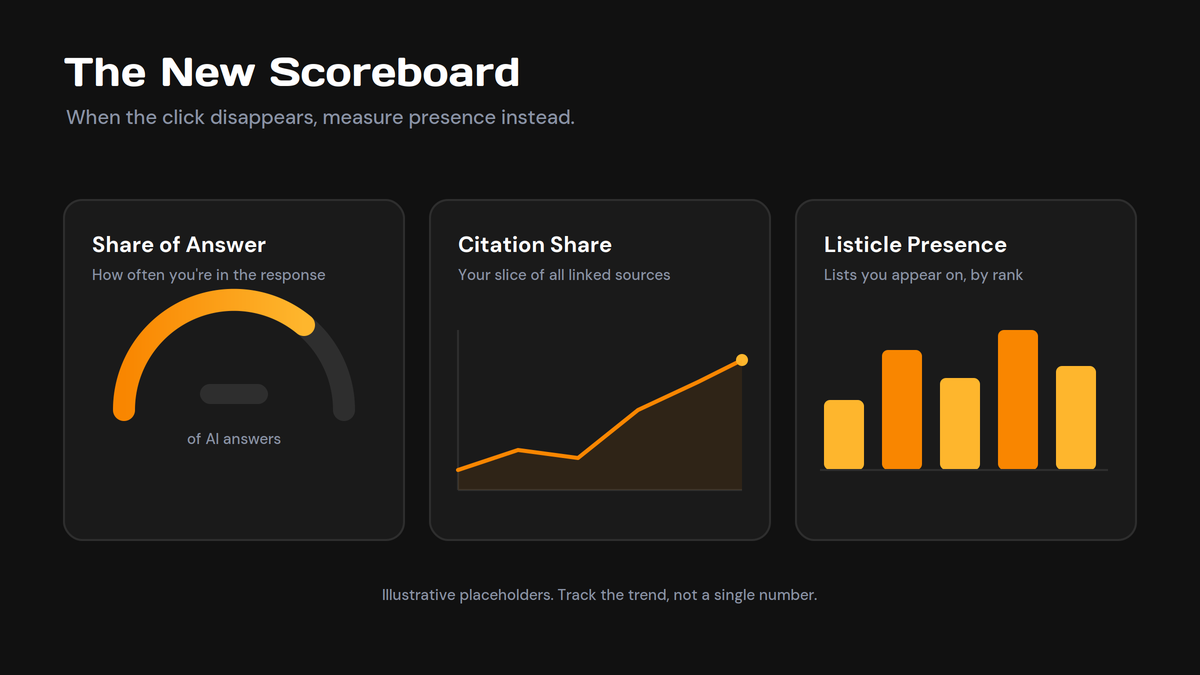
Watch those three and you can prove AI visibility is moving even on a quarter where raw clicks stay flat. Ignore them and you will swear SEO stopped working, right as it quietly changed jobs.
Coverage Depends on the Engine
One more wrinkle worth knowing. The pipes feeding these models are not identical, so your visibility changes by platform.
Reporting on ChatGPT’s plumbing suggests the business tier leans on Bing’s index, which means a top-ten Bing position can decide whether you make the answer. Consumer tiers pull from scraped Google results through other providers. The takeaway is not to chase one engine. It is to rank broadly, since the model you want to reach may be reading a different search index than the one you watch each morning.
The deeper your content sits across these indexes, the more often you survive the cut. We dug into how one prompt fans out into many of these background searches in our guide to query fan-out for GEO.
What Still Moves the Needle
Strip away the noise and the playbook for AI visibility looks a lot like good SEO with sharper aim.
- Rank for the money questions. The searches your buyers actually type before they buy. Rank there and you feed the AI answer. Miss them and you are invisible to it.
- Earn the roundup spots. Map the “best” listicles ranking for your category and get into them. Pitch, prove results, build the relationship. This is digital PR doing double duty.
- Win the review hubs. G2, Capterra, Clutch, and the directories show up again and again in AI citations. Real reviews on those pages are an asset now, not a vanity badge.
- Structure for clarity. Direct answers, clean headings, plain facts in text. Our guide to semantic SEO covers how to make a page easy for a model to read and trust.
None of that is a trick. It is the same durable work that earned rankings before the chatbots arrived, pointed at a new surface. That is the core idea behind our AI SEO services: the brands winning AI answers are the brands doing the patient work, ranking the right pages and earning the right mentions.
The Verdict
SEO is not dead. The headline writers want it dead since “the rules still apply” does not get clicks. Our test, and the studies around it, say the opposite. AI recommends what ranks. It quotes the listicles that rank. It names the brands inside them.
The unit changed from your page to the page that ranks you. Win that, and you win the answer.
Want to know which listicles and reviews AI cites for your category, and how to get into them? Book a call and we will pull the map for you.
Related guide: how AI search retrieves, grounds and cites sources.
Suggested

Our Ahrefs Health Score Went From 74 to 96. Here’s What Our AI SEO Agent Found.
Seven problems our AI SEO agent found on our own site, from leads GA4 never recorded to 195 pages linking through redirects, and how we fixed them.
October 8, 2026

How Our AI SEO Agent Cleared 1,186 Schema Errors in One Day
How our AI SEO agent and team took a Shopify store from 1,186 structured data errors, 12 404s and 155 broken links to zero in one day.
October 8, 2026

How to Integrate HubSpot and Tripleseat: Lessons From 9 Builds
A step-by-step guide to connecting HubSpot and Tripleseat: forms, OAuth 2.0, field and stage mapping, multiple locations, documents and monitoring, with real lessons from nine production integrations.
October 4, 2026
Answer-First Content: The Inverted Pyramid (∇) for AI Search
The inverted pyramid (∇) puts the answer first and the detail after. Here is how answer-first writing serves busy buyers and AI systems that quote short passages, with examples, common mistakes, and a checklist.
October 3, 2026

Retrieve-for-Train explained: how Google Research is speeding up AI search fan-out
Google Research’s Retrieve-for-Train method trains a small diffusion model to fan out search queries in one pass. Here is how it works, what it reports, where it stops, and our cautious read for brands.
October 3, 2026
Contact us
We value your privacy and won't share your email with others.
We'll only contact you with curated content.
