
Google just shipped the Open Knowledge Format, and the SEO world is split on what to do with it. Some say it’s the next big thing for AI search. Others say it has nothing to do with your rankings. Both camps are partly right.
Here’s the short version. Open Knowledge Format (OKF) is a way to package your business knowledge so AI agents can read it directly. It’s new, it’s free to try, and most of the takes online come from people who haven’t built one.
We did. We ran it on our own site, found where the easy path falls short, and fixed it by hand.
This piece breaks down what OKF is, if it belongs in your SEO work, and what we learned shipping it on alchemyleads.com. No hype. Just the parts that matter for marketing leaders deciding if this is worth their time.
What Is Open Knowledge Format?
Open Knowledge Format is an open spec that Google Cloud published in June 2026. It’s still early. The current release is version 0.1.
The idea is simple. You take your knowledge and write it as a set of plain markdown files. One file per concept. Each file carries a little structured data at the top, then the content below. The files link to each other, so the whole set becomes a connected map of what your business knows.
That map is the point. An AI agent can read it without scraping your site, calling an API, or guessing at your meaning. The knowledge is already clean, labeled, and connected.
OKF didn’t invent this pattern. It formalizes an idea Andrej Karpathy described as the “LLM wiki,” where a language model reads, sorts, and maintains a living set of notes instead of re-reading raw documents every time. Google turned that loose idea into a shared standard.
What makes it worth watching? It’s plain underneath. You can write it in any text editor. You can store it on GitHub. You can read it without special software. And the spec asks for almost nothing. The only required label on each file is its type. Everything else is optional.
So it’s flexible, open, and human-readable. Now the real question.
Is Open Knowledge Format Actually an SEO Thing?
Short answer: no, not directly. And that trips people up.
OKF is not a Google ranking signal. Google does not crawl your OKF bundle and bump your position because of it. It’s not public content built for search results. Google built it for data teams who want their own AI agents to understand internal tables, metrics, and reports. The reference examples point at BigQuery and GA4 data, not blog posts.
So why does it matter to anyone in search? Because the line between SEO and AI search keeps blurring. We’ve written before about how AI search is part old SEO and part something new. OKF sits in that new part. It won’t move your blue-link rankings. It can help the agents that read your business understand it.
There’s a discovery angle too. You can point agents at your knowledge with an llms.txt file, the same way a sitemap points crawlers at your pages. OKF gives those agents something structured to read once they arrive.
So OKF isn’t SEO. It’s closer to GEO. And that’s where it gets interesting.
How an Open Knowledge Format Bundle Is Structured
A bundle is just a folder of markdown files. Two parts make up each file.
At the top sits a small block of structured data called frontmatter. It holds a few labeled fields. The spec only demands one of them.
| Field | Required? | What it holds |
| type | Yes | What kind of concept this is (Article, Playbook, Metric) |
| title | No | A human-readable name |
| description | No | A one-line summary |
| resource | No | The URL the concept maps to |
| tags | No | Topic labels |
| timestamp | No | When it last changed |
Below the frontmatter sits the body. Plain markdown. Write whatever the concept needs.
Two filenames are reserved. An index.md acts as the front desk, listing what’s in the bundle so an agent knows where to look. A log.md tracks changes over time. One quirk to know: the index file is the one file that should carry no frontmatter.
Links tie it together. When one concept references another, you link the files. Do that across the bundle and you get a graph, not a pile. That graph is what separates a real bundle from a folder of loose notes.
The WordPress Plugin: What It Gets Right
You don’t have to build a bundle by hand. Suganthan Mohanadasan, an AI SEO consultant, built a free WordPress plugin that does it for you.
Install it, activate it, and it turns your published pages into an OKF bundle. It serves that bundle live at a tidy address: yoursite.com/okf/. It even draws a graph of how your content connects.
The best part is the upkeep. The plugin regenerates the bundle on its own every time you publish, update, or delete a post. No manual exports. No stale files. Your knowledge layer stays in sync with your site.
We ran it on alchemyleads.com. In one pass it produced 216 concepts from our published pages and put them online in minutes. For a free tool, that’s a strong start. If you want an OKF bundle today with near-zero effort, this is the fastest way there.
So the plugin nails the easy 80%. Setup, hosting, and sync are handled. But there’s a catch, and it’s the part that decides if your bundle is useful to an agent.
What the Plugin Misses: Pages Versus Concepts
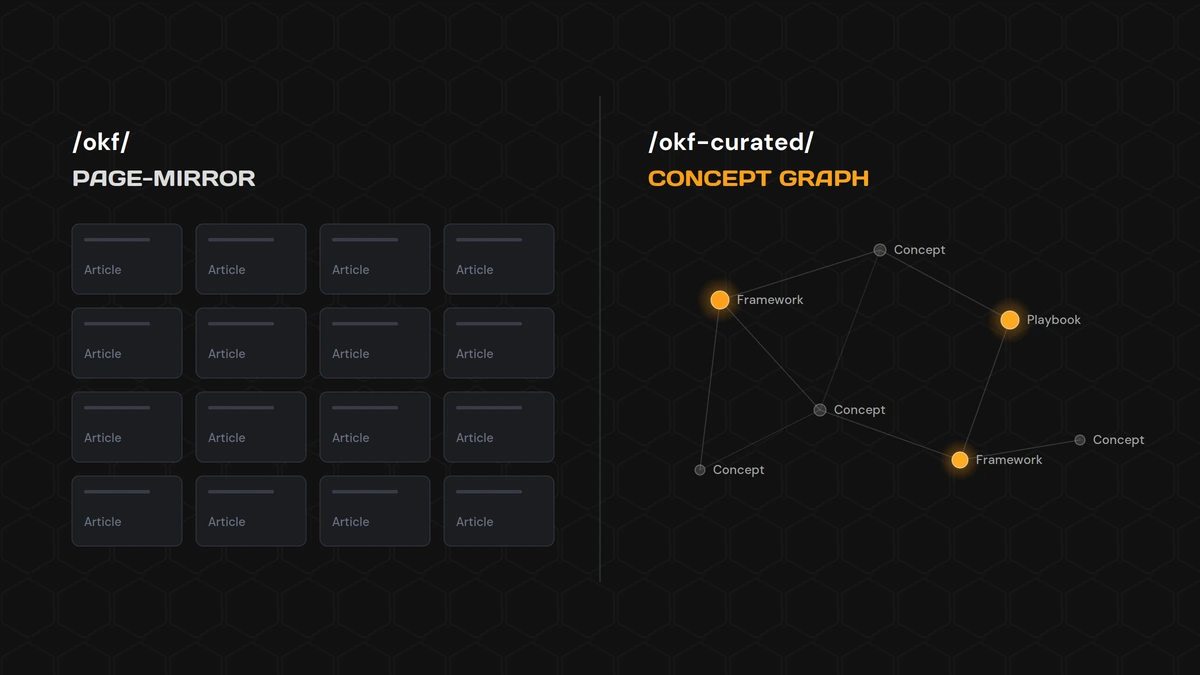
Here’s the catch. The plugin makes one markdown file per existing page. Your About page becomes one file. Each blog post becomes one file. Every file gets the same type: Article.
That’s a mirror of your website. Handy, but it’s not what OKF was built for.
Remember the spec. A concept is one unit of knowledge, not one web page. A single page might hold three concepts. Three pages might describe one. The real value shows up when you pull those concepts apart and name them: a process, a metric, a definition, a play you run.
| Page-mirror (the plugin) | Concept graph (the spec) | |
| Unit | One file per page | One file per idea |
| Type | Everything is “Article” | Framework, Playbook, Metric, more |
| Value to an agent | Reads like your sitemap | Reads like your expertise |
This is the same shift we cover in entity-based SEO for AI search. Agents reward clear, named entities over loose pages.
Pulling concepts out of pages is human work. The tool doesn’t do it yet. That’s not a knock on the plugin. It’s the line where automation stops and strategy starts.
How We Built the Concept Layer Ourselves
So we built the second layer by hand.
We left the plugin’s bundle alone at /okf/. Then we added a separate bundle at /okf-curated/, written concept by concept. This is where our actual expertise lives, not a copy of our pages.
We split it into two kinds of files.
Concepts describe what we know. We wrote one for the Revenue First SEO approach, typed as a Framework. We added concepts for GEO and topical authority.
Playbooks describe what we do. We wrote a play for diagnosing a traffic drop, one for GEO content work, one for a technical SEO audit, and one for digital PR. Each is typed as a Playbook, with the trigger and the steps spelled out the way an agent could follow them.
Then we linked them. The traffic-drop play points to the audit play. The Revenue First concept points to the plays that deliver it. Cross-linked, the set reads like a connected map of how we think.
We checked every file against the version 0.1 spec, served the bundle as proper markdown, and pointed our llms.txt at it so agents can find it.
The difference is night and day. The plugin bundle tells an agent what pages we have. The hand-built bundle tells an agent how we solve problems. One is a directory. The other is knowledge.
What Open Knowledge Format Means for GEO and Your Brand
Step back and look at where search is going. AI answers don’t rank ten links. They pick sources, pull facts, and cite a few. That’s a citation game, and it runs on how well a machine can read and trust your knowledge.
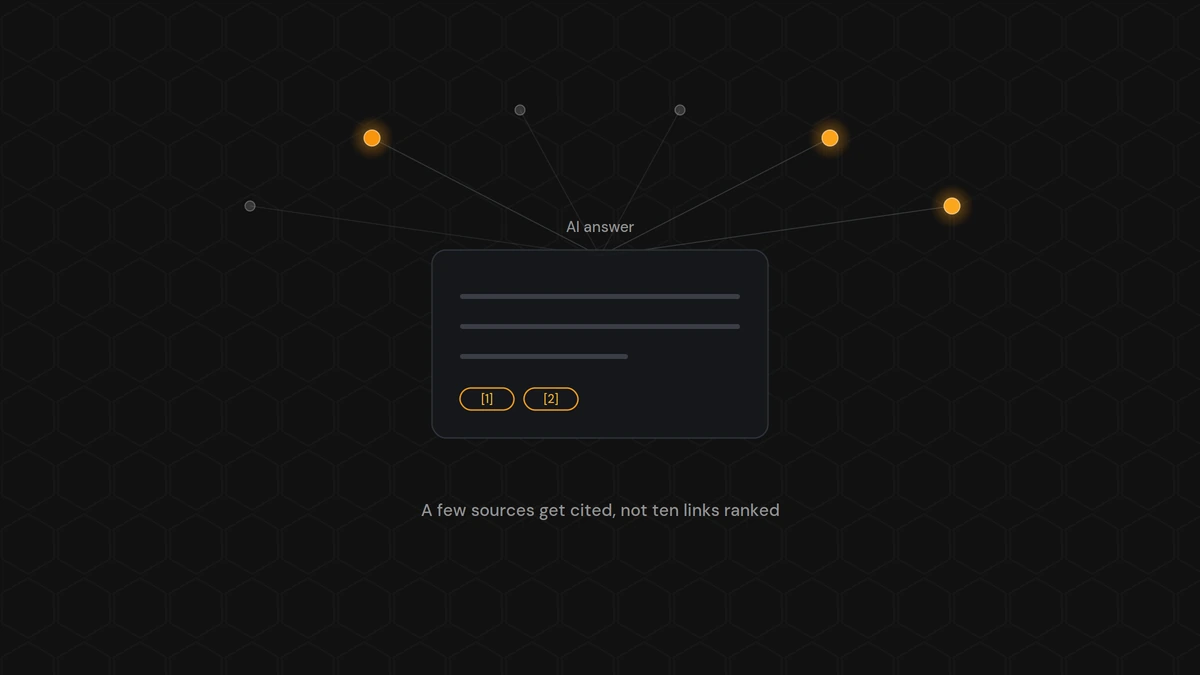
OKF feeds that directly. Clean, labeled, connected knowledge is easier for an agent to quote than a wall of page copy. Pair it with an llms.txt pointer and you’ve made your expertise simple to find and simple to use. This connects to how generative engines fan out a single query into many smaller questions, then build an answer from the best sources.
Does this work move revenue? The AI-search motion behind it already has. For one B2B industrial cleanroom client, a cleanroom manufacturer, we paired question-shaped content, third-party authority building, and technical cleanup. The result was a 170% sales pipeline lift in 90 days.

OKF is one more input to that same machine. It won’t carry a brand on its own. It makes the knowledge that wins citations easier for agents to read. For brands sitting on real expertise, that’s a head start worth taking.
Should You Implement Open Knowledge Format Now?
It depends on what you’re sitting on.
OKF is version 0.1. It’s early, it’s free, and the standard will change. The cost to try it is low. The upside is being early on a format that agents are starting to read.
Run the plugin for a baseline bundle. That part takes an afternoon. The edge comes from the next step: pulling your real concepts and plays into their own files. The brands that win here have proprietary knowledge worth reading. A process. A method. A point of view.
If that’s you, this is worth a look now. Our AI SEO services cover this kind of early-mover work. If your knowledge is thin or generic, wait. The format will still be here when you have something worth feeding it.
Where AlchemyLeads Fits In
Open Knowledge Format won’t replace your SEO. It won’t lift your rankings overnight. What it does is make your expertise readable by the agents that more buyers now trust.
The plugin gets you a bundle. The real work is turning your knowledge into something an agent wants to cite. That’s the part we do every day, across SEO, GEO, and AEO.
Want to put your knowledge to work for AI search before your competitors do? Book a strategy call with AlchemyLeads. We’ll show you where to start.
Related guide: how AI search retrieves, grounds and cites sources.
Suggested

How to Integrate HubSpot and Tripleseat: Lessons From 9 Builds
A step-by-step guide to connecting HubSpot and Tripleseat: forms, OAuth 2.0, field and stage mapping, multiple locations, documents and monitoring, with real lessons from nine production integrations.
October 4, 2026
Answer-First Content: The Inverted Pyramid (∇) for AI Search
The inverted pyramid (∇) puts the answer first and the detail after. Here is how answer-first writing serves busy buyers and AI systems that quote short passages, with examples, common mistakes, and a checklist.
October 3, 2026
Retrieve-for-Train explained: how Google Research is speeding up AI search fan-out
Google Research’s Retrieve-for-Train method trains a small diffusion model to fan out search queries in one pass. Here is how it works, what it reports, where it stops, and our cautious read for brands.
October 3, 2026

AlchemyLeads Launches Free AI Visibility Checker That Shows Brands Whether ChatGPT and Google AI Recommend Them
The tool scores a website’s AI readiness, checks which AI crawlers can reach it, and runs real buying questions through AI answer engines to show which competitors get named instead. LOS ANGELES, Calif. — AlchemyLeads, an SEO and generative engine optimization (GEO) agency, today launched the AI Visibility Checker, a free tool that tells businesses whether AI assistants such as
September 25, 2026

The Future of Natural Language Processing, Machine Learning & what it Means for Your Digital Business
One of the most important things to know about in today’s market is the future of natural language processing and machine learning. If that sounds like Greek to you, don’t worry, we’ve got your back. Running a business today is significantly more complicated than it was in previous years. As a modern business owner, not only are you expected to
September 10, 2026
Contact us
We value your privacy and won't share your email with others.
We'll only contact you with curated content.
