
Executive AI Search Brief · Issue 03 · June 29, 2026
Who Owns AI Search Now?
hint: not the marketing manager
i’ll be blunt: this stuff is moving at a breakneck pace, and waiting too long now means falling behind in ways that get expensive to undo. just in the four weeks since the last brief, an AI agent shipped straight into people’s phones, bot traffic went through the roof, the money chasing AI agents landed on real budgets, and a giant consulting firm got caught vibe-coding knockoffs of the companies it’s about to buy. any one of those would’ve been the story on its own last year.
and here’s the real reason for this issue. AI search isn’t just what shows up in google. it’s shaped by what your customers say about you on social, on review sites, in the press. if you want an AI to call you the best at something, you have to actually be the brand that earns those signals: real reviews, real coverage, a real reputation. and your website is now the knowledge base AI agents read to understand who you are, so you have to genuinely know your customers, where they are in their buying journey, and the place you hold in your market. that’s how you come to own those concepts. and that job sits with leadership, well above any one channel owner.
heads-up: same as last time, this runs long by design. fewer emails, more signal. start with the story in section 01. what we’re building is in section 06.
01 / THE PACE, IN ONE (SLIGHTLY UNHINGED) STORY
There’s a story from this month that pretty much sums up where all of this is heading.
Bain & Company got caught quietly vibe-coding rough copies of the software companies its private-equity clients are about to buy. They use AI to rebuild a target’s product from the outside, before the deal closes, just to see how hard it really is. Hundreds of these knockoffs now, and it’s regular consultants doing it, not just engineers. The question it puts on the table is a rough one: if we can clone the guts of your product in a few days, what are we actually paying a premium for?
At least one investor reportedly backed out of a deal because the knockoff came out good enough.
The takeaway isn’t “wow, AI can code now.” It’s that the moat moved. When anyone can copy what your product looks like over a weekend, the hard-to-copy stuff is your reputation, the category you own in people’s heads, and whether you’re the name that comes up when a buyer (or their AI) goes looking.
So being known, and being the one that gets recommended, is the moat now. That’s not a marketing nicety. It shows up on the balance sheet, and it’s what this whole brief is about.
02 / THE MONTH THE AGENT LEFT THE SEARCH BOX
Last month the AI agent lived inside the search results. This month it moved into the phone itself.
Gemini Spark is a personal AI agent that runs on its own in the background, and it keeps working even when your phone and laptop are off. It’s rolling out to Google’s Ultra subscribers on both Android and iPhone in the US, with a new Android screen called Halo where you watch it work. You hand it a goal and it goes and does the thing: across Gmail, Calendar, Docs, and a growing pile of outside tools. Later this summer it’ll run inside Chrome and browse the web for you.
And the fact that it runs on iPhone at all is the real tell. Apple just agreed to build the next Siri on Gemini too, so Google is quietly becoming the AI layer on every phone, not only its own. Pixel or iPhone, the agent in your customer’s hand increasingly runs on Google.
Sit with where that lives for a second. This isn’t an app anyone has to go download. An agent that can actually take actions is now baked into the device most of your customers carry around all day, and it can buy things for them.
Want proof of where Google thinks this is going? They quietly added a WebMCP check to Chrome’s Lighthouse tool. WebMCP lets your site spell out its own actions, like “here’s the search box, here’s add-to-cart,” so an agent can just use them instead of screenshotting the page and guessing where to click. Google is now literally grading whether an agent can operate your website. Same move as the llms.txt thing last month: watch what they build, not what they say.
When an agent can’t get through checkout on your site, it doesn’t throw an error or email you about it. It just quietly gives up and buys from someone else. That’s a product problem, and product will never spot it in a marketing report.
03 / AI BOT TRAFFIC TRIPLED, AND THAT’S YOUR CUSTOMERS
Now go look at your own traffic, because a real chunk of it isn’t human anymore.
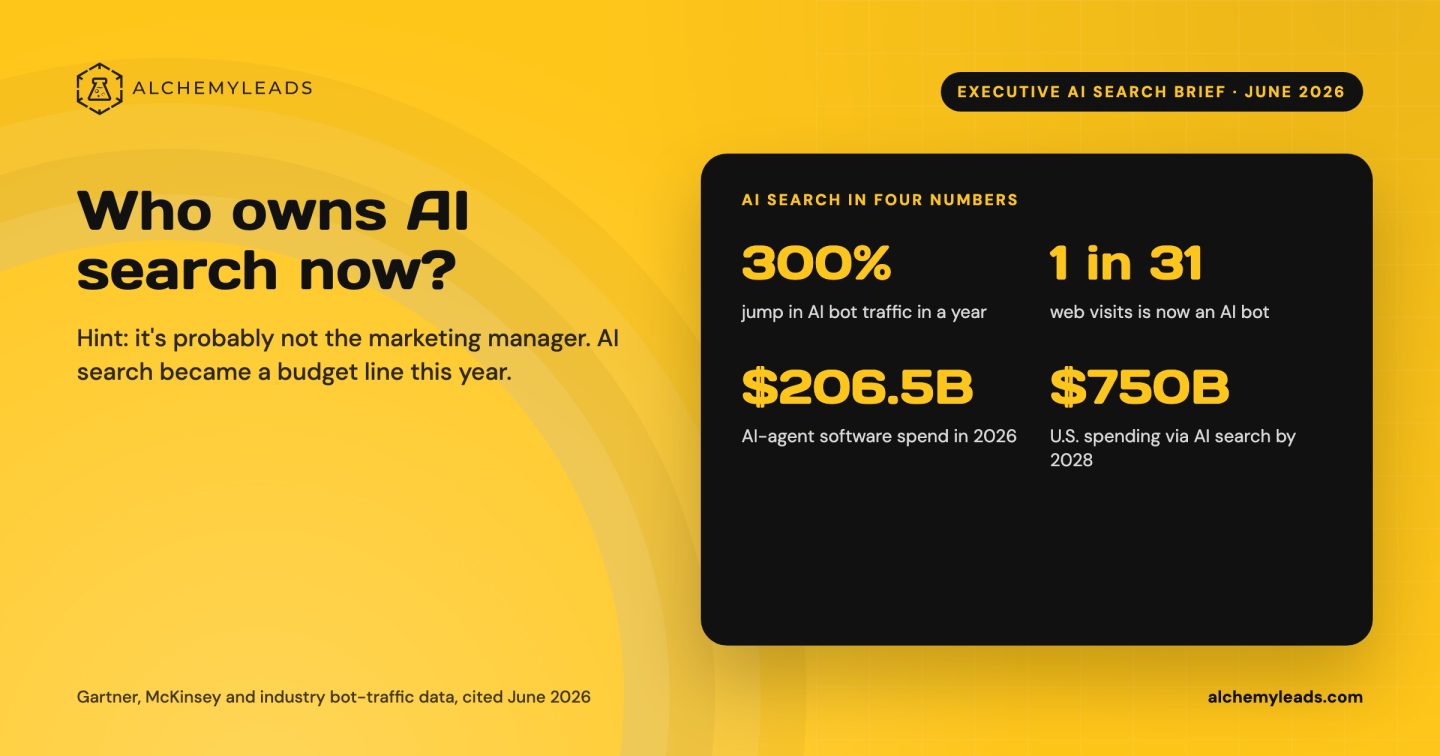
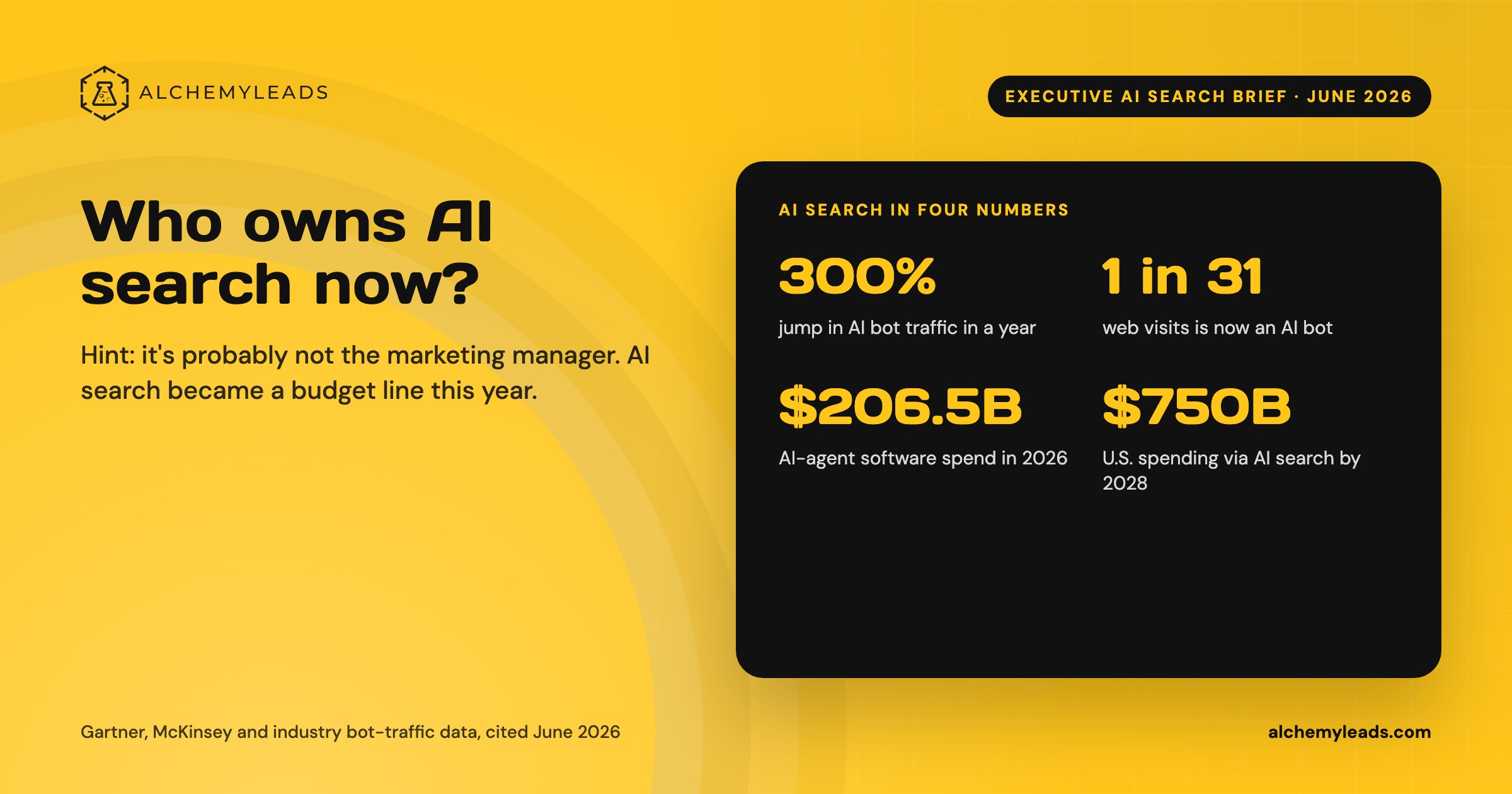
- AI bot traffic jumped around 300% in a single year.
- Roughly 1 in 31 web visits is now an AI bot, up from about 1 in 200 a year earlier.
- One bot alone hit a site with 3.75 million add-to-cart requests in a day, on the expensive, dynamic pages.
The reflex is to write all that off as junk and block it. Don’t. This is your customers changing how they shop. By 2027 most people will have an AI agent on their phone doing the searching and buying they do by hand today, so more and more, the “bot” hitting your site is a real person with a real wallet behind it.
Before long, agent traffic is the clearest read on real buyer intent you’ve got. If your reports still throw out bots as noise, you’re quietly throwing out your buyers too. That’s a number the C-suite needs to be looking at.
04 / FOLLOW THE MONEY: IT’S A BUDGET LINE NOW
A marketing tactic never gets its own line on a board deck. A platform shift does. This month the money settled which one this is.
- Gartner expects about $206.5B spent on AI-agent software in 2026, up 139% in a year. It’s the fastest-growing piece of enterprise software there is, and it’s moving from pilots to real budget.
- McKinsey expects $750B of U.S. consumer spending to run through AI search by 2028. That’s not a traffic stat. That’s where the revenue goes.
- Perplexity passed about $500M in annual revenue (up roughly 335% in a year), made its Comet browser free everywhere, and got its answer engine in front of Snapchat’s billion-odd users. This isn’t one competitor to keep an eye on anymore.
- Apple handed its brain to Google. The most locked-down, build-it-in-house company on the planet picked Gemini to run the next Siri, a multi-year deal worth around $1B a year, with that new Siri landing later this year on roughly 2 billion devices. So the assistant on iPhones and Android phones alike is increasingly running on the same engine.
Why this lands on the org chart, not just the marketing plan
Product decides whether an agent can even read your site and get through checkout. That’s an engineering and UX call, not a content calendar.
Brand decides what the AI says about you, because the agent boils your whole message down to one answer. How clearly you own your space is a brand and comms job now.
The C-suite owns the bet. When $750B starts moving through AI answers, “is the agent picking us?” is a board-level question with real budget behind it.
We count cash collected, not citations. The people approving the budget should too.
05 / WHY THIS STOPPED BEING SEO’S JOB
Last issue we argued that GEO is really a CMO problem, not an SEO one. This month pushes it even further up the chain.
While the agent lived in a search box, you could still call AI search a marketing job, just a new way to win the same visibility fight. The minute it moved into the phone and started actually buying things, that stopped holding up. Getting mentioned in the answer is marketing. Being a site an agent can read, trust, and check out on pulls in product, engineering, brand, and finance all at once.
And here’s the part the “GEO hacks” crowd skips right past: most of this comes down to positioning, and markup only gets you so far. What is your brand actually known for? What do you want to be known for that you’re not yet? An AI recommends the brand it understands to own a space, and if that’s fuzzy, no amount of FAQ schema or auto-generated llms.txt is going to save you. That’s brand and category strategy, which loops right back to the Bain story: once the features are easy to copy, the category you own is the moat.
AI search is roughly 60% the classic SEO motion and 40% genuinely new, and that 40% lives outside the marketing department. It’s why, in 2026, the people owning GEO and AEO execution are increasingly C-suites, VPs, and executive leadership, rather than the “marketing manager” and “marketing director” types who have historically run “SEO.”
06 / WHAT WE’RE BUILDING TO STAY TEN STEPS AHEAD
We don’t sit around waiting for these standards to get blessed as official. We build for them while they’re still half-formed, same as we did with our own EntityMap last month, before the engines ever came looking for one.
Right now we’re building the next wave of AI SEO frameworks for our partners. The goal now is getting read correctly by AI agents, on top of ranking in regular search. A few of the standards we’re already working in:
- Markdown for Agents: a clean, stripped-down version of your content that agents can read cheaply, without wading through the clutter that trips up crawlers
- LLMs.txt: basically a map that tells AI agents how to read your site instead of leaving them to guess
- EntityMaps.json: the structure that tells LLMs what your concepts mean and ties your name to them, so you still get the credit once everything’s been chopped up into a database
- Agent Resource Discovery (ARD): the newest one, just published by Google and ten other companies this month. You drop an ai-catalog.json file on your site that lists what you can do for an agent, and a registry reads those files so an agent can ask “who handles X” and get a real answer. Think of it as the index for the agent web, and we’re already building these for clients.
None of this is theory. It’s the unglamorous groundwork that decides whether an AI hands the buyer your name or your competitor’s when their agent goes shopping.
Coming soon: a done-for-you AI SEO agent that handles the heavy stuff, like full site migrations, on its own. Full breakdown in a future issue. Keep an eye out.
WHAT DO CHATGPT, CLAUDE, GEMINI & PERPLEXITY SAY ABOUT YOU?
We run an LLM Citations Report, The Invisible Index™, that shows you exactly what the AI engines say about your brand right now: where they cite you, where they don’t, where they’ve got you wrong, and what to fix before agents start buying and selling around you.
or reply to this email with your domain and i’ll run it for you.
talk soon,
Sean
Founder, AlchemyLeads®
Sources
The moat moved: Bain vibe-codes its targets
The agent goes autonomous
• Google: The Gemini app becomes more agentic (Gemini Spark, 24/7)
• Joint statement: Apple Foundation Models to be based on Google Gemini (Siri)
Google’s agentic tooling tell: WebMCP audit
• Bastian Grimm: Google just shipped a WebMCP audit in Chrome
• Chrome for Developers: Lighthouse Agentic Browsing scoring (WebMCP, llms.txt)
The bot-traffic reality
• Kinsta: AI & Bot Traffic: Findings from 10 Billion Requests
The money following the agents
• 79 Development: State of AI Search 2026 (McKinsey $750B; Perplexity)
• Gartner forecast: ~$206.5B AI-agent software spend in 2026 (+139% YoY)
GEO is a category problem
• Gaetano DiNardi: nearly all GEO problems are category/product problems
The discovery layer we’re building for
• Suganthan Mohanadasan: I shipped Agentic Resource Discovery on my site
AlchemyLeads coverage
• Agentic Engine Optimization (AEO): 6 Things Every CMO Should Be Learning Right Now
• Is AI Search Just SEO? The AlchemyLeads Take
• AlchemyLeads EntityMap: live on our site
AlchemyLeads®: Specialized GEO/SEO and content strategy consultancy
Founded 2017 · 95% of new clients since 2020 stayed past 12 months · 22 five-star Google reviews
Built on the Good SEO® Framework · USPTO 90568504 / 98690186
