
Client: a B2B industrial equipment manufacturer that sells US-built equipment to plants, terminals and fleets.
What the AI SEO agent did: rated every page on the site against a Quality Rater Guidelines-style rubric, joined each rating to 90 days of Search Console data, ranked what to fix first, and re-rated the pages after every round of fixes. Four rounds, one afternoon.
The short version
- 40 pages rated in a few minutes, for about a cent in model costs. 9 rated High, 21 Medium, 10 Low.
- 6 pages made the “fix first” list: low quality and already earning impressions, including one page with about 1,450 impressions in 90 days.
- The average rating of those 6 pages went from 3.3 to 5.2 out of 9. Every one of them moved up. The industries hub went from Low to Medium+, the product catalog from Low+ to Medium+, and the online store from Low to Medium.
- It caught things a human review missed: an unfilled template placeholder on a live page, a typo in the company’s main trust line, copy duplicated between two industry pages, and two technical claims that didn’t match the standards they cited.
How the quality rater works
Google pays human raters to judge pages against its public Search Quality Rater Guidelines. Raters don’t rank pages directly. Google uses their judgments to evaluate and improve its ranking systems. AI assistants make a similar call every time they pick a page to quote. We built that judgment into our AI SEO agent so it can run on every page of a site, every quarter.
- Crawl. The agent reads the sitemap (including nested sitemap indexes) and fetches every page politely, the way a crawler would. Firewall-blocked pages are counted and reported, never guessed at.
- Extract. For each page: title, H1, meta description, schema types, author and date markup, and the main content with navigation, headers, footers and forms stripped out.
- Join Search Console. 90 days of clicks and impressions per page, so every rating comes with its traffic.
- Rate. A small, fast model rates pages in batches of 8 against our rubric: page purpose, effort and originality of the main content, expertise and who stands behind it, reputation signals, and a higher bar for pages that touch safety or money. The scale runs 1 to 9, Lowest to Highest.
- Prove it. Every issue the model flags has to quote the text it’s based on, and every rating has to echo back the page path it belongs to. A human can verify any finding in seconds.
- Rank. Fix first: low quality with traffic. Prune or merge: low quality, no traffic. Weak sections: clusters where 40% or more of pages rate Low. Build out: sections averaging Medium+ or better.
- Report. A bubble map of quality against impressions, a CSV of every page, and a short Slack digest. The agent never edits the site on its own. Rewrites go through approval, and anything touching specs, standards, pricing or legal copy is plan-only.
What it found
The site was mostly fine, with a cluster of weak pages in one section. The findings were specific:
- An unfilled template placeholder on a live page, with example values still in square brackets inside a product description. Every visitor and every AI crawler could see it.
- A typo in the company’s main trust line (a missing space in the years-in-business claim), repeated on a high-impression page.
- An unsourced anecdote about an unnamed customer site, used as evidence in a risk section.
- Wrong-discipline content: electrical wiring terms in a section about a different kind of protection, an off-topic sentence about another industry, and a paragraph on standards from a different engineering field.
- Legal text copied word for word from one page onto another.
- Thin utility pages: an online store with no products on it, a catalog that listed category names only, and a quote page with no phone number or email.
Three rounds of fixes
Round 1: remove what hurts. We removed the placeholder, the anecdote and the off-topic material, fixed the typo, rewrote one technical paragraph in the right terms, shortened the copied legal text to a summary that keeps its key condition and links the full terms, and added phone and email to the quote page.
Round 2: add what’s missing. We pulled the client’s own product data (28 products, their materials and what each is built for) and turned it into a “which one do I need?” selection table on the catalog page. We put real products, with buy buttons, on the online store page. We softened a safety claim so it describes exactly what the equipment does.
Round 3: fix the template. The industries hub was rated Low because its theme template never printed the page’s own intro, and its cards showed titles only. Two small template changes, made through the theme editor with its built-in error check, put the intro on the page and gave every card the opening line of its own industry page.
Round 4: re-rate and verify. The agent re-rated all six pages and confirmed every change live, as a logged-out visitor.
| Page | Before | After |
|---|---|---|
| Product catalog | Low+ (4) | Medium+ (6) |
| Online store | Low (3) | Medium (5) |
| Industry page | Low (3) | Medium (5) |
| Quote request | Low+ (4) | Medium (5) |
| Industry page | Low (3) | Low+ to Medium+ (4–6 across runs) |
| Industries hub | Low (3) | Medium+ (6) |
| Average | 3.3 | 5.2 |
Each rating is one model pass, so a page can move a point between runs. We report the range where it moved. The direction held on every page.
What the agent left for humans
On the final pass, the rater flagged a technical rating claim that didn’t match the standard it cited, plus a safety threshold with no clause reference. An agent should never rewrite statements like these. Both are flagged for the client’s engineers to confirm. The agent finds and ranks. People decide anything that touches specs, standards or code.
The cache catch
After the template change, the agent re-rated the hub and still saw the old, empty page. The fix was live, but the site’s page cache was serving the previous version to every visitor and every crawler, including Googlebot and AI crawlers. Saving a post clears its own cache. Editing a template does not. A browser check with a cache-busting URL had looked fine. The agent’s crawl, which sees exactly what a bot sees, did not. One cache purge later, the hub rated Medium+. If a fix doesn’t show up in the crawl, it doesn’t count.
What we fixed in the agent
We also tightened the agent itself. On an early re-check, our review caught the model numbering pages in a different order than we sent them, which put a few ratings on the wrong URLs. Now the model has to echo each page’s path with its rating, and the agent matches each rating by that path. It also tolerates the different ways models format a reply, and it logs any reply it can’t read so a person can look. We found the issue by checking the agent’s work against the live site, which is the habit this whole system is built around.
Why this matters for AI search
AI assistants quote pages they trust. A live placeholder, a copied block of legal text or a technical claim that contradicts its own standard tells a model, and a buyer, that nobody is minding the page. For an equipment manufacturer, that gap shows up as fewer quote requests from engineers who are comparing vendors. Finding those pages used to take a manual content audit. Now it’s a quarterly job in our AI SEO agent, with a map, a ranked fix list, verified quotes and a person approving every change.
See how our AI SEO agent works or book a call to get a quality map of your own site.
Suggested
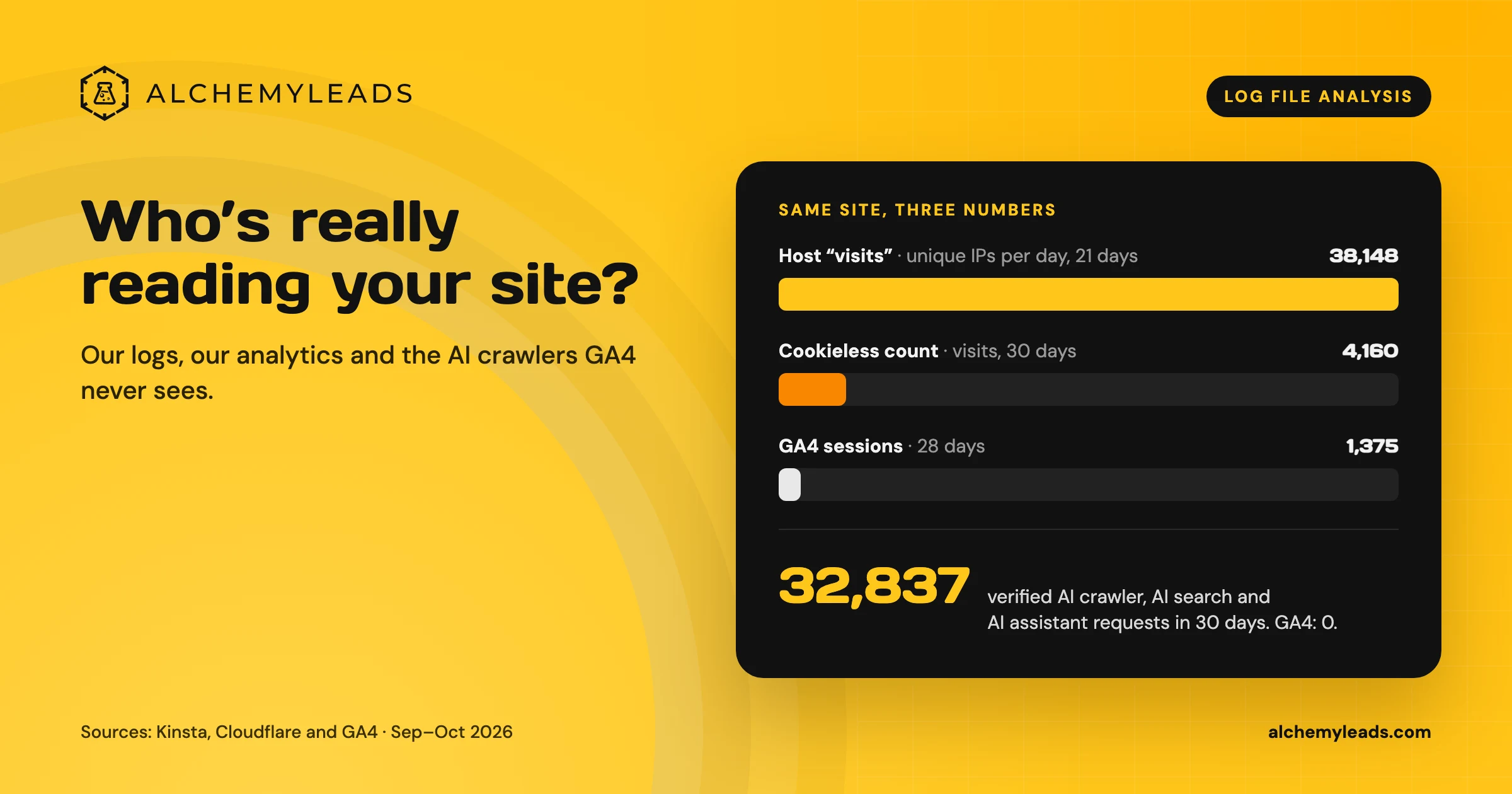
Log File Analysis for AI Search: Our Logs Showed 38,148 Visits. GA4 Showed 1,375.
Our host logged 38,148 visits. GA4 logged 1,375 sessions. We opened the server logs to see who was really there, and what AI crawlers read.
October 16, 2026
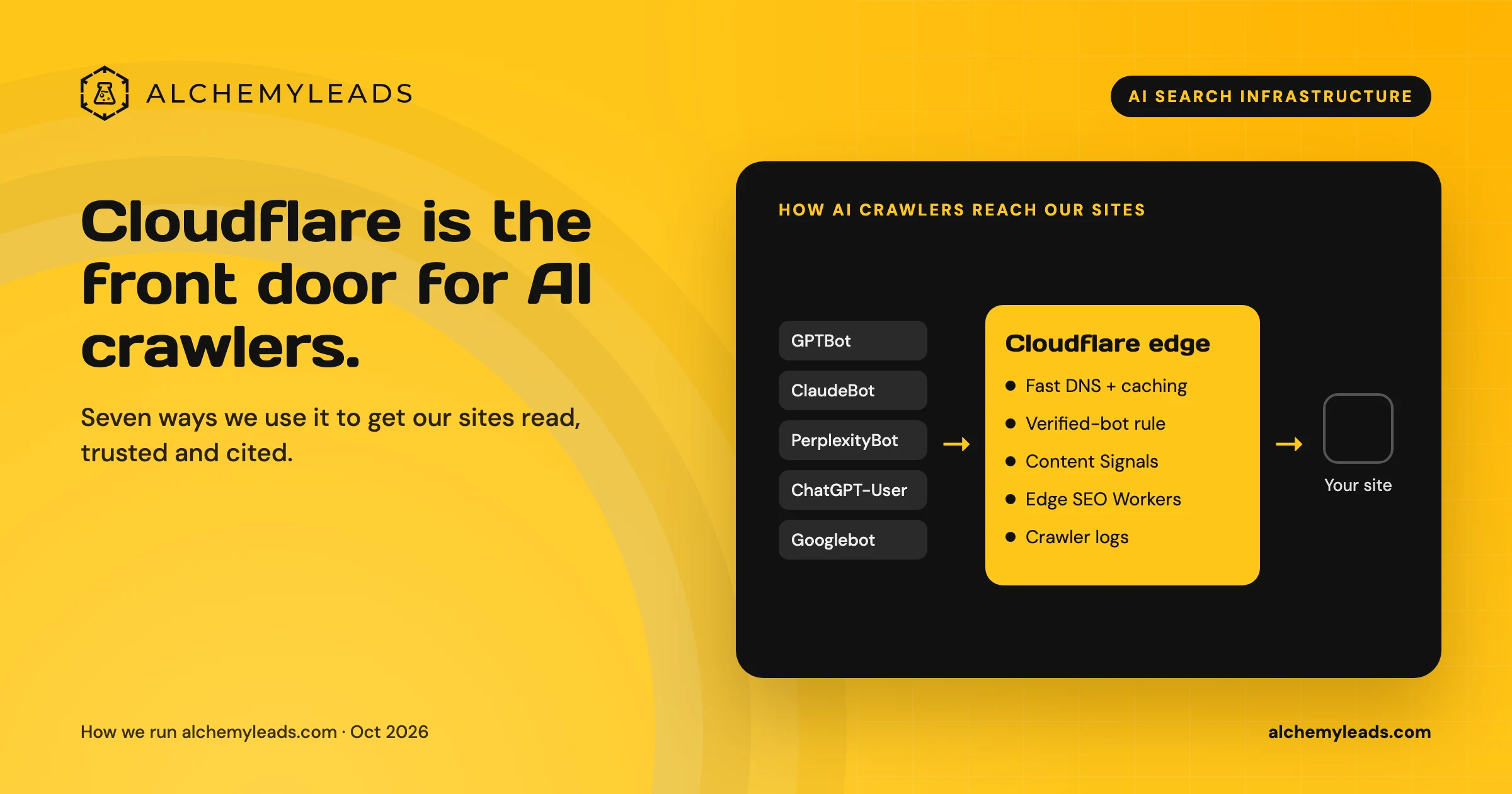
Why We Love Cloudflare for AI Search: 7 Ways We Use It for GEO and AEO
How we use Cloudflare DNS, bot rules, Content Signals and Workers to make our sites fast, crawlable and citable for ChatGPT, Claude and Perplexity.
October 16, 2026
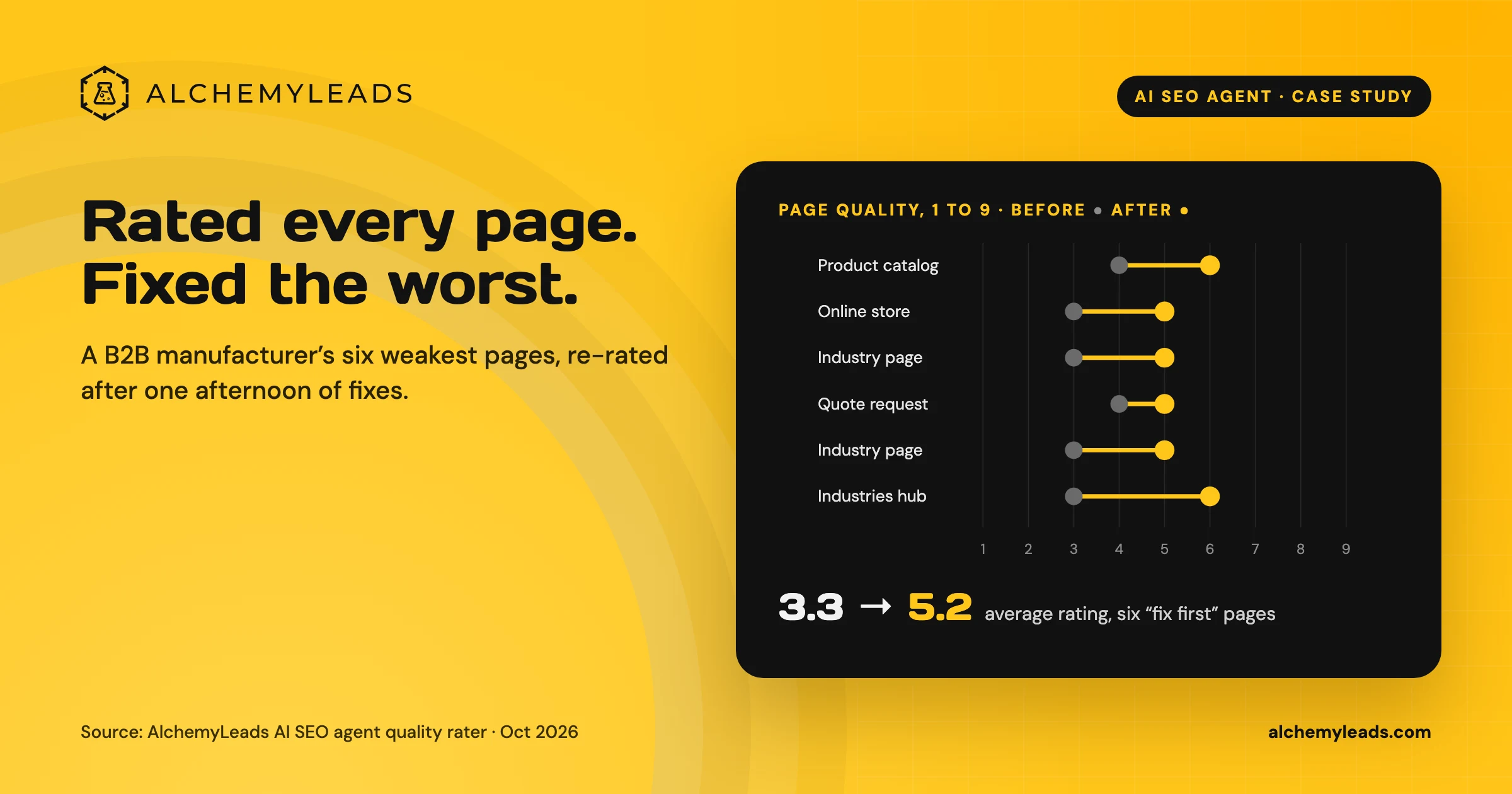
Our AI SEO Agent Rated Every Page on a Manufacturer’s Site, Then Fixed the Worst Ones in an Afternoon
Our AI SEO agent rated 40 pages of a B2B industrial equipment manufacturer’s site against a Quality Rater Guidelines-style rubric, joined the ratings to Search Console data, and lifted the six weakest pages from an average of 3.3 to 5.2 out of 9 in one afternoon.
October 16, 2026
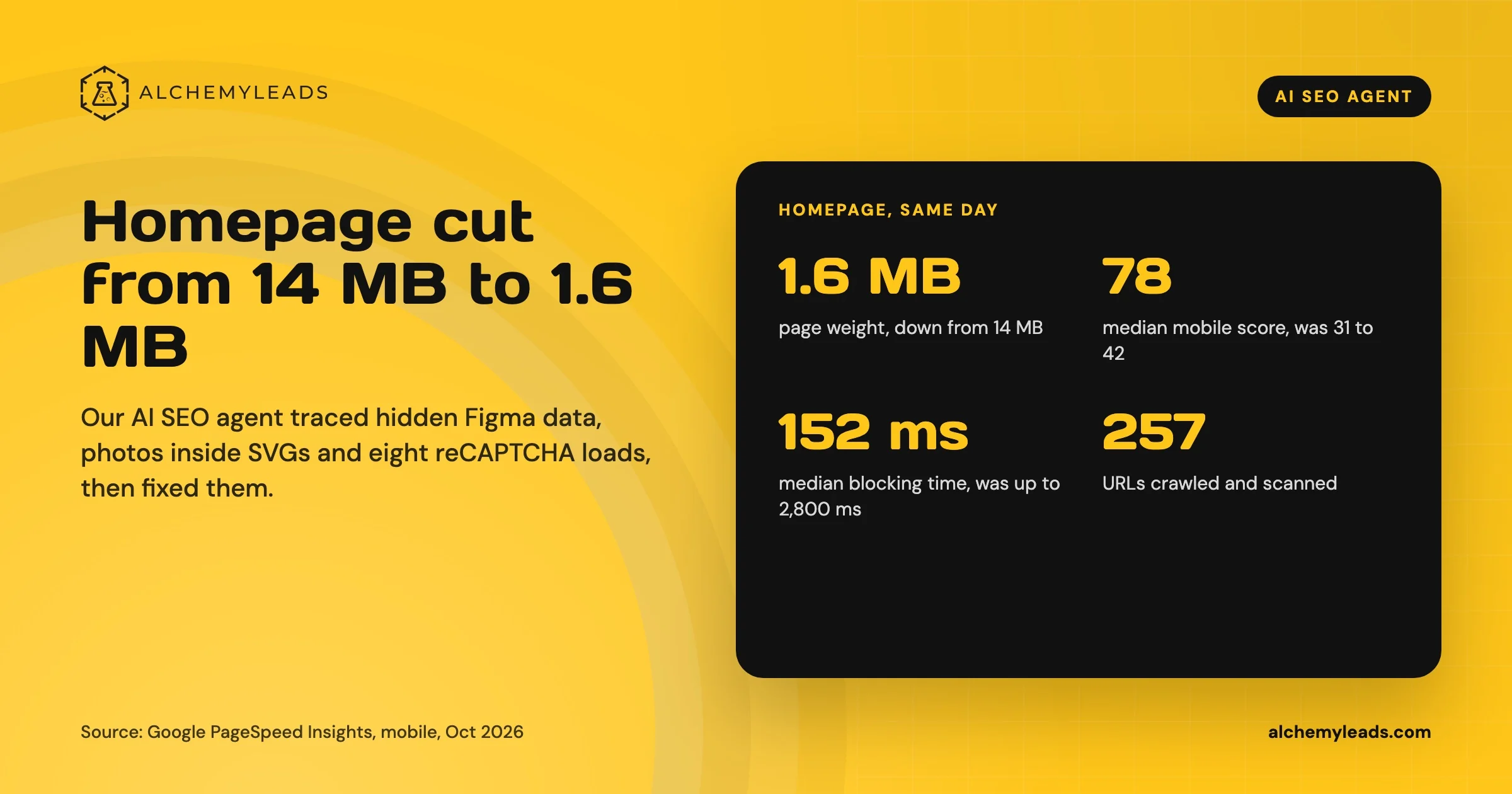
Our Homepage Went From 14 MB to 1.6 MB. Here’s What Our AI SEO Agent Found.
How our AI SEO agent cut our homepage from 14 MB to 1.6 MB: hidden Figma data, photos inside SVGs, a preloading video, eight reCAPTCHA loads, and the code behind each fix.
October 15, 2026
Gated Content and AI Search: Why We Turn PDFs Into Web Pages
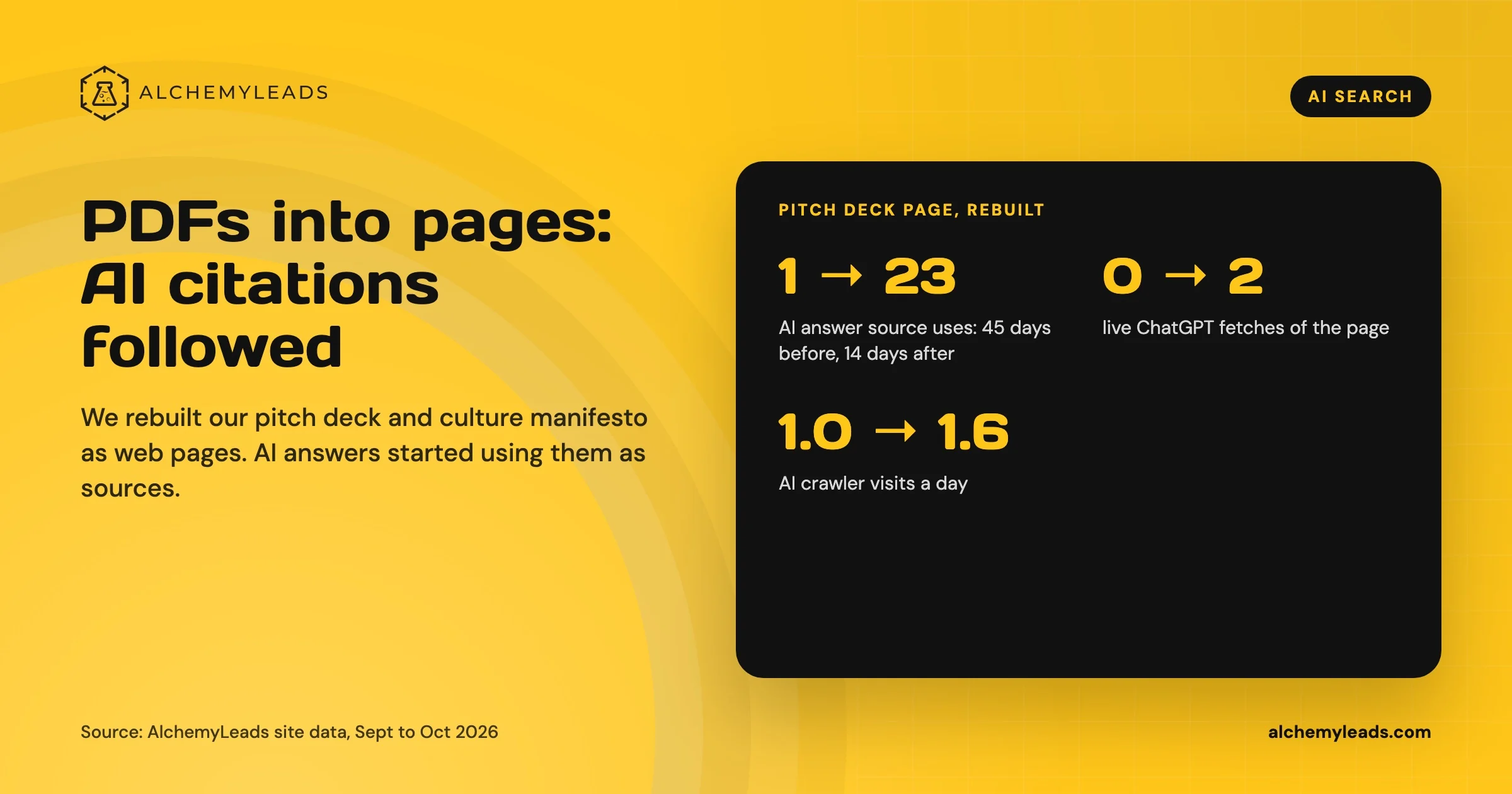
Gated content and PDFs hide your best information from AI search. Our before-and-after data from rebuilding two embedded files as web pages, and how to keep PDF downloads as a conversion.
October 14, 2026
Contact us
We value your privacy and won't share your email with others.
We'll only contact you with curated content.
