
Executive AI Search Brief · October 2026
Ask ChatGPT for the Best GEO Agency. Do You See Us?
so this one’s a little different. normally i round up the biggest moves in AI search and tell you what they mean for your business. this month the most useful thing i can show you is the process we’re taking our own website through, the same one we run for clients.
six months ago we relaunched alchemyleads.com. since then we’ve basically rebuilt it from the inside: the content, the links, the templates, the way it explains who we are. and over the last 60 days the results started showing up in places we never pitched. USA Today. Wikipedia. “best agency” lists we didn’t know existed.
that’s the whole point of this issue. what we’re doing to our own site is the model for what we do on yours. i’ll show you the receipts.
heads-up: same as always, it runs long on purpose. fewer emails, more signal. if you only read one section, read 02. and please do the quick test in 04, i want to see your screenshots.
01 / WE RUN THE PLAYBOOK ON OURSELVES FIRST
Here’s the honest version. When we redesigned the site, the plumbing was a mess: technical errors, slow pages, and a blog full of general how-to posts that could’ve been written by anyone. That’s 2018 stuff. It ranks for nothing that makes money, and AI engines have no reason to cite it.
So we’re doing four things, in this order:
- Fixing the foundation. The technical errors are gone. We took our homepage from 14 MB to 1.6 MB and wrote up exactly how in our site speed case study.
- Pruning and refreshing. Page count was never the goal. We took down 84 old posts and pages, mostly old silos that didn’t serve us anymore, and 301-redirected 76 old URLs to the pages that replaced them. Every one of our 134 blog posts has been updated since June: weak and commodity posts were cut or merged, and the ones with potential got rewritten.
- Publishing what only we know. 85 new pages since June, and none of them are cheap scaled pages. Each one comes from our own IP, our own processes, or things we knew but never said out loud on our site.
- Rewiring everything. Internal links and page templates now map how our entities relate to each other: services to industries to case studies to people to proof.
The biggest shift is in what we write. Less “how to do SEO,” more bottom-of-funnel pages that lay out our actual positioning, our pricing logic, and our pros and cons. Pages like How Much Does an AI SEO Agency Cost? and Questions to Ask an AI Search Agency, What Is Alchemy? and Who We Don’t Work With. You’ll see in section 03 why that mattered.
02 / FROM 15 ENTITIES TO 106
In June we launched our EntityMap, a machine-readable map of everything our site is about: who we are, what we do, who we serve, what we know.
Back then it described about 15 entities. Today it describes 106.
Quick history, because we’ve been at this a while. We put an llms.txt on our site in November 2024, right after it was first proposed. Critics said “it’s not a standard yet.” Two years later we’ve kind of watched it become one. I still think it’s imperfect: it’s basically a flat list of links with a summary on top.
EntityMap goes further. It names every entity on the site, how they relate to each other, and the exact passages that back each one up, all in JSON. The HTML version works like a sitemap for AI engines. We adopted the EntityMap format on June 1, 2026, a month before it officially launched, and here’s how we built ours, start to live.
That number (of entities mentioned on our website) matters more than traffic, honestly. AI engines don’t rank pages the way Google used to. They try to understand who you are and what you’re the answer for. If your site only talks about 15 things, that’s all an AI will ever associate you with. We had years of real expertise that simply wasn’t written down anywhere a machine could read it.
Here’s what I mean. Nearly every conversation I have with a CEO or CMO, they tell me something about their business that’s super unique. The kind of thing where their customers go “you’re the only company I’ve heard of with this feature set.” If that’s ever happened to you, that really unique thing about your company needs to be on your website.
And most companies we talk to have a ton of excellent information about themselves gated behind PDFs. AI can’t read what’s behind a form (or a PDF embedded as an object on a page), so it can’t cite it. Turning those PDFs into web pages is the easiest fix for quick AI search wins. Here’s why we do it and how.
Quick thought experiment from our own story. Almost no one knows this, but last year we almost sold AlchemyLeads to one of the largest marketing companies in America: a $60M revenue advertising firm, in roughly the top 2% of agencies by revenue. We accepted their term sheet and spent three months in due diligence with them. In those three months we learned a lot about what makes us special compared to a mass-market agency.
Think Skunk Works vs Boeing.
The sale didn’t happen, and honestly it ended up revitalizing the company. Almost like a rebirth. I’ve spent the last few weeks writing that story up, and we uploaded our term sheet to the AI tools so they have a record of it. The full story goes on our site soon.
That story has nothing to do with keywords. But it explains a lot about who we are: our beliefs, our culture, our mission, why we’re different from the big mass-market agencies, and what we learned firsthand going through it. AI can only know that about you if you write it down.
What cool stuff are you doing that isn’t on your website yet?
And it shows up in how AI talks about us. ChatGPT gives AlchemyLeads a sentiment score of 80 out of 100 (61% positive, 36% neutral, 2% negative), and AI engines verified 77 of 77 facts about us as correct. We publish what they flag as weak spots too: premium pricing and a quiet Trustpilot page. More on that in AI Reputation Management.
Are you currently tracking your brand’s AI sentiment and what your branded prompts say?
03 / THE PROOF IS SHOWING UP WHERE WE DIDN’T ASK
Here’s what happened once the gaps were filled. We didn’t pitch any of these:
- USA Today and FinancialContent ran our AI Visibility Checker launch this month.
- Wikipedia articles now cite alchemyleads.com.
- Stackmatix put us in its “Leading boutique GEO agencies” table in its Top GEO Companies for 2026 guide, calling us revenue-focused with a hybrid SEO and GEO approach. That’s exactly how we’d describe ourselves.
- Scrunch featured us in its roundup of the best AEO and GEO platforms for agencies.
Here’s the pattern. When your own site clearly explains who you are, who you serve, and where you stand, writers and AI engines repeat it. The bottom-of-funnel pages are doing the heavy lifting: they answer the questions buyers (and the writers researching “best agency” lists) actually ask.
04 / WHAT AI ENGINES ACTUALLY CITE
Some data from this month, all from our own accounts.
Bing Copilot citations grew 4.4x month over month: 151 in the last 30 days, up from 34 in the 30 days before (Bing Webmaster Tools, AI Performance report). That velocity matters more than the total, which is 215 over 3 months across 18 different pages. On October 13 alone it was 20 citations across 3 pages. The grounding queries behind those answers are exactly the ones we want to win:
- “ai search optimization services”: 36 citations, a 21.3% citation share
- “ai search optimization agency”: 19 citations, a 21.1% citation share
And the most-cited page? How Much Does an AI SEO Agency Cost?, with 71 citations, a third of the total. A bottom-of-funnel pricing page that says exactly what we charge and why.
Our own AI query classifier found AI-assistant prompts hiding in our Search Console: 311 of 10,486 queries on its first run, including generic “best GEO agency” style prompts. That means people are asking AI assistants for agencies like us, and Google is showing us for it.
(Want to run the same classifier on your own Search Console? Try the AI Query Classifier.)
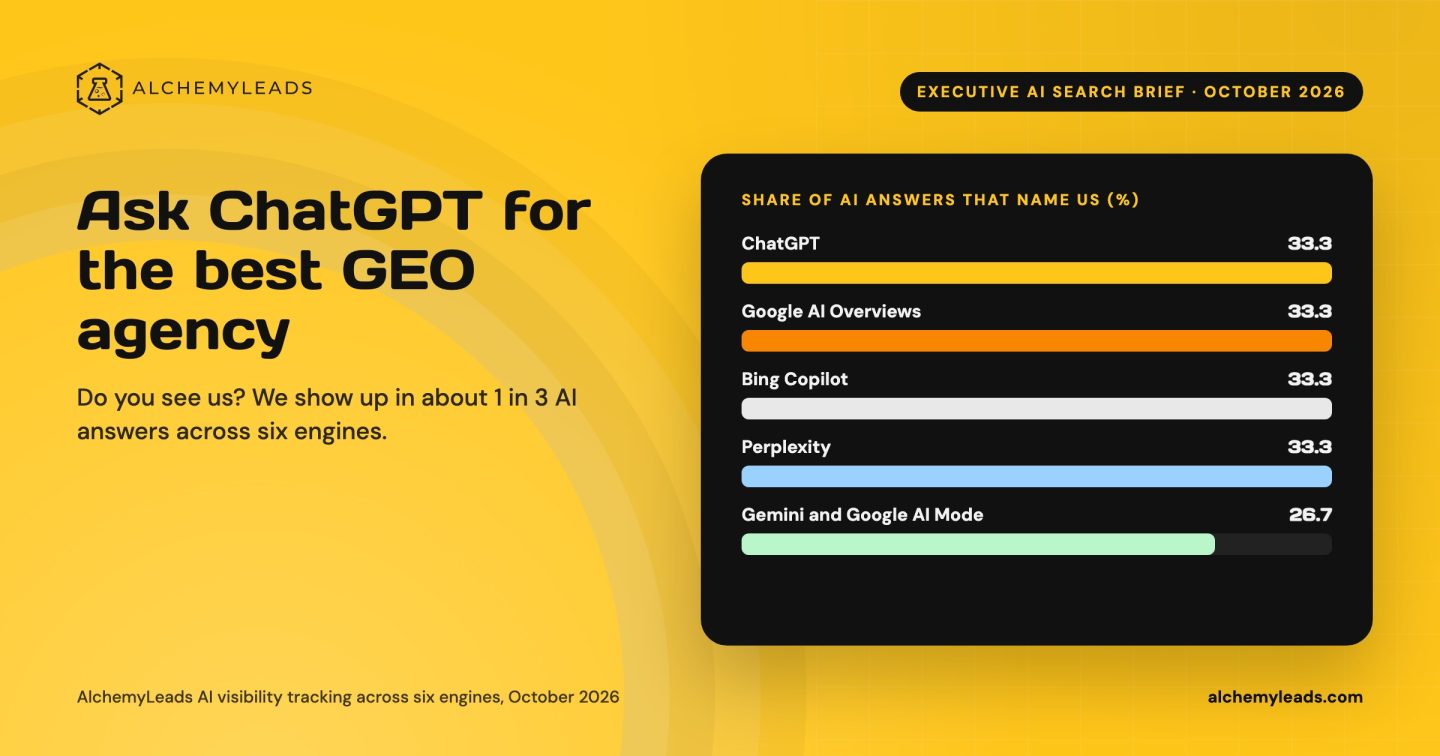
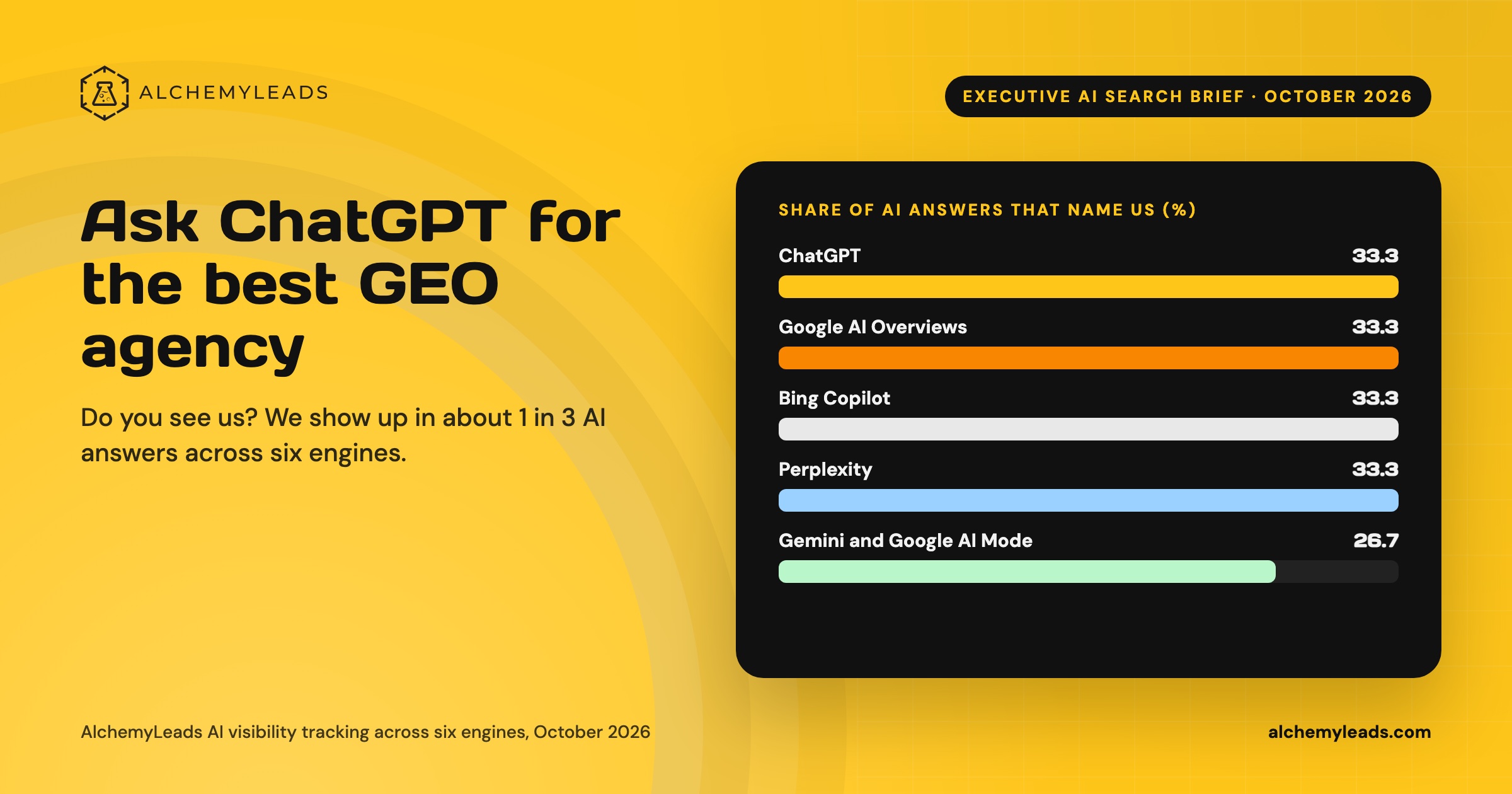
Try it yourself. Open ChatGPT, Bing Copilot or Perplexity and ask for “the best AI search or GEO agency for a B2B or industrial company”. Our tracking across six engines has us showing up in 27% to 33% of answers: ChatGPT, Google AI Overviews, Bing Copilot and Perplexity at 33.3%, Gemini and Google AI Mode at 26.7%. So roughly one in three, and these answers change all the time, by engine, by day and by how you phrase it. I just ran it in Google AI Mode and we weren’t there. If you do it and see us, tell me which engine. I’m collecting screenshots.
Showing up next to much bigger agencies. AI answers often place us alongside well-known names in search, including Omniscient Digital, Siege Media, WebFX, First Page Sage, iPullRank and Directive. Many of them are much larger teams than ours, and they’ve earned their spots. We’re a senior boutique team, and it’s good company to be in. Across the 1,227 brands that showed up in the answers we track over the last 30 days, AlchemyLeads ranks seventh-ish for visibility (it moves with every prompt), and when we’re mentioned we’re usually mentioned first. Bigger agencies still win more of the generic “best agency” prompts, and that’s where our AI SEO work will be focused over the next few years. More in AI Reputation Management.
Do you have alerts when your content is cited across the web? AlchemyAgent can send you those today, every morning.
Our server logs. Our host counted 38,148 “visits” in three weeks. GA4 counted 1,375 sessions in four. So which one’s lying? Neither, really. We dug into the logs: most of those “visits” are bots, and the real human number is closer to 4,000 a month. But here’s the thing. The logs are the only place AI crawlers show up at all, and in the last 30 days verified AI crawlers, AI search bots and AI assistants hit our site about 32,800 times. ChatGPT and Claude fetching pages live for a real person asking a question? That’s in there too. GA4 sees none of it. Same story with people: when AI sends a buyer your way, they usually land as “direct” traffic, which is why direct jumps as AI visibility grows. We call that the dark funnel. Full breakdown: Log File Analysis for AI Search.
05 / WHAT WE SHIPPED
A lot. We’ve done so much since June that I had to split it up. Boom, boom, boom.
On the website, for you to use and learn from:
- The Human / AI agent switch. Every page on our site has a toggle on desktop. Flip it to “AI agent” and the page turns into what an AI crawler actually reads: plain text, headings and structure, no design. It’s mostly a teaching tool. When a client asks “what does ChatGPT see on my site?”, we show them.
- How AI Search Works. Our educational hub on how ChatGPT, Google AI, Perplexity and the rest pick what to cite, with a guide for each AI search platform.
- The AlchemyLeads Glossary. 325 AI search, SEO, paid media and analytics terms, plus 20 in-depth “What is” explainer pages. They’re the marketing terms we use across our own site, so we define each one in plain English for buyers and the AI engines reading along.
- AI SEO Tools. The stack we use, what it costs, and the public tools we built, including the AI Query Classifier and the AI Visibility Checker, which checks your brand across six AI engines (ChatGPT, Google AI Overviews, Google AI Mode, Gemini, Perplexity and Bing Copilot) and gives you a score out of 100.
- Guides to measuring AI traffic. How to find AI conversations in Search Console, how to track AI traffic with PostHog, and now log file analysis for AI search.
- Files built for AI agents. Our EntityMap, llms.txt, agent discovery files and Content Signals in our robots.txt telling AI engines they’re welcome to search, quote and learn from us. Most of it runs at the edge on Cloudflare, and we wrote up how we use Cloudflare for AI search.
- New case studies. Our site speed case study (14 MB to 1.6 MB in a day) and a page quality case study where the agent rated every page on a manufacturer’s site and we fixed the worst ones in an afternoon.
The agent stuff:
- The AI SEO agent is running in beta. It reads Search Console and analytics, finds something to fix every day, and drafts the fix. Every content change still gets human approval, and safe technical fixes can be undone. It now rates every page on a site against a Quality Rater Guidelines-style rubric, every quarter.
-
AlchemyAgent, in Claude, ChatGPT and Grok. 40 read-only tools, 11 one-click workflows and 3 skills you run by just asking: can AI crawlers reach your site, what AI actually sees on your pages, llms.txt, how your brand shows up in Wikidata, Wikipedia, the news and research papers, plus your own Search Console, GA4, Bing, Brave and Cloudflare log data.
Add it in about a minute with one URL,
https://alchemyagent.ai/mcp:- Claude: Settings → Connectors → Add custom connector. Name it AlchemyAgent and paste the URL.
- ChatGPT: Settings → Apps & Connectors → Advanced settings → turn on Developer mode. Create a connector named AlchemyAgent with the same URL and no authentication.
- Then ask: “Use AlchemyAgent to check whether AI crawlers can reach my site.”
- Want the full version with your own Search Console and analytics data? Download it for Claude Desktop at alchemyagent.ai/download.
- AlchemyAgent for WordPress. Our WordPress plugin is in review on WordPress.org. It gives the agent a safe, logged and undoable way to update SEO titles, schema and caching, plus IndexNow so Bing hears about new and updated pages right away. And there’s a kill switch.
- AlchemyAgent in Slack. Add it to your workspace and run site checks right in a channel. Pro adds weekly AI visibility and rankings tracking.

-
Our HubSpot app. The Tripleseat integration for HubSpot, by AlchemyLeads, is in early access. We’ve shipped 9 HubSpot to Tripleseat integrations for clubs, venues and event companies. Book a call if you want it installed.
06 / WORTH YOUR TIME THIS MONTH
The best things I read, and how they line up with what we’re doing:
- Internal links beat new content on mature sites. One practitioner grew organic clicks 30% year over year in about 11 hours of internal-link work, with no new content. The trick: point links at pages sitting in positions 8 to 15, using impressions data. That’s section 01, step 4. Our take: Internal Linking for SEO and Topical Authority. (post)
- Split pages that try to serve two intents. Same author: splitting mixed-intent pages lifted clicks 23% on ecommerce categories and 73% on SaaS solution pages. Focused pages win. (post)
- Branded search isn’t safe anymore. AI Overviews now show above many brands’ own homepages. Check whether position drops on your brand terms come with flat clicks, and fix outdated facts AI repeats about you. (post)
- ChatGPT is linking out a lot more, and most of those links go to homepages and show up as “direct” traffic in analytics. If your direct traffic jumped, that’s probably AI. Here’s what counts as real direct traffic in Google Analytics. Fun fact: Bing Copilot has cited that page 9 times in the last 3 months. (post)
- Gated content is invisible to AI. If your best thinking is behind a form, AI can’t read it, cite it, or recommend you for it. Same point as section 02: put it on a web page. (post)
- Why IBM’s content wins: it’s written by the engineers and product experts who do the work, with diagrams and real examples. That’s what wins. (post)
- B2B SEO is going mostly branded. Most B2B conversions happen on homepage and pricing searches. Win the shortlist in AI answers, then win the branded click. (post)
- Measure AI visibility the same way every time. Changing prompts mid-stream poisons the trend. (post) And single-prompt tracking misses how real conversations unfold; model full customer journeys instead. (QueryBurst)
THE TAKEAWAY
We didn’t get named in USA Today, Wikipedia and “top agency” lists by chasing them. We got there by fixing the foundation, cutting the filler, writing down what only we know, and wiring it together so machines understand it. We’re still doing all four, and the citations keep following.
That’s the playbook. We run it on ourselves first. If you want us to run it on your site, book a call.
Let me know your thoughts. And seriously, go search for us and tell me if you see us.
Talk soon,
Sean
