
Building personas for AI search is now a requirement for brands that want to stay visible. AI-powered search engines like Google’s AI Overviews and ChatGPT don’t just match keywords to pages. They interpret who is asking the question. They analyze context, constraints, and what proof the searcher needs before taking action. If your content doesn’t match the person behind the query, it won’t get surfaced.
This guide shows you how to build data-driven personas that help your content appear when it matters most. You’ll learn a practical four-step process using data you already have.
How AI Search Changed the Game
AI search works differently than traditional SEO. The old model was simple. Queries signaled intent. You matched a keyword to a page. Rankings followed. Personas were nice to have, but they weren’t critical for organic visibility.
That approach no longer works.
Today’s AI systems analyze long prompts that reveal much more than search intent. They expose who is asking and what constraints that person brings to the conversation.
Consider this example. A user prompts ChatGPT: “I’m a healthcare compliance officer at a mid-sized hospital. Can you draft a checklist for evaluating new SaaS vendors, making sure it covers HIPAA regulations and costs under $50K a year.”
That single prompt contains role information, budget limits, risk tolerance, and format preferences. AI systems like Google’s AI Overviews personalize their responses around this context. If your content doesn’t meet those requirements, it gets passed over.
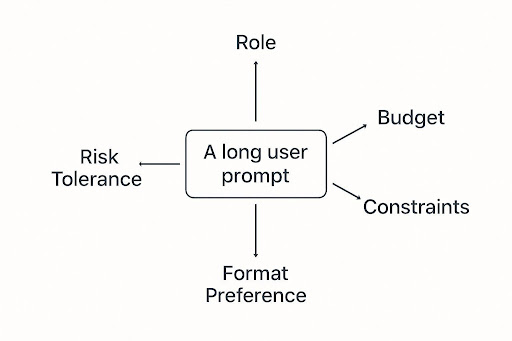
Three things matter in this new landscape:
- Prompts reveal identity. Phrases like “as a solo marketer on a $2k budget” or “for EU users under GDPR” expose role, constraints, and risk tolerance.
- Trust beats length. Search results get clicked when pages show the trust signals a specific persona needs for their query.
- Format matters by persona. Some users want quick summaries and comparison tables. Others need video demos, community validation, or primary source citations.
The bottom line is clear. You’re now optimizing for behavior patterns that AI systems can detect and match. Understanding your personas makes this possible.
Why Most Personas Fail (And What to Do Instead)
Most persona documents were built for branding teams. They don’t tell writers, SEOs, or content managers what to do next. So they get ignored after creation.
Three mistakes cause this problem:
- Demographics don’t equal decisions. Classic personas focus too much on age, job title, and location. These details don’t help your brand stand out from competitors. They also don’t reveal what drives buying decisions.
- Static documents age fast. If personas were created once and never updated, they probably got lost in your file storage. Without someone owning implementation, there’s no feedback loop.
- Pretty decks don’t drive action. Well-designed persona slides look great. But when they aren’t connected to content briefs or content journey mapping, they stay siloed from production.
The fix is straightforward. Personas must shape pages and prompts directly. If a persona can’t inform a content brief or an LLM prompt, it won’t shape your outcomes.
Step 1: Mine Your Existing Data
You don’t need an expensive research study. You need to collect and organize data you already have. Being thorough during this step matters. Sloppy data collection means weak personas.
Attributes to Capture
Build each persona around these core elements:
- Jobs-to-be-done (top 3 tasks they’re trying to complete)
- Role and seniority level
- Buying triggers and blockers (budget, legal constraints, risk tolerance)
- 10-20 example questions at top, middle, and bottom of funnel stages
- Trust cues (which creators, domains, and formats do they prefer?)
- Output preferences (depth, format, tone)
Four AIO Validation Patterns
Research shows that users interact with AI Overviews in four distinct ways. Knowing which pattern your persona follows helps you structure content correctly.
- Efficiency-first: Short dwell time, minimal scrolling, no query refinements. These users want quick answers and will leave if they don’t find them fast.
- Trust-driven: Longer dwell time, multiple scrolls, hesitation before clicking. These users validate claims with authority sources before acting.
- Comparative: Multiple scrolls, several tabs open (YouTube, Reddit, vendor sites). These users are actively evaluating options.
- Skeptical rejection: Minimal AI Overview engagement, direct clicks to government or medical authority sites. These users don’t trust AI summaries for high-stakes decisions.
Where to Find Quantitative Data
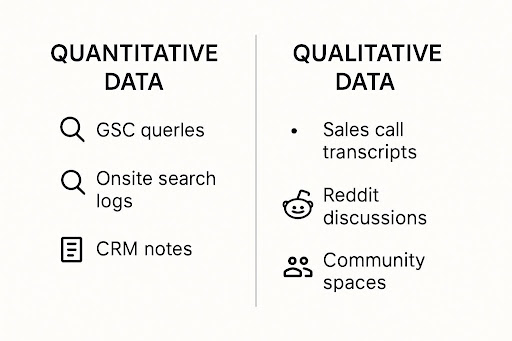
- Google Search Console queries. Split your queries by funnel stage (awareness, consideration, decision), branded versus non-branded, and country. Use regex patterns to identify question-style queries. This shows who’s really searching at each stage. Learn more about using Google Analytics and Search Console for this type of analysis.
- On-site search logs. These records show what visitors type into your website’s search bar. Extract the exact phrasing of problems. Look for zero-result searches and refined searches. The wording visitors use reveals jobs-to-be-done and vocabulary you should mirror.
- Support tickets and CRM notes. Convert objections, blockers, and “how do I” threads into searchable themes. Mine ticket titles, first messages, resolution summaries, and lost-deal reasons.
Where to Find Qualitative Data
- Sales calls and customer success notes. Use AI tools to analyze transcripts. Look for jobs-to-be-done, triggers, blockers, and decision criteria in your customer’s own words.
- Reddit and social discussions. This is where buyers compare options and validate claims. Capture the authority sources (brands and domains) they reference.
- Community spaces and email replies. Mine recurring stuck points and vocabulary. Group recurring themes and look for patterns across data sources.
Step 2: Build Your Persona Prompt Card
A persona prompt card is a one-page document designed for action. Unlike demographic-heavy personas, a prompt card connects jobs-to-be-done, constraints, questions, and trust cues directly to content briefs and LLM prompts.
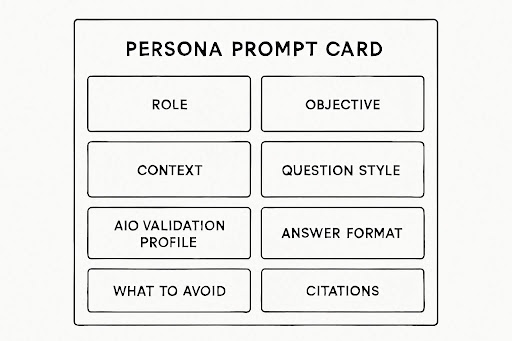
Convert each data cluster into a prompt card that can be embedded into ChatGPT or other AI tools. Include the input patterns you expect from that persona and the output format they’d likely want.
Persona Prompt Card Template
Use this structure as your foundation. Customize it based on your specific personas and industry. Consider using a content mapping template to organize your prompt cards alongside your content strategy.
PERSONA PROMPT CARD
Role: [ROLE, SENIORITY] at a [COMPANY TYPE, SIZE, LOCATION]
Objective: [Top 1-2 goals tied to KPIs and timeline]
Context: [Market, constraints, budget limits, compliance notes]
Question style: [Example inputs they’d type; tone and jargon tolerance]
AIO Validation Profile:
– Dominant pattern: [Efficiency-first / Trust-driven / Comparative / Skeptical]
– Hesitation triggers: [What makes them pause]
– Click-out anchors: [Authority sites they trust]
– Evidence threshold: [What proof ends hesitation]
Answer format:
– Start with a 3-bullet summary
– Provide a numbered playbook with 5-7 steps
– Include 2 proof points and 1 template or calculator
– Flag risks and trade-offs clearly
What to avoid: [Banned claims, fluff, vendor speak]
Citations: [Preferred domains, creators, and original research]
Example: B2B Industrial Buyer Persona
Here’s what a completed prompt card might look like for a B2B buyer:
Role: Operations Director at a mid-sized manufacturing company (US)
Objective: Reduce supply chain costs by 15% in Q2; find vendors who can scale
Context: Tight margins; needs board approval for purchases over $25K;
previous vendor failures created internal skepticism
Question style: “What’s the ROI timeline?”, “Who else in my industry uses this?”,
“What happens if it doesn’t work?” Prefers direct, no-jargon responses.
AIO Validation Profile:
– Dominant pattern: Trust-driven with Comparative secondary
– Hesitation triggers: Vague ROI claims; missing case studies; no industry references
– Click-out anchors: Industry publications, LinkedIn posts from peers, vendor reviews
– Evidence threshold: Specific metrics, named clients, implementation timelines
Answer format:
– Lead with bottom-line impact
– Include comparison table with alternatives
– Show 2 case studies with metrics
– Address common objections directly
What to avoid: Marketing buzzwords; unverified statistics; generic benefits
Citations: Industry reports, client testimonials with names, third-party reviews
Step 3: Calibrate and Validate
The goal here is to prove your persona prompt cards produce useful outputs. You also want to learn what evidence each persona needs to take action.
How to Run the Calibration
- Set up your cards. Save one prompt card per persona as a custom instruction profile or prompt snippet in ChatGPT.
- Build an evaluation set. Create 10-15 real queries per persona. Include queries from all funnel stages. Add 2-3 compliance or high-stakes queries, 3-4 comparison queries, and 3-4 quick how-to questions.
- Require structured output. Ask for a summary first, then numbered steps, then a table, then risks, then citations.
- Test variations. Add constraints and location differences. Ask the same query two different ways to test consistency.
- Score and improve. Rate outputs on clarity, scannability, and credibility. Add missing trust anchors or evidence types to your prompt card.
Test Across Multiple Platforms
Your audience may use different AI tools. If they prefer Perplexity, calibrate there too. Run your prompt cards through Google’s AI Mode as well.
Validate with Real Performance Data
Track these SEO KPIs after publishing persona-tuned content:
- Branded search trends
- Assisted conversions by topic cluster
- Non-Google referral traffic
- Topic-level performance (not just page-level)
Review results at 30, 60, and 90 days. Most importantly, refresh your personas every 60-90 days. Compare new versions against old ones to keep improving.
Validation Guidelines by Pattern
- Trust-driven pages with high scroll but low conversions: Add or upgrade citations and expert reviews.
- Comparative pages with good click-through but low demo signups: Add a short demo video, “best for” sections, and clearer calls to action.
- Efficiency-first pages missing AI Overview presence: Tighten summaries, simplify tables, add schema markup.
- Skeptical-rejection pages with authority traffic but no lift: Consider pursuing partnerships with authority sources.
Putting Personas Into Production
Creating personas is only valuable if they shape actual content. Here’s how to translate persona insights into production outputs.
Content Brief Integration
Your content marketing briefs should include persona-specific requirements:
- “Resolve hesitation X with Y evidence above the fold”
- Include “best for” and “not for” sections matching persona constraints
- Build comparison tables formatted for how this persona evaluates options
- Use terminology and citations from sources the persona trusts
- Create snippetable summary blocks for AI Overview citation
Page Structure by Persona Type
Structure pages to match how each persona validates information:
- For efficiency-first personas: Lead with the answer. Put the conclusion first. Use clear headings, short paragraphs, and bulleted lists.
- For trust-driven personas: Front-load credentials and authority signals. Include expert quotes, case studies, methodology notes, and citations to primary sources.
- For comparative personas: Build decision frameworks. Include comparison tables, pros and cons breakdowns, “best for” scenarios, and clear differentiators.
- For skeptical personas: Provide primary source links prominently. Reference official documentation, regulatory guidelines, and authoritative third-party validation.
Building topical authority reinforces all of these approaches. When your brand becomes a recognized source on a topic, AI systems are more likely to cite your content regardless of customer persona type.
Common Pitfalls to Avoid
Watch out for these mistakes as you implement buyer persona-driven optimization:
- Creating documents that never connect to production. Personas that don’t specify search intents, pain points, and AIO patterns won’t change behavior.
- Trying to win every SERP feature. This wastes resources. Optimize for the right features based on your target persona’s behavior patterns.
- Ignoring hesitation signals. Hesitation is your biggest indicator of what needs to change. If you don’t resolve it on-page, the visitor leaves.
- Focusing on demographics over jobs-to-be-done. Identity characteristics without behavioral patterns is the old approach. What people need to accomplish matters more than who they are.
Start Building Your First Buyer Persona This Week
The shift toward persona-driven AI optimization isn’t temporary. It’s the new foundation of SEO. Brands that invest in understanding their audiences will outperform those that treat personas as optional.
Start with one persona using the process outlined here. Mine your existing data. Build a prompt card. Calibrate it in ChatGPT. Validate with real performance metrics. Then expand from there.
The brands that understand who their customers are and what pain points they have will be the brands that AI systems consistently surface when it matters most.
Related guide: how AI search retrieves, grounds and cites sources.
Suggested

AI Reputation Management: What LLMs Say About Our Brand, and What We Do About It
Our real AI sentiment data: what ChatGPT, Perplexity and Google AI Overviews get right and wrong about AlchemyLeads, and how we manage LLM reputation.
October 13, 2026

The Dark Funnel: Why Direct Traffic Spikes When AI Search Visibility Grows
Direct traffic doubled and nobody can explain it? That is the dark funnel. Why AI search hides attribution, how to rule out other causes, and the client data that shows what it is worth.
October 13, 2026

Industrial Marketing for the Builders: Why We Bet on Hard Tech
Why AlchemyLeads put industrial and hard tech companies at the center of its work in 2023, what reindustrialization changes, and who we’re built for now.
October 12, 2026

Our Ahrefs Health Score Went From 74 to 96. Here’s What Our AI SEO Agent Found.
Seven problems our AI SEO agent found on our own site, from leads GA4 never recorded to 195 pages linking through redirects, and how we fixed them.
October 8, 2026

How Our AI SEO Agent Cleared 1,186 Schema Errors in One Day
How our AI SEO agent and team took a Shopify store from 1,186 structured data errors, 12 404s and 155 broken links to zero in one day.
October 8, 2026
Contact us
We value your privacy and won't share your email with others.
We'll only contact you with curated content.
